HAL Kiran Jet Trainer: Specs, Surya Kiran History, IAF Role
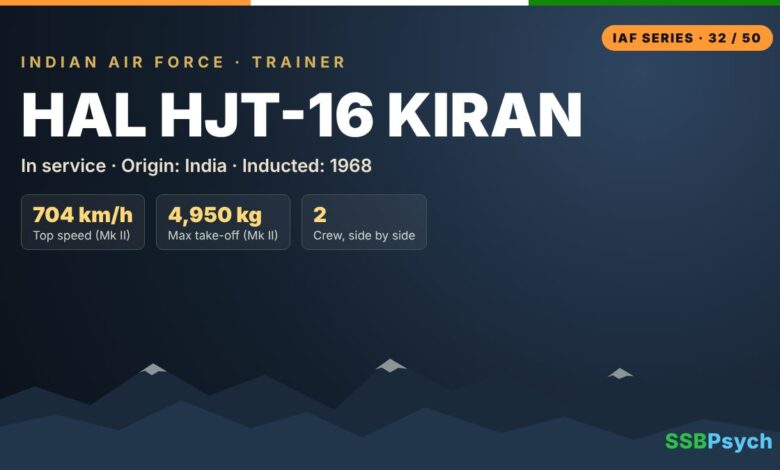
Ask almost any Indian Air Force fighter pilot from the last fifty years about their first jet, and the answer is likely to be the HAL Kiran. This small, friendly-looking trainer, whose name means ‘ray of light’, has carried thousands of young cadets from propeller planes into the fast, noisy world of jets. It also gave India one of its most loved air display teams, the Surya Kiran.
In this article you will discover why India built its own jet trainer, how the Kiran Mk I and Mk II differ, its specifications explained in plain words, how it trains pilots to use guns and rockets, its Surya Kiran years, its future, and why it is an important topic for NDA, CDS, AFCAT and SSB candidates. A 10-question quiz and quick FAQs are waiting at the end.

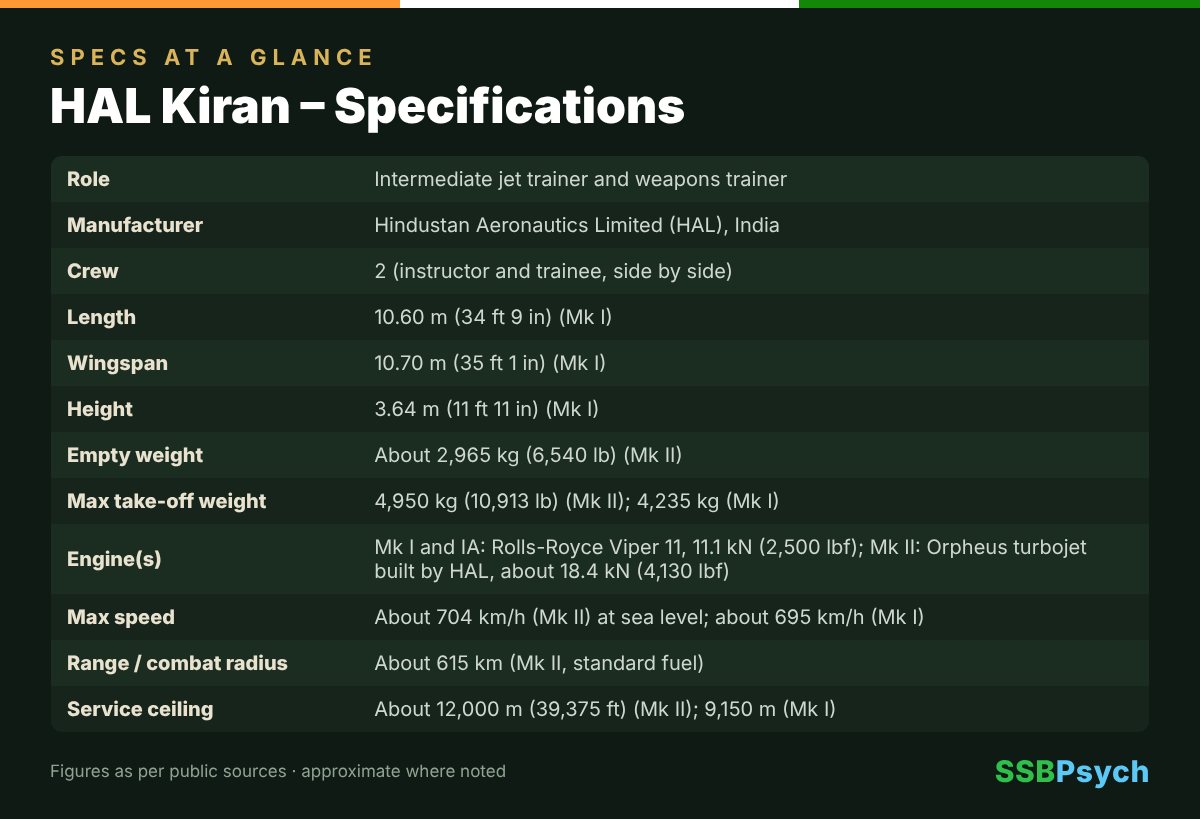
HAL Kiran Specifications
| Role | Intermediate jet trainer and weapons trainer |
| Manufacturer | Hindustan Aeronautics Limited (HAL), India |
| Crew | 2 (instructor and trainee, side by side) |
| Length | 10.60 m (34 ft 9 in) (Mk I) |
| Wingspan | 10.70 m (35 ft 1 in) (Mk I) |
| Height | 3.64 m (11 ft 11 in) (Mk I) |
| Empty weight | About 2,965 kg (6,540 lb) (Mk II) |
| Max take-off weight | 4,950 kg (10,913 lb) (Mk II); 4,235 kg (Mk I) |
| Engine(s) | Mk I and IA: Rolls-Royce Viper 11, 11.1 kN (2,500 lbf); Mk II: Orpheus turbojet built by HAL, about 18.4 kN (4,130 lbf) |
| Max speed | About 704 km/h (Mk II) at sea level; about 695 km/h (Mk I) |
| Range / combat radius | About 615 km (Mk II, standard fuel) |
| Service ceiling | About 12,000 m (39,375 ft) (Mk II); 9,150 m (Mk I) |
| Endurance | About 1 hour 45 minutes (Mk I) |
| First flight | 4 September 1964 (Mk II: 30 July 1976) |
| Inducted in IAF | 1968 (Mk II deliveries from 1985) |
| Number built | 190 Mk I and IA, plus Mk IIs; production ended in 1989 |
Why India Needed the HAL Kiran
In the late 1950s the IAF was flying more and more jets, but pilots were still jumping almost straight from slow propeller trainers into combat jets. That is like learning to drive on a scooter and then being handed the keys of a racing car. India needed an in-between step: an intermediate jet trainer that was easy to fly but still taught pilots how jets behave.
Hindustan Aeronautics Limited (HAL) took up the challenge and designed the HJT-16, short for Hindustan Jet Trainer 16. It used a dependable Rolls-Royce Viper engine and seated the instructor and student side by side, so the instructor could watch every move the trainee made. The aircraft first flew on 4 September 1964, and the team that built it went on to work on India’s HF-24 Marut fighter.
History of the HAL Kiran in the IAF
The first pre-production Kirans were delivered to the IAF in March 1968. The basic Kiran Mk I was soon joined by the Mk IA, which added two under-wing hardpoints so trainees could practise firing weapons. HAL built 190 Mk I and Mk IA aircraft in total.
Pilots and instructors wanted more power and more weapons training, so HAL developed the Kiran Mk II. It swapped the Viper for a stronger Orpheus turbojet, added two machine guns in the nose and four under-wing pylons. The Mk II first flew on 30 July 1976 and deliveries began in 1985. Production of all Kirans ended in 1989.
For decades the Kiran was the workhorse of the IAF’s intermediate flying training. Trainee pilots who were picked for the fighter stream flew it after their basic training, learning jet handling, formation flying, aerobatics, navigation and night flying before moving on to advanced jet trainers. The Indian Navy also flew Kirans for training at its air station in Goa, and its small Sagar Pawan aerobatic team used them too.
HAL Kiran Mk I vs Mk II: What Changed
From the outside, the Mk I and Mk II look like close cousins, with the same chubby nose, straight wings and side-by-side cockpit. The big changes are inside. The Mk II’s Orpheus engine gives roughly two thirds more thrust than the Viper of the Mk I. That extra push lets it carry more weight, climb faster and reach a much higher ceiling of about 12,000 m, compared with about 9,150 m for the Mk I.
The Mk II also turned the Kiran into a proper weapons trainer. The Mk IA had already added two under-wing hardpoints, but the Mk II brought four pylons plus two machine guns in the nose. Its maximum take-off weight rose to about 4,950 kg from about 4,235 kg on the Mk I. In simple terms, the Mk I taught pilots how to fly a jet, while the Mk II also taught them how to fight with one.
What a Training Sortie Looks Like
A typical training flight begins long before take-off with a detailed briefing, where the instructor explains the exercise, the weather and the safety rules. In the air, the trainee might practise steep turns, stalls, loops and rolls, then formation flying with another Kiran or a low-level navigation route. Back on the ground, a debrief goes through every mistake and every good decision. This cycle, repeated hundreds of times, slowly turns a nervous cadet into a confident jet pilot.
Because the instructor sits right beside the trainee, he or she can see the trainee’s hands, eyes and instruments at a glance and take control in an instant if something goes wrong. This close, shoulder-to-shoulder style of teaching is one of the biggest reasons side-by-side trainers like the Kiran are so valued by flying instructors around the world.
HAL Kiran and the Surya Kiran Aerobatic Team
In 1996 the IAF formed the Surya Kiran aerobatic team at Bidar in Karnataka, flying Kiran Mk II aircraft painted in eye-catching colours. The team started with four aircraft, moved to six within months and, in 1998, grew to nine. Its nine-aircraft formation was first shown at the Independence Day celebrations in August 1998, and soon crowds across India and abroad were cheering its loops, rolls and smoke trails.
Display flying is risky, and the team lost brave pilots in practice accidents in 2006 and 2009. In 2011 the IAF faced a shortage of trainer aircraft, so Surya Kiran was suspended and its Kirans went back to training new pilots. The team returned in 2015 flying the BAE Hawk Mk 132, but its name still carries the memory of the Kiran.
Engine and Performance Explained Simply
The Kiran Mk II uses an Orpheus turbojet built under licence in India, giving about 18.4 kN of thrust. A turbojet works like a powerful hair dryer combined with a fire: it sucks air in, compresses it, burns fuel in it and shoots the hot gas out of the back, pushing the aircraft forward.
Its top speed is about 704 km/h at sea level. That is more than twice as fast as India’s quickest trains and roughly the speed of a big passenger airliner at cruising height. The Mk II can climb to a service ceiling of about 12,000 m, the highest level where it can still climb usefully. That is well above the height of Mount Everest and higher than most airliners fly.
On standard fuel it can fly about 615 km, roughly the road distance from Delhi to Lucknow. The older Mk I could stay airborne for about an hour and 45 minutes, plenty for a full training lesson. The Kiran is only about 10.6 m long, roughly the length of two and a half cars, and its maximum take-off weight of about five tonnes is less than that of many trucks.
What It Carries
- Two 7.62 mm machine guns in the nose (Mk II)
- Four under-wing pylons on the Mk II (two on the Mk IA)
- Unguided rocket pods for weapons training
- Practice bombs on under-wing pylons
- Under-wing drop tanks for extra range
The Kiran is not a combat aircraft, but the Mk II’s guns, rockets and practice bombs let trainees learn how to aim and fire before they ever sit in a fighter. Learning these skills in a cheap, forgiving trainer saves money and lives.
HAL Kiran Missions and Operations
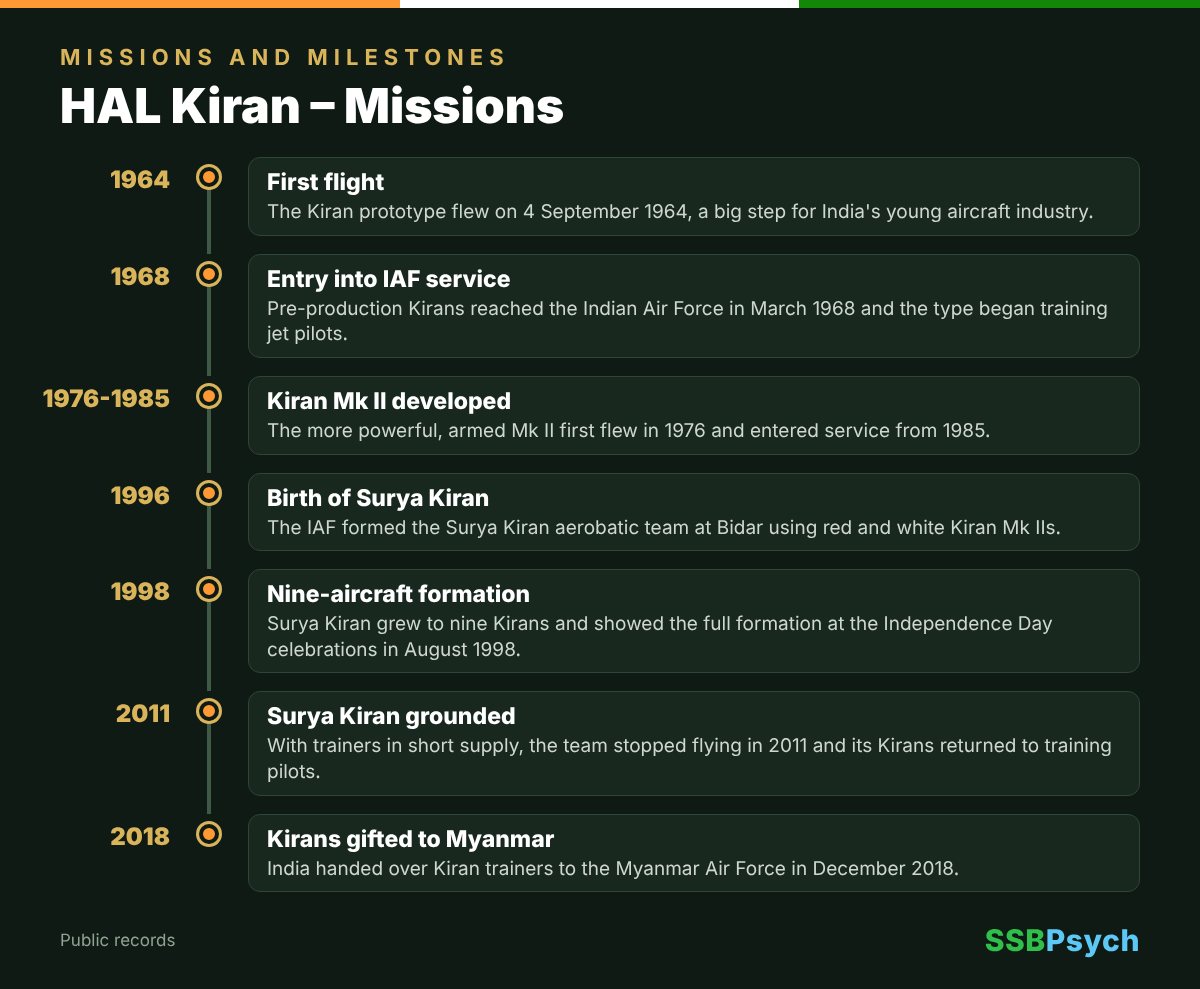
- 1964 – First flight: The Kiran prototype flew on 4 September 1964, a big step for India’s young aircraft industry.
- 1968 – Entry into IAF service: Pre-production Kirans reached the Indian Air Force in March 1968 and the type began training jet pilots.
- 1976-1985 – Kiran Mk II developed: The more powerful, armed Mk II first flew in 1976 and entered service from 1985.
- 1996 – Birth of Surya Kiran: The IAF formed the Surya Kiran aerobatic team at Bidar using red and white Kiran Mk IIs.
- 1998 – Nine-aircraft formation: Surya Kiran grew to nine Kirans and showed the full formation at the Independence Day celebrations in August 1998.
- 2011 – Surya Kiran grounded: With trainers in short supply, the team stopped flying in 2011 and its Kirans returned to training pilots.
- 2018 – Kirans gifted to Myanmar: India handed over Kiran trainers to the Myanmar Air Force in December 2018.

Where It Is Based and Who Flies It
The Kiran has served mainly at IAF flying training establishments in southern India, with the Air Force Academy at Dundigal near Hyderabad being the best known. Bidar was home to Surya Kiran in its Kiran days. Testing units such as the Aircraft and Systems Testing Establishment in Bengaluru have also used the type, and the Indian Navy flew Kirans with its squadron INAS 551 in Goa.
Training units are led much like squadrons. A flying unit is usually commanded by a Wing Commander, with Squadron Leaders as flight commanders, while experienced Qualified Flying Instructors teach the trainees, who are Flight Cadets or young officers. Behind them stand engineers, technicians and airmen who prepare the jets for many sorties a day.
A typical fighter-stream pilot today joins through NDA, CDS or AFCAT, learns basic flying on a propeller trainer, then moves to an intermediate jet such as the Kiran and finally to advanced jets like the Hawk before joining a fighter squadron. The whole journey usually takes around two years or more and a few hundred flying hours.
Strengths and Limitations
- Strength: side-by-side seating lets the instructor watch and guide the trainee closely.
- Strength: simple, sturdy and easy to maintain, ideal for many training sorties a day.
- Strength: the Mk II’s guns and pylons allow realistic weapons training.
- Strength: designed and built in India, a landmark for the country’s aircraft industry.
- Limitation: old analogue cockpit, very different from the glass cockpits of modern fighters.
- Limitation: the ageing fleet has become harder to keep flying as aircraft and engines grow older.
- Limitation: modest speed and climb compared with newer trainers.
Future of the HAL Kiran
The Kiran is now well over fifty years old as a design, and the IAF has said for some years that it wants to retire it. Its planned replacement is HAL’s HJT-36 intermediate jet trainer, first called Sitara and renamed Yashas when an upgraded version was shown at Aero India 2025. The project has faced long delays, so the Kiran has had to keep flying far longer than planned.
Interestingly, the Kiran may find a second life without a pilot. HAL has converted a Kiran Mk II into an optionally crewed test aircraft to support its CATS programme, which explores drones flying alongside manned fighters. In December 2018 India also gifted Kiran trainers to Myanmar, extending the aircraft’s story beyond India.
Why It Matters for SSB and AFCAT Aspirants
If you are aiming for the flying branch, the Kiran or its successor could be the first jet you fly, so knowing it shows genuine interest in your future job. The Kiran also tells the story of Indian self-reliance in defence, a frequent theme in group discussions, lecturettes and interviews. Linking it with Surya Kiran, the HJT-36 Yashas and the wider push for home-grown trainers can make your answers stand out.
Did You Know?
- HJT-16 stands for Hindustan Jet Trainer 16.
- The Kiran first flew on 4 September 1964.
- Its side-by-side seating is unusual for a jet trainer and makes teaching easier.
- Surya Kiran flew Kirans from 1996 until 2011 before switching to the Hawk.
- The Indian Navy’s Sagar Pawan aerobatic team also flew the Kiran.
- Kiran production ended in 1989, yet the type kept flying for decades after.
- A Kiran Mk II has been turned into an optionally crewed aircraft for drone research.
Quiz: Test Your Knowledge of HAL Kiran
Click an option to see if you are right. Your score updates live.
HAL Kiran: Frequently Asked Questions
The Kiran Mk II can reach about 704 km/h at sea level, while the older Mk I could reach about 695 km/h.
Yes, the Kiran has continued in IAF training service, but the ageing fleet is due to be retired once a replacement such as the HJT-36 Yashas is ready.
Yes. From 1996 to 2011 the Surya Kiran aerobatic team flew Kiran Mk II jets from Bidar. Since 2015 it has flown the Hawk Mk 132.
The Mk I and Mk IA use a Viper engine, while the Mk II has a stronger Orpheus engine, two nose guns and four under-wing pylons for weapons training.
The Surya Kiran team was based at Air Force Station Bidar in Karnataka when it flew Kiran Mk II jets between 1996 and 2011.
This is part 32 of 50 in SSBPsych’s Indian Air Force aircraft series – a new aircraft every evening at 6 PM.
Sources: en.wikipedia.org, bharat-rakshak.com, en.wikipedia.org, pressreader.com, tribuneindia.com.
Preparing for NDA, CDS, AFCAT or your SSB? Join SSBPsych’s online and offline batches – explore our courses or call +91 8076540582.