INS Vikrant 2022: India’s First Home-Built Aircraft Carrier
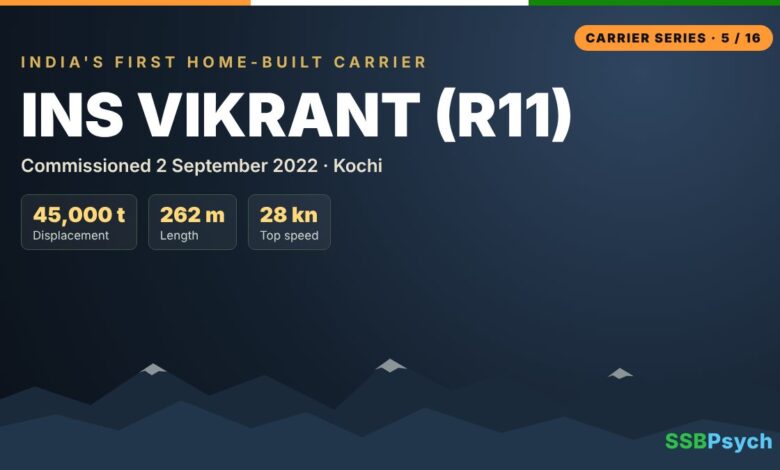
On 2 September 2022, as Prime Minister Narendra Modi stood on the deck at Kochi, India entered a very small club: nations that can design and build their own aircraft carrier. The ship was INS Vikrant 2022, also called IAC-1 (Indigenous Aircraft Carrier-1). At about 45,000 tonnes, it is the largest warship ever built in India, and it carries the name and pennant number of India’s first carrier from 1961.
In this article, you will find the full story: how the project started, why it took over two decades, where and when it was commissioned, its specifications, fuel and endurance, aircraft, crew, reported cost, missions and fun facts. Whether you are preparing for NDA, CDS, AFCAT or an SSB interview, this is one of the most important current affairs topics in defence.

Origin of INS Vikrant 2022: From Idea to Steel
In 1999, the Navy began designing a carrier it called the Air Defence Ship, a vessel to give the fleet its own fighter cover. In 2006 the project was renamed the Indigenous Aircraft Carrier. The design was prepared by the Navy’s own Warship Design Bureau, which had designed many destroyers and frigates but never a carrier. As the plan matured, the ship grew from a planned 37,500 tonnes to over 45,000 tonnes.
Construction was given to Cochin Shipyard Limited in Kochi, Kerala. The ship was built in blocks, like giant Lego pieces, and then joined together; reports mention 874 such blocks. The keel was laid on 28 February 2009, the hull first floated out of its dock on 29 December 2011, and the ship was formally launched on 12 August 2013.
Why did it take so long?
Building a carrier is one of the hardest jobs in shipbuilding. India had to develop special warship-grade steel at home, train workers to weld thick plates, lay enormous lengths of cable and fit complex systems for flying jets at sea. Some equipment, such as the aviation systems that had to work with Russian-origin MiG-29K jets, depended on foreign partners, and that also caused delays. Basin trials were completed in November 2020, sea trials began on 4 August 2021, and the ship was delivered to the Navy on 28 July 2022.
Commissioning and the New Naval Ensign
INS Vikrant was commissioned on 2 September 2022 at Cochin Shipyard by Prime Minister Narendra Modi. On the same day, the Prime Minister unveiled the Navy’s new ensign, the flag flown by warships. It dropped the old St George’s Cross, a reminder of the colonial past, and added a design inspired by the seal of Chhatrapati Shivaji Maharaj. So the day marked two symbols of self-reliance at once.
Why the Name Vikrant?
Vikrant means courageous or bold. The first INS Vikrant (1961 to 1997) was India’s first carrier and a hero of the 1971 war. Giving the same name and pennant number, R11, to the new ship honours that legacy. Many described it as the old Vikrant being reborn, this time made in India.
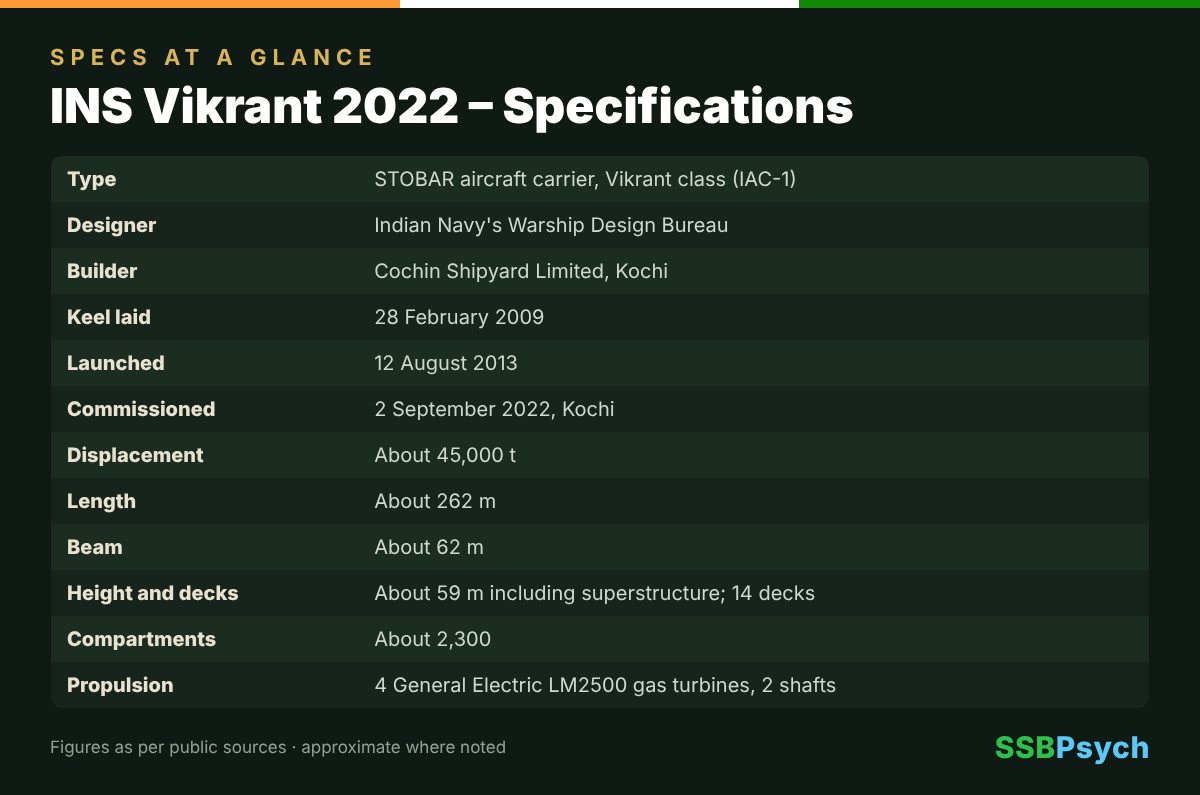
INS Vikrant 2022 Specifications
| Type | STOBAR aircraft carrier, Vikrant class (IAC-1) |
| Designer | Indian Navy’s Warship Design Bureau |
| Builder | Cochin Shipyard Limited, Kochi |
| Keel laid | 28 February 2009 |
| Launched | 12 August 2013 |
| Commissioned | 2 September 2022, Kochi |
| Displacement | About 45,000 t |
| Length | About 262 m |
| Beam | About 62 m |
| Height and decks | About 59 m including superstructure; 14 decks |
| Compartments | About 2,300 |
| Propulsion | 4 General Electric LM2500 gas turbines, 2 shafts |
| Speed | About 28 knots (52 km/h) |
| Range / endurance | About 7,500 nautical miles |
| Crew | About 1,600 to 1,700 including air wing |
| Aircraft | Air wing of about 30 aircraft; hangar for about 20 |
What do these numbers mean?
At about 262 metres long and 62 metres wide, the ship is longer than two and a half football fields. Its flight deck covers about 12,500 square metres, roughly the area of two football fields. From the keel to the top of the superstructure it stands about 59 metres tall, around the height of a 20-storey building. It weighs about 45,000 tonnes, close to the weight of 35,000 small cars. Inside are about 2,300 compartments spread over 14 decks.
INS Vikrant 2022 Timeline
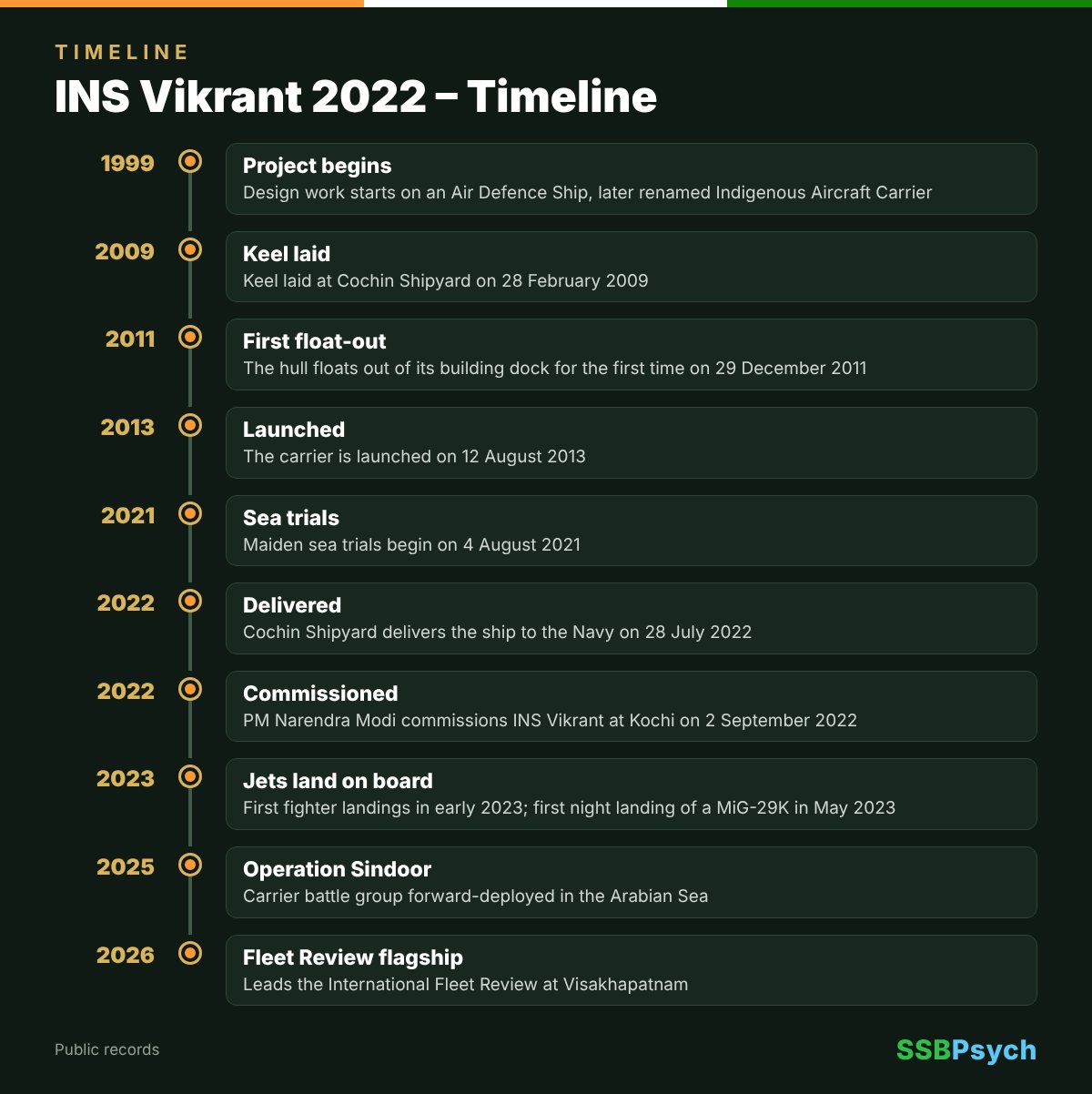
- 1999 – Project begins: Design work starts on an Air Defence Ship, later renamed Indigenous Aircraft Carrier
- 2009 – Keel laid: Keel laid at Cochin Shipyard on 28 February 2009
- 2011 – First float-out: The hull floats out of its building dock for the first time on 29 December 2011
- 2013 – Launched: The carrier is launched on 12 August 2013
- 2021 – Sea trials: Maiden sea trials begin on 4 August 2021
- 2022 – Delivered: Cochin Shipyard delivers the ship to the Navy on 28 July 2022
- 2022 – Commissioned: PM Narendra Modi commissions INS Vikrant at Kochi on 2 September 2022
- 2023 – Jets land on board: First fighter landings in early 2023; first night landing of a MiG-29K in May 2023
- 2025 – Operation Sindoor: Carrier battle group forward-deployed in the Arabian Sea
- 2026 – Fleet Review flagship: Leads the International Fleet Review at Visakhapatnam
How INS Vikrant 2022 Launches and Recovers Jets
Like INS Vikramaditya, the new Vikrant is a STOBAR carrier, short for Short Take-Off But Arrested Recovery. Fighters take off by racing up a ski-jump at the bow, which gives them an upward push. To land, a jet lowers a hook under its tail that catches one of several arrester wires on the deck, bringing it to a stop within seconds. Below the deck, a hangar can hold about 20 aircraft, and two large lifts move jets between the hangar and the flight deck.
Aircraft, Weapons and Sensors
- Mikoyan MiG-29K fighter jets
- Rafale M naval fighters (26 ordered in 2025, deliveries expected from 2030)
- Kamov Ka-31 airborne early-warning helicopters
- MH-60R multi-role anti-submarine helicopters
- HAL Dhruv helicopters
- Barak 8 surface-to-air missiles
- AK-630 close-in weapon systems
- Israeli-origin multi-function radar and Indian electronic-warfare suite
Why India Needed an Indigenous Carrier
India’s earlier carriers were all bought from abroad and arrived second-hand. That meant depending on foreign shipyards for repairs and spare parts and accepting old designs. A home-built carrier changes this. Indian yards can repair it, Indian industry supplies many of its parts, and the experience gained can be used for future ships. The ship was officially reported to have about 76 percent indigenous content, with many Indian companies and small businesses contributing equipment.
Strategically, a second modern carrier means India can keep at least one carrier ready while the other is in refit, and in a crisis it can deploy both, one on each seaboard or together for maximum strength.
Operations and Missions
- Feb 2023 – First fighter landings: LCA Navy and MiG-29K make their first landings on the new deck
- May 2023 – First night landing: A MiG-29K lands at night, a major step towards full operations
- Jun 2023 – Twin-carrier operations: Operates with INS Vikramaditya and about 35 aircraft
- Feb 2024 – Exercise Milan 2024: Takes part in the multinational exercise with INS Vikramaditya
- Jan 2025 – TROPEX 2025 and medical rescue: Joins the Navy’s major exercise and evacuates a sick sailor from a merchant ship
- 2025 – Operation Sindoor: Part of the carrier battle group forward-deployed in the Arabian Sea
- Nov 2025 – Operation Sagar Bandhu: Delivers relief material to Sri Lanka after Cyclone Ditwah
- Feb 2026 – International Fleet Review: Flagship at the International Fleet Review at Visakhapatnam

Crew, Fuel and Endurance
The ship is designed for about 1,600 to 1,700 people, including officers, sailors and the air wing. It has a full medical complex, large galleys and fresh-water plants. Like all Indian carriers, it is commanded by an officer of Captain rank.
Unlike older Indian carriers that used steam, Vikrant is powered by four General Electric LM2500 gas turbines, the same family of engines used on many modern warships. Think of them as giant jet engines that turn propeller shafts instead of pushing an aircraft. They can push the ship to about 28 knots, roughly 52 km per hour. The ship’s endurance is about 7,500 nautical miles, enough to sail from Kochi to the east coast of Africa and back. On long deployments, fleet tankers refuel it at sea.
Life on board
A carrier never sleeps. While one watch of sailors rests, another runs the engines, radars and communication rooms. Flight deck crews in coloured jerseys handle aircraft, fuel and weapons, each colour showing a different job so that everyone can be identified at a glance in the noise and wind. Galleys cook thousands of meals daily, and the ship’s hospital can handle emergencies far from land. New sailors are given time to learn the layout, because with 14 decks and thousands of compartments, getting lost is very easy.
Cost of INS Vikrant 2022
At commissioning, the cost of the project was officially reported as about Rs 20,000 crore, while some later reports place it closer to Rs 23,000 crore. This does not include the aircraft. Fighter jets are bought separately: for example, India signed a deal for 26 Rafale M naval fighters in April 2025, with deliveries expected from 2030. Running costs depend on fuel, spare parts, crew, aircraft maintenance and regular dry-dock refits, which is why navies plan carrier budgets over decades, not years.
Operations and Milestones
After commissioning, the ship spent months on flight trials. In early 2023, the naval Tejas and the MiG-29K made their first landings on its deck, and in May 2023 a MiG-29K landed at night, a tough skill for any carrier. In June 2023 it operated alongside INS Vikramaditya in a twin-carrier drill with about 35 aircraft. Reports in December 2024 said it had become fully operational.
In 2025, during the tension with Pakistan after the Pahalgam terror attack, Vikrant’s carrier battle group was forward-deployed in the Arabian Sea as part of Operation Sindoor. Later that year it carried relief supplies to Sri Lanka after Cyclone Ditwah, showing that a carrier is also useful in humanitarian missions. In February 2026 it served as the flagship at the International Fleet Review in Visakhapatnam.
INS Vikrant 2022 vs INS Vikramaditya
- Origin: Vikrant was designed and built in India; Vikramaditya is a rebuilt Soviet-era ship.
- Size: both displace around 45,000 tonnes, but Vikramaditya is longer at about 284 metres versus about 262 metres.
- Engines: Vikrant uses gas turbines; Vikramaditya uses steam boilers and turbines.
- Flying method: both are STOBAR carriers with a ski-jump and arrester wires.
- Commissioned: Vikramaditya in November 2013 in Russia; Vikrant in September 2022 in Kochi.
Because both ships use the same flying method and the same MiG-29K fighters, pilots and deck crews can move between them easily, and aircraft from one deck can land on the other during joint operations. This makes India’s two-carrier fleet more flexible than two completely different ships would be.
The industry behind the ship
Hundreds of Indian firms, large and small, supplied steel, pumps, valves, cables, furniture, kitchen equipment and electronic systems. The combat management system, which links the ship’s sensors and weapons, was developed with Tata Advanced Systems. Thousands of workers gained skills that will stay in the shipbuilding industry for decades, which is one of the biggest long-term benefits of building a carrier at home.
Analysis: What INS Vikrant Means for India
Vikrant is more than a ship. It shows that India’s design teams, steel makers, shipbuilders and hundreds of suppliers can deliver one of the most complex machines in the world. The lessons learned, from block construction to aviation trials, are expected to make the next carrier faster and cheaper to build. Its biggest remaining challenge is its air wing: the MiG-29K fleet is ageing, so the arrival of the Rafale M and, later, an Indian twin-engine deck-based fighter will decide how powerful the ship truly becomes.
For SSB aspirants, Vikrant is a perfect topic for a lecturette or group discussion on self-reliance in defence. You can talk about the long gestation period, the challenges of building complex systems at home, the benefits to Indian industry, and the importance of carriers in the Indian Ocean. A balanced answer will also mention the debate on cost versus value and the need for modern aircraft to make the ship truly effective.
Quick revision: INS Vikrant (R11), IAC-1, designed by the Warship Design Bureau, built by Cochin Shipyard, keel laid 2009, launched 2013, commissioned 2 September 2022 at Kochi, about 45,000 tonnes, about 262 metres long, gas turbine powered, top speed about 28 knots and an air wing of about 30 aircraft. Learn these and you have the core facts covered.
Did You Know?
- INS Vikrant is the largest warship ever built in India, at about 45,000 tonnes.
- It shares the name and pennant number R11 with India’s first carrier of 1961.
- The Navy’s new ensign was unveiled on the same day the ship was commissioned.
- The ship has about 2,300 compartments, so new crew members often need weeks to learn their way around.
- Its hull was built in hundreds of blocks that were joined together like a giant puzzle.
- It completed its thousandth MiG-29K take-off and landing in March 2026, according to published reports.
Quiz: Test Your Knowledge of INS Vikrant 2022
Click an option to see if you are right. Your score updates live.
INS Vikrant 2022: Frequently Asked Questions
INS Vikrant (R11), commissioned on 2 September 2022, is India’s first indigenously designed and built aircraft carrier. It was built by Cochin Shipyard and displaces about 45,000 tonnes.
Its cost was officially reported as about Rs 20,000 crore at commissioning, with some later reports placing it near Rs 23,000 crore. Aircraft are bought separately.
It can operate an air wing of about 30 aircraft, including MiG-29K fighters and helicopters such as the Ka-31, MH-60R and Dhruv, with hangar space for about 20.
It was designed by the Indian Navy’s Warship Design Bureau and built by Cochin Shipyard Limited in Kochi, Kerala, with many Indian companies supplying equipment.
Its top speed is about 28 knots, or roughly 52 km per hour, and its endurance is about 7,500 nautical miles.
This is part 5 of 16 in SSBPsych’s Indian Navy aircraft carrier series – a new post every day at 2 PM.
Sources: en.wikipedia.org, en.wikipedia.org, en.wikipedia.org.
Preparing for NDA, CDS, AFCAT or your SSB? Join SSBPsych’s online and offline batches – explore our courses or call +91 8076540582.