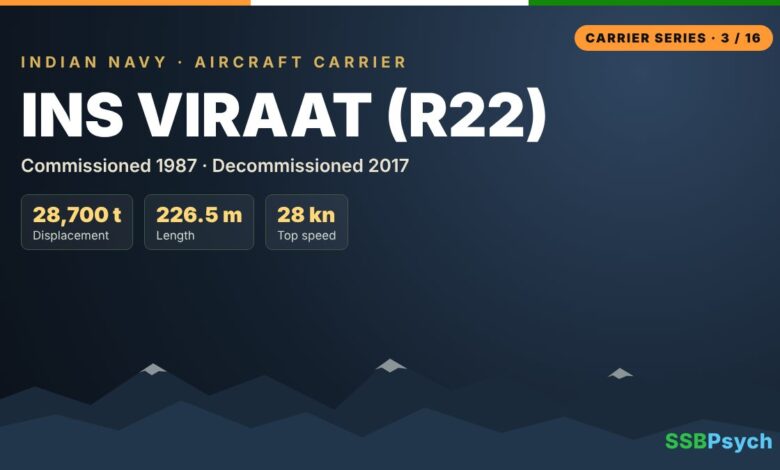
INS Viraat (R22): Ex-HMS Hermes, India’s Grand Old Carrier
Few warships in history can say they led two navies. INS Viraat could. Before it carried the Indian tricolour, it was HMS Hermes, the flagship of Britain’s task force in the 1982 Falklands War. Then, for almost 30 years, it served as the pride of the Indian Navy, flying Sea Harrier jump jets over the Arabian Sea and the Bay of Bengal.
In this guide you will learn how Viraat was born, why India bought it, why it got its name, its specifications, aircraft, crew, fuel and endurance, its missions, and the emotional story of its final days at the ship-breaking yards of Alang. Perfect reading for NDA, CDS, AFCAT and SSB aspirants.

Origin: The British Years as HMS Hermes
The ship was ordered during the Second World War, and its keel was laid on 21 June 1944. But the war ended before it could be finished, and work moved slowly. It was launched on 16 February 1953 and finally commissioned into the Royal Navy as HMS Hermes in November 1959. It belonged to the Centaur class of light carriers.
Over the years Hermes was rebuilt several times, changing from a carrier for regular jets to a commando carrier and later to a carrier for Sea Harrier jump jets with a ski-jump at the bow. Its most famous moment came in 1982, when Argentina seized the Falkland Islands in the South Atlantic. Hermes sailed as the flagship of the British task force, with Sea Harriers and helicopters on board, and played a central role in Britain winning back the islands.
Why India Bought INS Viraat
By the mid-1980s, India’s first carrier, INS Vikrant, was over 40 years old counting from its keel-laying. The Navy needed a second carrier so that at least one would be ready while the other was under repair. It had already chosen the Sea Harrier as its carrier jet, and Hermes was designed to operate exactly that aircraft. After evaluating options, India selected Hermes in 1986. The ship was towed to Devonport Dockyard in Plymouth, England, for an extensive refit.
The refit added new fire-control equipment, navigation radars, better protection against nuclear, biological and chemical threats, and deck landing aids. Its boilers were also converted to burn distillate fuel. Reliable public figures for the purchase price are hard to verify, so we do not quote one here.
Where and when was INS Viraat commissioned?
The ship was commissioned into the Indian Navy as INS Viraat on 12 May 1987, with the pennant number R22. It then sailed to India and soon became the flagship of the Navy, the ship that symbolically leads the fleet.
Why the Name Viraat?
Viraat is a Hindi and Sanskrit word meaning giant, huge or mighty. At the time, it was the biggest warship in the Indian Navy, so the name suited it perfectly. Like Vikrant before it, its name started with V, a tradition continued by Vikramaditya and the new Vikrant.
INS Viraat Specifications
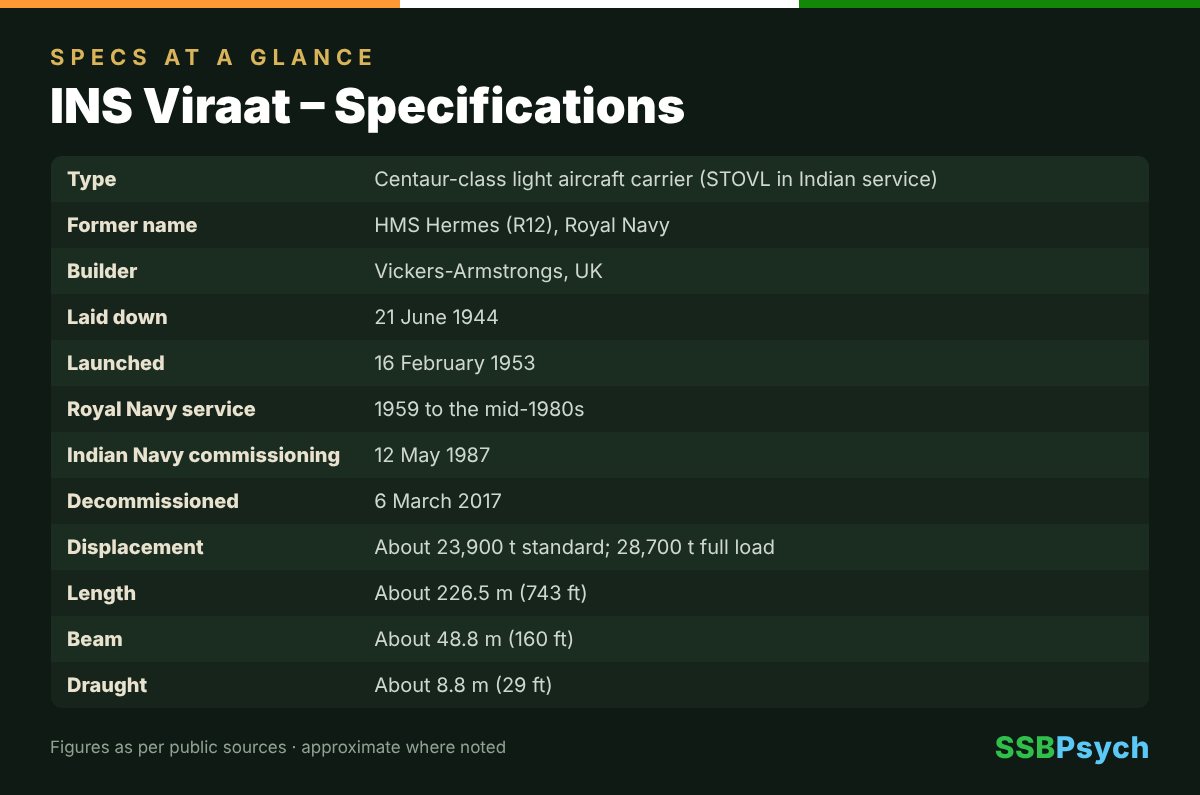
| Type | Centaur-class light aircraft carrier (STOVL in Indian service) |
| Former name | HMS Hermes (R12), Royal Navy |
| Builder | Vickers-Armstrongs, UK |
| Laid down | 21 June 1944 |
| Launched | 16 February 1953 |
| Royal Navy service | 1959 to the mid-1980s |
| Indian Navy commissioning | 12 May 1987 |
| Decommissioned | 6 March 2017 |
| Displacement | About 23,900 t standard; 28,700 t full load |
| Length | About 226.5 m (743 ft) |
| Beam | About 48.8 m (160 ft) |
| Draught | About 8.8 m (29 ft) |
| Propulsion | 4 boilers, 2 Parsons geared steam turbines, about 76,000 shp |
| Speed | About 28 knots (52 km/h) |
| Crew | Up to about 2,100 including air group |
| Aircraft | Up to about 26 aircraft and helicopters |
Putting the numbers in perspective
At about 28,700 tonnes fully loaded, Viraat was nearly 50 percent heavier than the first Vikrant. Its length of about 226.5 metres is more than two football fields. Four boilers and two steam turbines produced about 76,000 shaft horsepower, enough to push this floating airbase at around 28 knots, or about 52 km per hour.
INS Viraat Timeline
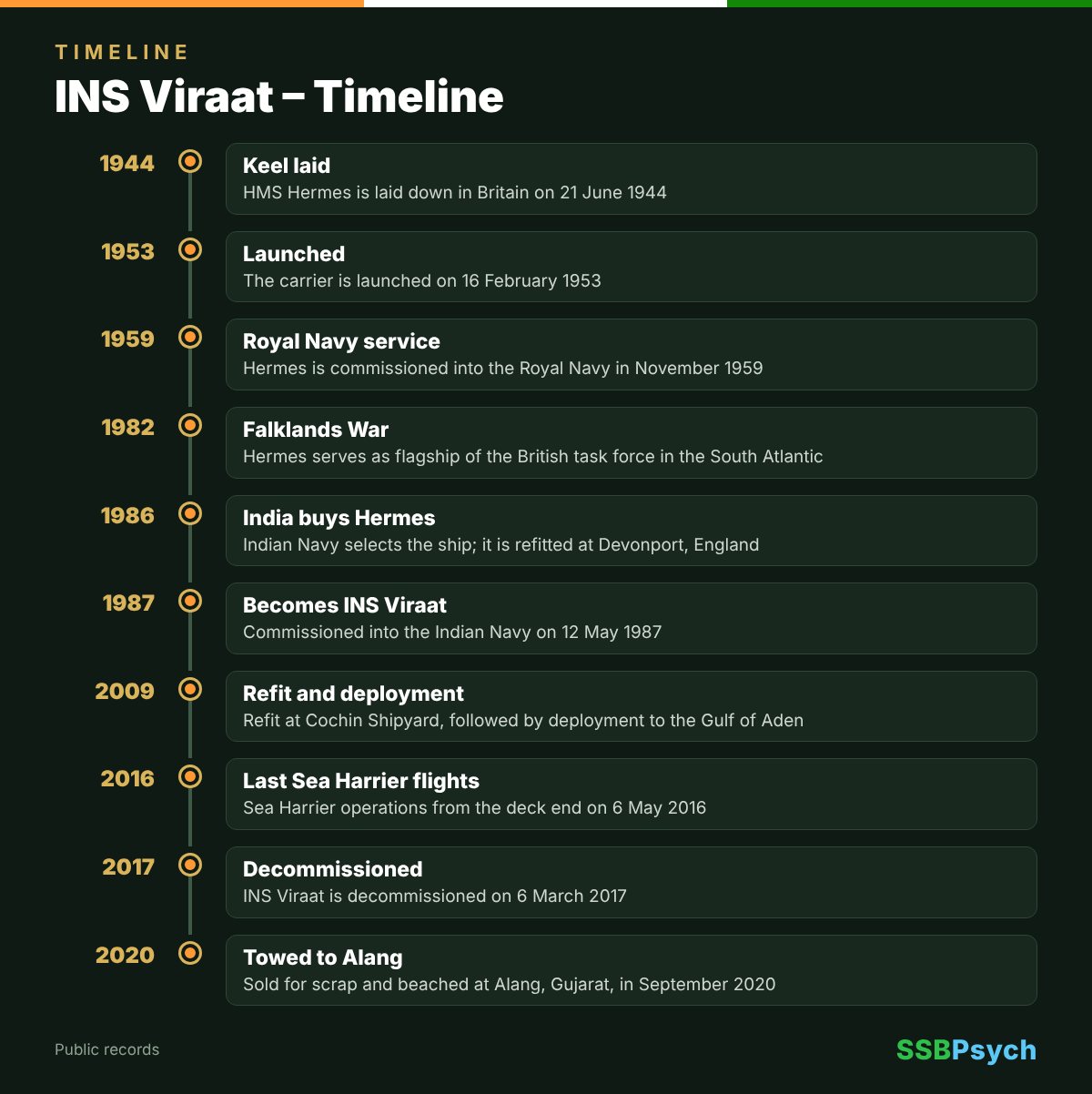
- 1944 – Keel laid: HMS Hermes is laid down in Britain on 21 June 1944
- 1953 – Launched: The carrier is launched on 16 February 1953
- 1959 – Royal Navy service: Hermes is commissioned into the Royal Navy in November 1959
- 1982 – Falklands War: Hermes serves as flagship of the British task force in the South Atlantic
- 1986 – India buys Hermes: Indian Navy selects the ship; it is refitted at Devonport, England
- 1987 – Becomes INS Viraat: Commissioned into the Indian Navy on 12 May 1987
- 2009 – Refit and deployment: Refit at Cochin Shipyard, followed by deployment to the Gulf of Aden
- 2016 – Last Sea Harrier flights: Sea Harrier operations from the deck end on 6 May 2016
- 2017 – Decommissioned: INS Viraat is decommissioned on 6 March 2017
- 2020 – Towed to Alang: Sold for scrap and beached at Alang, Gujarat, in September 2020
Aircraft of INS Viraat: The Sea Harrier Story
Viraat’s main weapon was its air group. It could carry up to about 26 aircraft, including around 16 Sea Harrier FRS51 jump jets, Sea King helicopters for hunting submarines, and smaller Chetak and Dhruv helicopters for rescue and transport. The Sea Harrier is a STOVL aircraft, meaning Short Take-Off and Vertical Landing. It can point its engine nozzles downward to hover like a helicopter and land gently on the deck.
To take off with a full load of fuel and weapons, Sea Harriers rolled down the deck and up the ski-jump, a curved ramp at the bow that throws the jet upward like a cricket ball off a bat’s edge. This let the jet lift more weight than a flat-deck take-off. India’s Sea Harriers flew from Viraat until 6 May 2016, when the jets were retired and replaced by MiG-29Ks on the newer carrier.
Aircraft, Weapons and Sensors
- BAe Sea Harrier FRS51 STOVL fighter jets
- Westland Sea King Mk 42B anti-submarine helicopters
- HAL Chetak utility and rescue helicopters
- HAL Dhruv helicopters
- Ski-jump ramp for short take-offs
- Navigation and fire-control radars added in the 1986-87 refit
Why Was INS Viraat So Important?
For years, Viraat was the backbone of India’s sea-based air power. After the first Vikrant retired in 1997, Viraat was India’s only aircraft carrier until INS Vikramaditya arrived in 2013. That means for about 16 years, all of India’s carrier flying, training and experience depended on a single, ageing ship. Its crews kept it running through careful maintenance and several refits, making sure India never lost its skills in carrier warfare.
Operations and Missions
- 1987 – Indian Navy flagship: Became the flagship of the Indian Navy, a role it held until 2013
- 1993 – Engine room flooding: Flooding in the engine room kept the ship out of action for months
- 1999-2001 – Life-extension refit: A major refit extended Viraat’s service life
- 2009 – Gulf of Aden deployment: Deployed to the Gulf of Aden region after a Cochin Shipyard refit
- 2014 – Twin-carrier operations: Sailed with INS Vikramaditya in January 2014, the first two-carrier drill in about 20 years
- 2016 – Final voyage under own power: Sailed from Mumbai to Kochi on 23 July 2016 for deactivation

A Day of Flying on INS Viraat
Flying from a jump-jet carrier needed perfect teamwork. Before a launch, the ship turned into the wind and picked up speed so that air flowed fast over the deck, giving the jets extra lift. Deck handlers in coloured jackets moved aircraft from the lifts, fuel teams topped up tanks, and armourers loaded weapons. A flight deck officer then signalled each Sea Harrier to start its roll towards the ski-jump.
Landing was different from a normal carrier. Instead of catching an arrester wire, the Sea Harrier slowed down beside the ship, hovered, slid sideways over the deck and set down vertically. Pilots had to judge the rolling and pitching of the ship, the wind and their fuel carefully. Meanwhile, Sea King helicopters dipped sonar into the water to listen for submarines that might threaten the carrier, and a Chetak or Dhruv helicopter often hovered nearby as a rescue guard in case a pilot had to eject.
INS Viraat vs the first Vikrant in brief
- Size: Viraat was about 28,700 tonnes at full load, compared with about 19,500 tonnes for the first Vikrant.
- Speed: about 28 knots for Viraat versus about 25 knots for Vikrant.
- Jets: Viraat was a Sea Harrier carrier; Vikrant flew Sea Hawks first and Sea Harriers later.
- Service in India: Viraat about 30 years (1987-2017); Vikrant about 36 years (1961-1997).
- Combat: Vikrant fought in the 1971 war; Viraat served mainly in peacetime deterrence, exercises and deployments.
Together, these two British-built ships carried Indian naval aviation for more than five decades and prepared the Navy for the much larger carriers that followed.
Crew, Fuel and Endurance
Viraat could carry up to about 2,100 people, including roughly 1,200 ship’s crew plus aviators and maintenance staff of the air squadrons. Running such a ship was like managing a small town: engineers kept the boilers alive, electricians ran the generators, supply officers stored months of food and spare parts, and doctors ran the sick bay. As an Indian Navy carrier, it was commanded by an officer of Captain rank.
Being a steam ship, Viraat burned fuel to boil water in its boilers. Its range was limited by its fuel tanks, so on long deployments it relied on Indian Navy tankers to refuel at sea. Exact endurance figures from official sources are not easily available, so we leave them out. What is certain is that keeping a 1950s-era steam plant working into the 2010s took great skill from its engineers.
Refits that kept it alive
- 1986-87: major refit at Devonport, England, before joining India.
- 1993: engine room flooding kept it out of service for several months.
- 1999-2001: a life-extension refit; because of it, Viraat could not take part in Operation Talwar during the 1999 Kargil conflict.
- 2009: refit at Cochin Shipyard, followed by deployment to the Gulf of Aden.
- 2012-13: its final major refit.
The End of INS Viraat
After its last Sea Harrier flights in May 2016, Viraat made its final voyage under its own power from Mumbai to Kochi on 23 July 2016 for a month of deactivation work, and was then towed back to Mumbai. It was formally decommissioned on 6 March 2017. Counting its British years, the ship had served for nearly six decades, and by the end it was described as the oldest aircraft carrier in service anywhere in the world.
Plans were discussed to turn Viraat into a museum or hotel, but they did not work out, and in 2019 the idea was dropped. In 2020 the ship was sold for scrap, reportedly for about Rs 38.5 crore, and towed to the ship-breaking yard at Alang in Gujarat, where it was beached in September 2020. A private group tried to buy it back for preservation, and the matter reached the Supreme Court in 2021. By then a large part of the ship had already been broken up, and the court did not stop the process.
Analysis: The Legacy of INS Viraat
Viraat’s biggest gift was continuity. It kept Indian naval aviation alive between the retirement of the first Vikrant and the arrival of Vikramaditya. It trained hundreds of pilots, deck handlers and engineers who later ran India’s newer carriers. It also showed that a well-maintained ship can serve far beyond its expected life, though at rising cost and effort. The lesson for India was clear: buying old ships is a short-term fix, and real strength comes from building your own, which India finally did with the new INS Vikrant.
For SSB aspirants, Viraat is also a great example of adaptability. A ship designed in the 1940s changed its role many times, from regular jets to commandos to jump jets, and still stayed useful. Officers face similar challenges: new technology, new roles and the need to keep learning throughout a career.
If you are asked about INS Viraat in a GK paper or interview, remember four anchors: ex-HMS Hermes, commissioned 12 May 1987, Sea Harrier carrier with a ski-jump, and decommissioned 6 March 2017. Linking these facts to the bigger story of India moving from bought carriers to home-built ones will make your answer stand out.
Did You Know?
- INS Viraat was the flagship of two navies: the Royal Navy in the Falklands War and later the Indian Navy.
- Its keel was laid in 1944, during the Second World War, but it was commissioned only in 1959.
- Viraat means giant, and it was the largest warship in the Indian Navy when it joined in 1987.
- For about 16 years after 1997, it was India’s only aircraft carrier.
- In January 2014, it sailed with INS Vikramaditya in the first two-carrier drill by India in about two decades.
- Its scrapping at Alang reached the Supreme Court in 2021.
Quiz: Test Your Knowledge of INS Viraat
Click an option to see if you are right. Your score updates live.
INS Viraat: Frequently Asked Questions
INS Viraat (R22) was an Indian Navy aircraft carrier, formerly the British HMS Hermes. It served India from 12 May 1987 to 6 March 2017 and flew Sea Harrier jets and Sea King helicopters.
It served about 30 years in the Indian Navy and around 25 years in the Royal Navy before that, nearly six decades in total.
After decommissioning in 2017, museum plans did not succeed. It was sold for scrap in 2020, towed to Alang in Gujarat and broken up.
It could carry up to about 26 aircraft, including around 16 Sea Harriers plus Sea King, Chetak and Dhruv helicopters.
It did not fight in a full-scale war for India. It served as the fleet flagship, took part in exercises and deployments, and was under refit during the 1999 Kargil conflict.
This is part 3 of 16 in SSBPsych’s Indian Navy aircraft carrier series – a new post every day at 2 PM.
Sources: en.wikipedia.org, en.wikipedia.org.
Preparing for NDA, CDS, AFCAT or your SSB? Join SSBPsych’s online and offline batches – explore our courses or call +91 8076540582.