C-17 Globemaster in Indian Air Force: Specs, Payload, Missions
Whenever Indians are trapped in a war zone or a disaster strikes, one giant grey aircraft is usually the first to answer the call: the C-17 Globemaster III. With four huge engines and a belly big enough to swallow a tank, this American-built aircraft is the Indian Air Force’s heaviest lifter. From Kabul to Kathmandu and from Yemen to the icy heights of Ladakh, the C-17 has carried soldiers, rescue teams and hope.
In this guide we explain the C-17 in simple words: its specifications, how much it can carry, how far and how fast it flies, its history in the IAF, the famous missions it has flown, where it is based and who flies it. As always, there is a 10-question quiz and FAQ at the end to help you prepare for NDA, CDS, AFCAT and SSB.

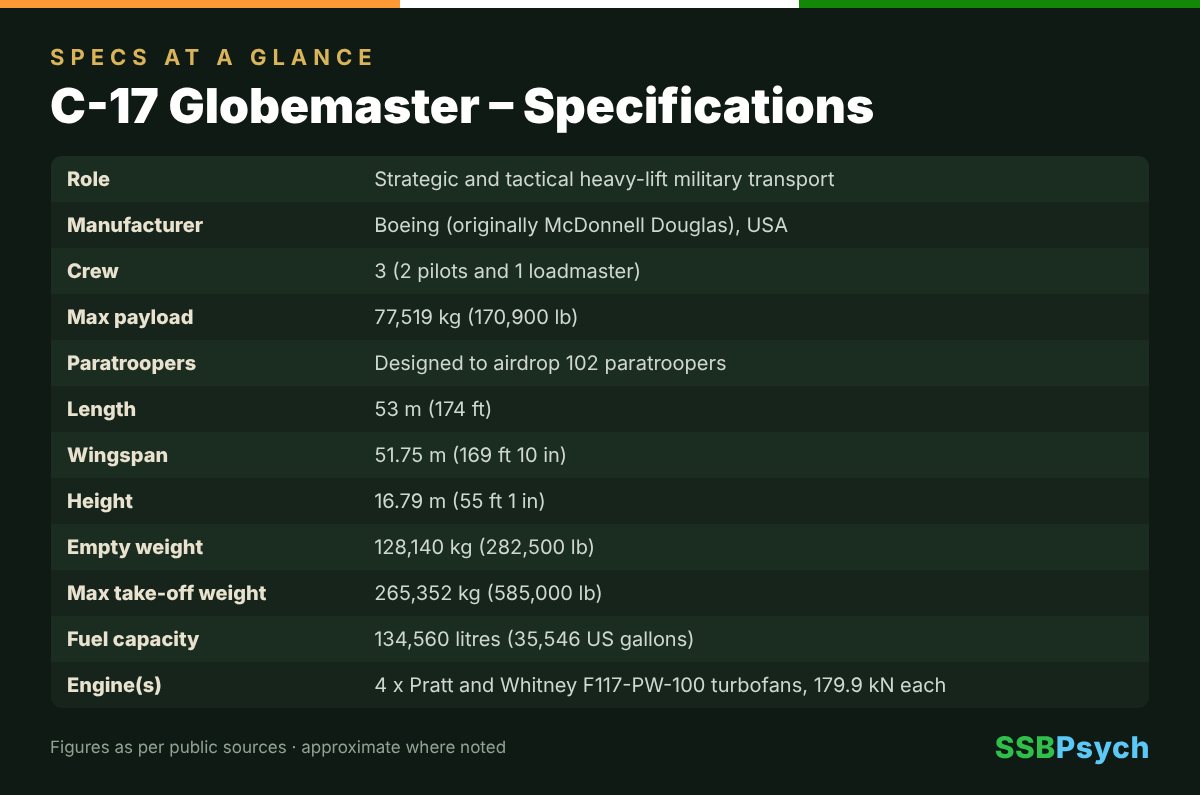
C-17 Globemaster Specifications
| Role | Strategic and tactical heavy-lift military transport |
| Manufacturer | Boeing (originally McDonnell Douglas), USA |
| Crew | 3 (2 pilots and 1 loadmaster) |
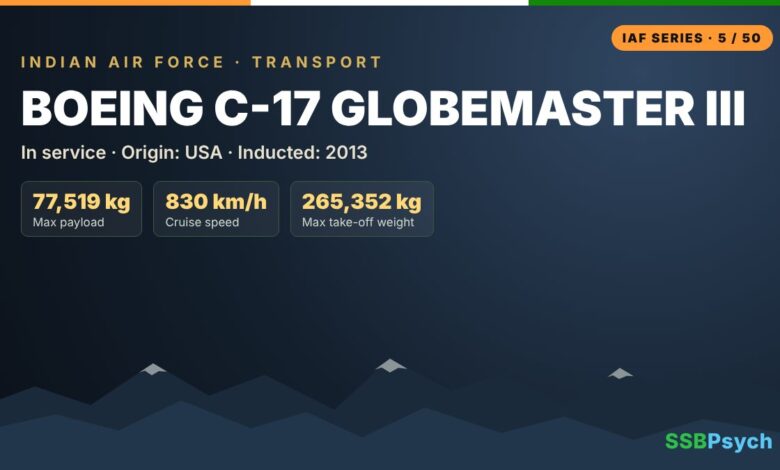
| Max payload | 77,519 kg (170,900 lb) |
| Paratroopers | Designed to airdrop 102 paratroopers |
| Length | 53 m (174 ft) |
| Wingspan | 51.75 m (169 ft 10 in) |
| Height | 16.79 m (55 ft 1 in) |
| Empty weight | 128,140 kg (282,500 lb) |
| Max take-off weight | 265,352 kg (585,000 lb) |
| Fuel capacity | 134,560 litres (35,546 US gallons) |
| Engine(s) | 4 x Pratt and Whitney F117-PW-100 turbofans, 179.9 kN each |
| Cruise speed | 830 km/h (Mach 0.74 to 0.79) |
| Range / combat radius | 4,480 km with about 71 tonnes of payload; 11,540 km ferry range |
| Service ceiling | 13,716 m (45,000 ft) |
| First flight | 15 September 1991 |
| Inducted in IAF | 2 September 2013, Hindan (No. 81 Squadron) |
| Number in IAF | 11 |
What Is the C-17 Globemaster III?
The C-17 Globemaster III is a large four-engine military transport aircraft designed by McDonnell Douglas, which later became part of Boeing. It first flew on 15 September 1991 and was built mainly for the US Air Force. It is called a strategic airlifter because it can carry heavy loads across continents, but it can also do tactical jobs, such as landing on short, rough airstrips close to the front line.
This combination is rare. Most aircraft that can fly very heavy loads over long distances need long, smooth runways, while aircraft that can use short airstrips usually carry much less. The C-17 bridges that gap. Its wings use powerful flaps, and its engines can direct some of their exhaust over those flaps to create extra lift at low speed. It also has engine thrust reversers strong enough to let it back up on the ground, which is very useful on cramped airfields.
At the back of the aircraft is a large ramp that folds down to the ground, so vehicles can simply drive in and out. Inside, the cargo floor has rollers and locks for standard pallets, and fold-down seats line the walls for troops. One loadmaster can manage much of this work, which is why the C-17 needs only a small crew compared with older airlifters of similar size.
Production of the C-17 ended in 2015. India’s 11th aircraft was the very last C-17 ever produced, and with 11 aircraft, the IAF has the largest C-17 fleet outside the United States.
Why India Needed the C-17 Globemaster
For decades, the IAF’s heavy-lift work was done by Soviet-era aircraft such as the Ilyushin Il-76. As India’s role in the world grew and its borders demanded faster movement of troops, the IAF wanted a modern airlifter that could carry more, fly further and land at difficult high-altitude bases. India also needed the ability to rush help to its citizens abroad and to neighbours hit by disasters.
In 2011, India signed a deal with the United States for 10 C-17s. In 2017, the US approved the sale of one more aircraft, bringing the fleet to 11. The decision made the IAF one of the most capable military airlift forces in Asia.
History of the C-17 Globemaster in the IAF
The first Indian C-17 was delivered in January 2013 for testing and training, and it was officially accepted on 11 June 2013. On 2 September 2013, the aircraft formally entered service with No. 81 Squadron, the “Skylords”, at Air Force Station Hindan near Delhi. The squadron motto translates as “capable, powerful and everywhere”, a perfect description of the C-17.
Within months, the C-17 was flying to high-altitude airfields such as Leh and Thoise in Ladakh, to Port Blair in the Andaman and Nicobar Islands, and abroad to places like Tajikistan and Rwanda to support Indian personnel. The sixth aircraft arrived in July 2014, and the 11th and final C-17 joined the fleet on 26 August 2019.
Flying a giant aircraft into Ladakh is a real test. Airfields like Leh sit more than 3,000 metres above sea level, where the thin air makes engines weaker and wings produce less lift, so aircraft need more runway and can carry less. The weather changes quickly and the runways are surrounded by mountains. The C-17’s powerful engines and short-field ability make it one of the few heavy airlifters that can do this job regularly.
Engine and Performance Explained Simply
The C-17 has four Pratt and Whitney F117-PW-100 turbofan engines, each producing about 180 kilonewtons of thrust. Each engine alone is more powerful than the single engine of a Tejas fighter, which shows how much push is needed to lift such a giant.
Payload: “Payload” means the useful load the aircraft carries. The C-17 can lift up to 77,519 kg, about 77.5 tonnes. That is roughly the weight of 40 big SUVs. It is designed to carry a main battle tank of over 60 tonnes, or a mix of vehicles and pallets, or 102 paratroopers ready to jump.
Speed and height: The C-17 cruises at about 830 km/h, close to the speed of a passenger jet and more than two and a half times as fast as a bullet train. Its service ceiling, the highest altitude where it can still fly usefully, is 45,000 feet or about 13,716 metres, roughly one and a half times the height of Mount Everest.
Range and fuel: With about 71 tonnes of cargo, the C-17 can fly about 4,480 km, roughly the distance from Delhi to Dubai and back. Empty of cargo, its ferry range is around 11,540 km. It carries more than 1.3 lakh litres of fuel and can also be refuelled in mid-air.
Size: At 53 metres long with a wingspan of almost 52 metres, the C-17 is about half the length of a football field in both directions. Its tail rises nearly 17 metres, as tall as a five-storey building. Yet it can land in just about 1,067 metres of runway.
What It Carries
- Up to 77.5 tonnes of cargo, or up to 18 standard cargo pallets
- 102 paratroopers for airborne assault drops
- Heavy vehicles, artillery guns and even a main battle tank
- Containerised Delivery System (CDS) airdrops of supplies
- Medical equipment, oxygen tankers and disaster relief stores
Because the C-17 is a transport aircraft, it carries no attack weapons. Its “firepower” is its cargo. One useful trick is the Containerised Delivery System, or CDS, in which bundles of supplies on special platforms are pushed out of the open ramp in flight and float down by parachute. This lets the IAF supply troops or disaster victims in places where no aircraft can land, such as remote mountain posts or flood-hit villages.
C-17 Globemaster Missions and Operations
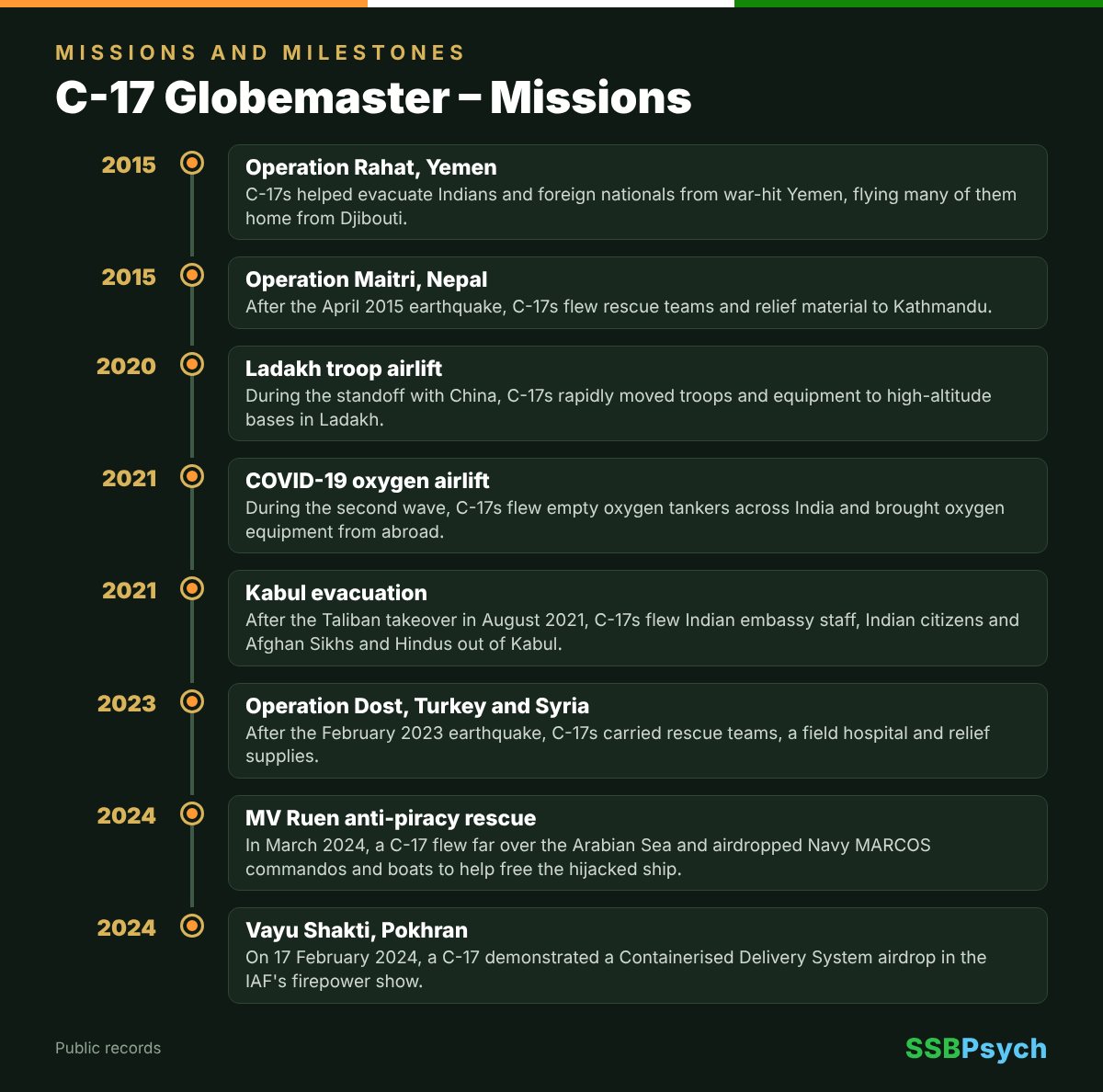
- 2015 – Operation Rahat, Yemen: C-17s helped evacuate Indians and foreign nationals from war-hit Yemen, flying many of them home from Djibouti.
- 2015 – Operation Maitri, Nepal: After the April 2015 earthquake, C-17s flew rescue teams and relief material to Kathmandu.
- 2020 – Ladakh troop airlift: During the standoff with China, C-17s rapidly moved troops and equipment to high-altitude bases in Ladakh.
- 2021 – COVID-19 oxygen airlift: During the second wave, C-17s flew empty oxygen tankers across India and brought oxygen equipment from abroad.
- 2021 – Kabul evacuation: After the Taliban takeover in August 2021, C-17s flew Indian embassy staff, Indian citizens and Afghan Sikhs and Hindus out of Kabul.
- 2023 – Operation Dost, Turkey and Syria: After the February 2023 earthquake, C-17s carried rescue teams, a field hospital and relief supplies.
- 2024 – MV Ruen anti-piracy rescue: In March 2024, a C-17 flew far over the Arabian Sea and airdropped Navy MARCOS commandos and boats to help free the hijacked ship.
- 2024 – Vayu Shakti, Pokhran: On 17 February 2024, a C-17 demonstrated a Containerised Delivery System airdrop in the IAF’s firepower show.
These missions show why the C-17 is often called India’s flying lifeline. In Operation Rahat in 2015, Indian ships and aircraft brought thousands of people out of war-torn Yemen. In Kabul in 2021, IAF crews flew into a city in chaos with the airport crowded and security uncertain. And in the MV Ruen operation of March 2024, a C-17 flew a long mission over the sea to airdrop Navy commandos and their boats, showing how the Air Force and Navy can work together to fight piracy.

Where the C-17 Globemaster Is Based and Who Flies It
As publicly reported, all of the IAF’s C-17s fly with No. 81 Squadron “Skylords” at Air Force Station Hindan in Ghaziabad, near Delhi, under Western Air Command. From this central location, the aircraft can reach the northern borders, the north-east, the islands and foreign countries quickly.
A C-17 crew normally includes two pilots and a loadmaster. The loadmaster is a vital member who plans and supervises how cargo, vehicles and people are loaded and tied down, because a badly balanced load can make an aircraft unsafe. Like other flying squadrons, a transport squadron is led by a commanding officer, usually of Wing Commander rank or above, with senior pilots as flight commanders.
Transport pilots join the IAF flying branch through NDA, CDS or AFCAT, just like fighter and helicopter pilots. After basic training on the Pilatus PC-7 Mk II at the Air Force Academy, Dundigal, cadets in the transport stream train on twin-engine aircraft such as the Dornier, and are commissioned after roughly one and a half to two years. Years of experience on aircraft like the An-32, Dornier or C-130J usually come before a pilot is ready to command a giant like the C-17.
Strengths and Limitations of the C-17 Globemaster
Here is a quick, balanced look at what makes the C-17 so valuable to India and where its challenges lie.
- Strength: Huge payload and long range, ideal for moving troops and heavy equipment quickly.
- Strength: Can land on short, rough airstrips and at high-altitude bases.
- Strength: Excellent for disaster relief and evacuation missions at home and abroad.
- Strength: Can airdrop paratroopers and supplies over remote areas.
- Limitation: Production has ended, so the IAF cannot buy new C-17s to add to the fleet.
- Limitation: Spares and long-term support depend on the United States.
- Limitation: With only 11 aircraft, each one is precious and heavily used.
Future of the C-17 in the IAF
Because no new C-17s are being built, the IAF’s focus is on keeping its 11 aircraft healthy for many years. On 5 August 2025, India’s Defence Acquisition Council approved sustainment support for the IAF’s C-17 and C-130J fleets, which covers spares, repairs and technical help.
The C-17 will remain the backbone of the IAF’s heavy airlift for the foreseeable future, supported by the Il-76 and the medium-sized C-130J Super Hercules. In any future crisis, whether a war, an earthquake or an evacuation, it is very likely that the Skylords will once again be among the first to fly.
Why It Matters for SSB and AFCAT Aspirants
The C-17 appears regularly in current affairs because of evacuation and disaster relief missions, so AFCAT, CDS and NDA papers often ask about operations like Rahat, Maitri, Devi Shakti or Dost. In SSB group discussions and interviews, the C-17 is a great example of soft power and humanitarian assistance, showing how the armed forces serve people in peace as well as war. Remember: not every IAF hero flies a fighter.
Did You Know?
- The IAF’s 11 C-17s make it the largest C-17 operator outside the United States.
- India’s 11th C-17 was the last C-17 ever produced.
- No. 81 Squadron “Skylords” at Hindan flies all of India’s C-17s.
- The C-17 can airdrop 102 paratroopers in one flight.
- Its tail is about as tall as a five-storey building.
- The C-17 can reverse on the ground using its engine thrust reversers.
- In 2024, a C-17 airdropped MARCOS commandos far out at sea to help rescue a hijacked ship.
Quiz: Test Your Knowledge of C-17 Globemaster
Click an option to see if you are right. Your score updates live.
C-17 Globemaster: Frequently Asked Questions
The Indian Air Force operates 11 C-17 Globemaster III aircraft, all with No. 81 Squadron “Skylords” at Hindan.
A C-17 can carry up to 77,519 kg of cargo, which can include heavy vehicles, a main battle tank, pallets or 102 paratroopers.
With about 71 tonnes of payload it can fly around 4,480 km, and its ferry range without cargo is about 11,540 km. It can also be refuelled in mid-air.
The first C-17 was delivered in 2013, and No. 81 Squadron formally entered service with it on 2 September 2013.
Notable missions include Operation Rahat in Yemen, earthquake relief in Nepal, Turkey and Syria, the Kabul evacuation in 2021, COVID-19 oxygen airlifts and troop moves to Ladakh.
This is part 5 of 50 in SSBPsych’s Indian Air Force aircraft series – a new aircraft every evening at 6 PM.
Sources: en.wikipedia.org, en.wikipedia.org, etvbharat.com, flightglobal.com, janes.com.
Preparing for NDA, CDS, AFCAT or your SSB? Join SSBPsych’s online and offline batches – explore our courses or call +91 8076540582.