INS Aridhaman: India’s Third Nuclear Missile Submarine
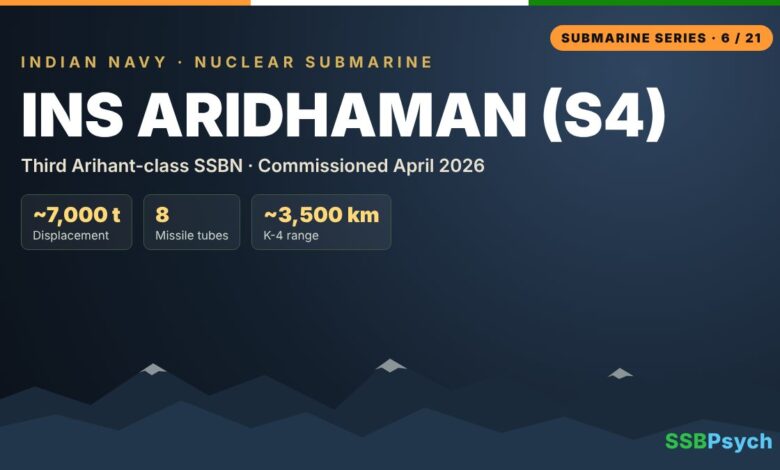
Somewhere under the sea, a giant steel tube can stay hidden for weeks, carrying weapons meant never to be used. That is the strange and serious job of INS Aridhaman, India’s third nuclear-powered ballistic missile submarine. According to reports in April 2026, it was commissioned at Visakhapatnam on 3 April 2026, joining INS Arihant and INS Arighaat in India’s undersea nuclear deterrent.
In this guide we explain, in simple words, what INS Aridhaman is, how big it is, what weapons it is reported to carry, why India needs such a submarine, who serves on it, what life is like inside, what dangers the crew face and what its name means. Wherever information is secret, we say so plainly instead of guessing. If you are preparing for NDA, CDS, AFCAT or the SSB interview, this is a topic you should know well.

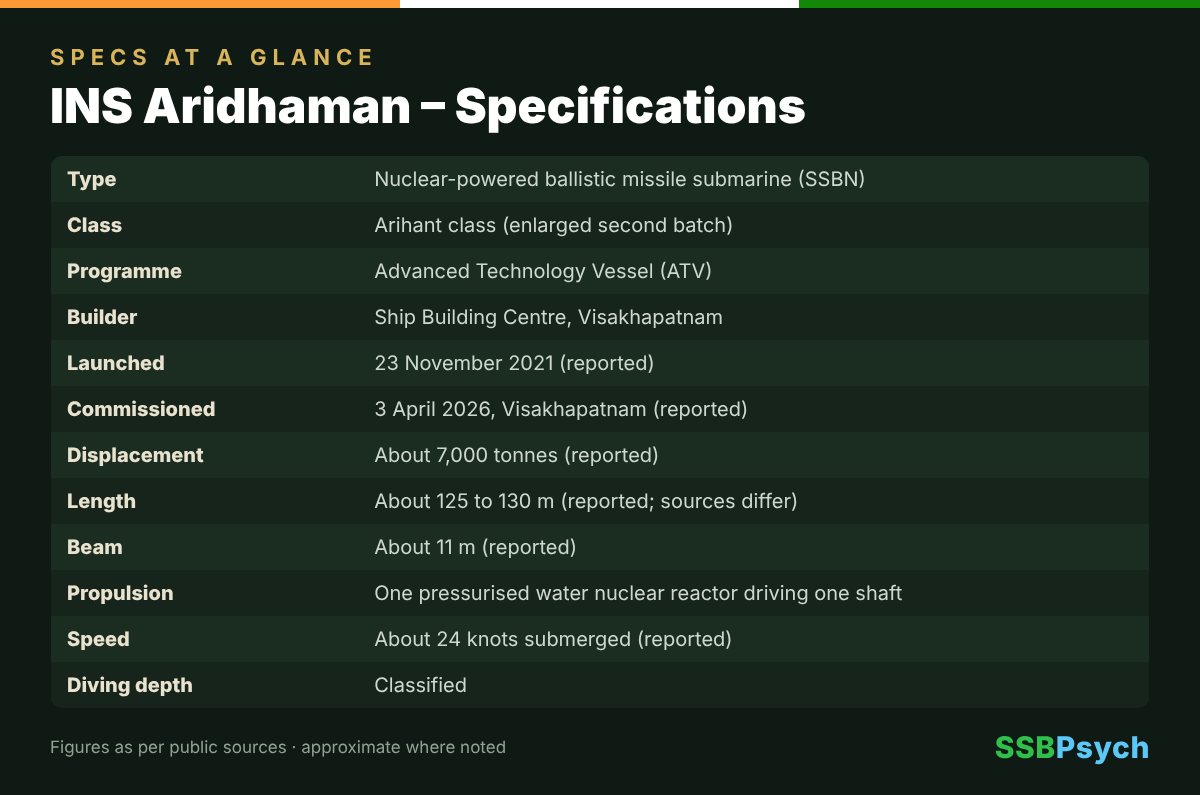
INS Aridhaman Specifications
| Type | Nuclear-powered ballistic missile submarine (SSBN) |
| Class | Arihant class (enlarged second batch) |
| Programme | Advanced Technology Vessel (ATV) |
| Builder | Ship Building Centre, Visakhapatnam |
| Launched | 23 November 2021 (reported) |
| Commissioned | 3 April 2026, Visakhapatnam (reported) |
| Displacement | About 7,000 tonnes (reported) |
| Length | About 125 to 130 m (reported; sources differ) |
| Beam | About 11 m (reported) |
| Propulsion | One pressurised water nuclear reactor driving one shaft |
| Speed | About 24 knots submerged (reported) |
| Diving depth | Classified |
| Crew | About 95 for the class (reported) |
| Missiles | Eight vertical tubes for K-4 or K-15 missiles (reported) |
| Status | In service |
What Is INS Aridhaman?
INS Aridhaman is an SSBN. The letters stand for Submersible Ship, Ballistic missile, Nuclear-powered. Put simply, it is a submarine that runs on a small nuclear reactor and carries long-range missiles that can carry nuclear warheads. It belongs to the Arihant class, which India built at home under a long, secret effort called the Advanced Technology Vessel (ATV) programme.
The boat was built at the Ship Building Centre in Visakhapatnam, on India’s east coast. It was launched, meaning floated out of the building dock for the first time, on 23 November 2021. After years of fitting out and harbour and sea trials, the Navy chief said in December 2025 that it was in the final stage of trials. Reports in April 2026 said it had been commissioned. As with India’s earlier SSBNs, there was no big public ceremony. ThePrint reported that the event was kept quiet and confirmed by defence sources.
Aridhaman is often described as the first boat of a stretched second batch. It is longer and heavier than INS Arihant and INS Arighaat, and the big gain is in firepower: it is reported to have eight missile tubes instead of four.
Why Does India Need INS Aridhaman? The Nuclear Triad Explained
India follows a policy of No First Use. This means India says it will not be the first to use nuclear weapons, but will hit back hard if it is attacked with them. For this promise to work, an enemy must believe that India’s weapons will survive a surprise first strike. This idea is called credible second-strike capability.
Land-based missiles can be found by satellites. Airbases can be bombed. But a nuclear submarine hiding deep in the ocean is extremely hard to find. That makes the sea the safest place to keep a part of the deterrent. With missiles that can be fired from land, from aircraft and from submarines, India has what is called a nuclear triad. Only a handful of countries operate nuclear-powered submarines, and INS Aridhaman strengthens India’s place in that small club.
One SSBN alone is not enough. Submarines need maintenance, crew rest and refits. To keep at least one boat always at sea, a navy needs several. That is why the third boat matters so much: it moves India closer to keeping a submarine on patrol around the year.
How Big Is INS Aridhaman?
Exact dimensions are not officially published, but credible reports give a clear picture. Displacement is simply the weight of water a vessel pushes aside, which equals its own weight. INS Aridhaman is reported at about 7,000 tonnes, roughly 1,000 tonnes more than the first two boats. That is roughly as heavy as 7,000 small hatchback cars of about one tonne each.
- Length: reported at about 125 to 130 metres, longer than a football field placed end to end with another half pitch.
- Width (beam): about 11 metres, roughly the width of a three-lane road.
- Power: a single pressurised water reactor that heats water to make steam, which spins turbines to turn one large propeller.
- Speed: reported around 24 knots underwater (about 44 km/h). A knot is one nautical mile per hour.
Aridhaman vs Arihant and Arighaat
The three boats look alike from outside, with a raised hump behind the sail (the tower on top) where missiles are stored upright. The differences are mainly inside and in size.
- INS Arihant and INS Arighaat are reported at about 6,000 tonnes and about 111 metres long, with four missile tubes each.
- INS Aridhaman is reported at about 7,000 tonnes with eight missile tubes, doubling the missiles one patrol can carry.
- Reports describe the newer boats as quieter, which is the single most important quality for a submarine that must stay hidden.
- All the boats can carry K-15 missiles of shorter range, but the longer-range K-4 is what gives real reach from safer waters.
INS Aridhaman Timeline
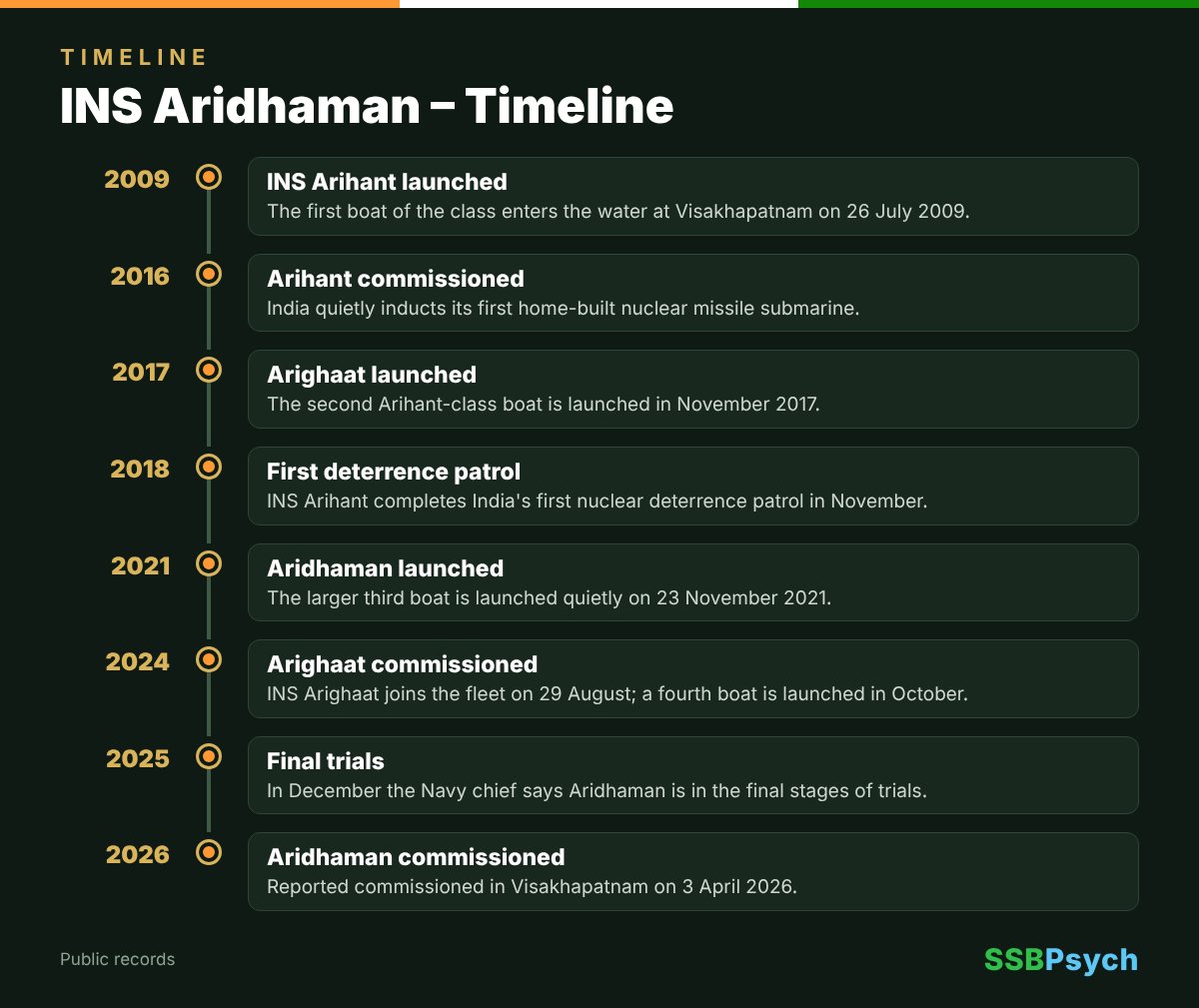
- 2009 – INS Arihant launched: The first boat of the class enters the water at Visakhapatnam on 26 July 2009.
- 2016 – Arihant commissioned: India quietly inducts its first home-built nuclear missile submarine.
- 2017 – Arighaat launched: The second Arihant-class boat is launched in November 2017.
- 2018 – First deterrence patrol: INS Arihant completes India’s first nuclear deterrence patrol in November.
- 2021 – Aridhaman launched: The larger third boat is launched quietly on 23 November 2021.
- 2024 – Arighaat commissioned: INS Arighaat joins the fleet on 29 August; a fourth boat is launched in October.
- 2025 – Final trials: In December the Navy chief says Aridhaman is in the final stages of trials.
- 2026 – Aridhaman commissioned: Reported commissioned in Visakhapatnam on 3 April 2026.
Aircraft, Weapons and Sensors
- K-4 submarine-launched ballistic missiles, reported range about 3,500 km
- K-15 Sagarika submarine-launched ballistic missiles, reported range about 750 km
- Eight vertical missile launch tubes in the hump behind the sail (reported), twice the four on INS Arihant
- 533 mm torpedo tubes for heavyweight torpedoes (reported)
- Sonar suite for listening and navigation (details classified)

Duty and Role of INS Aridhaman
The main duty of an SSBN is called deterrent patrol. The boat slips out of harbour, dives, and quietly moves to a hidden area, where it stays ready for weeks. Its job is not to chase enemy ships. Its job is to stay invisible and survive, so that any enemy knows India can always strike back. Patrol areas, patrol length and readiness levels are classified, and they should be. India’s strategic forces are controlled under the Strategic Forces Command, and any decision to use nuclear weapons rests with the country’s political leadership.
The submarine also carries torpedoes, but these are mainly for self-defence. An SSBN avoids fights. If it is ever detected, its best choice is to slip away quietly.
Who Commands It and How Big Is the Crew?
In the Indian Navy, a submarine is led by a Commanding Officer, usually of Commander or Captain rank. Nuclear submarines need very experienced officers, and their commanders have usually served for many years in conventional submarines first. The commanding officer is supported by an executive officer and specialist officers for engineering, weapons, navigation and communication.
The Arihant class is reported to have a crew of about 95 people. Many of them are trained to run and watch over the nuclear reactor. The Navy’s earlier experience with the leased INS Chakra helped train a generation of nuclear submariners, which made crewing these boats possible.
Life on Board a Nuclear Submarine
Imagine living for weeks in a narrow building with no windows, where day and night are set by a clock. That is life on an SSBN. Because the reactor gives almost unlimited power, nuclear submarines on many navies make their own fresh water from seawater and produce oxygen on board, so the real limits on time underwater are food, crew fatigue and mission needs.
Sailors work in shifts called watches, sleep in small bunks and eat in a tiny mess. Silence is a way of life: doors are shut gently and noisy machinery is avoided, because sound travels far under water. Contact with home is very limited during patrol. This is why submariners are carefully chosen for calm temperament, teamwork and mental toughness, qualities the SSB also looks for.
How Deep and How Fast Can It Go?
The true diving depth of INS Aridhaman is classified, and no official figure has been released. Some unofficial websites quote numbers, but these are not confirmed, so we do not repeat them. The same applies to its exact top speed; the commonly reported figure is about 24 knots submerged. What we can say is that nuclear submarines are built with thick, high-strength steel hulls to survive the crushing pressure of deep water.
Cost and What Drives Running Costs
The government has not published the cost of INS Aridhaman. The ATV programme is funded separately and kept secret, and figures in the media vary widely, so we do not give a number here. In general terms, these things make an SSBN expensive to build and run:
- Designing and building a compact nuclear reactor and its fuel.
- Highly trained crews who take years to prepare.
- Special dockyards, shore support and strict security.
- Long-range missiles and their testing.
- Regular maintenance and refits to keep the reactor and hull safe.
Dangers Faced by the Crew
Every submarine is a dangerous place. Water pressure grows by about one atmosphere for every 10 metres of depth, so a leak deep down can be deadly. Fire is another big threat in a closed steel tube, because smoke has nowhere to go. A nuclear boat adds the need for strict reactor safety and radiation control. That is why crews practise damage control, firefighting and escape drills again and again until they become second nature.
What Does the Name Aridhaman Mean?
The name comes from Sanskrit. Ari means enemy, and the name as a whole is usually translated as destroyer of enemies or vanquisher of foes. It fits the family pattern of the class, since Arihant also means slayer of enemies. On the day the boat was reported commissioned, the Defence Minister posted a short message on social media playing on the name, saying it was not words but power.
What Comes Next for India’s SSBN Fleet?
A fourth Arihant-class boat was launched in October 2024 and is reported to be in sea trials. Work is reported to have begun on even larger future SSBNs. Separately, India has approved plans to build its own nuclear-powered attack submarines (SSNs), which hunt enemy ships and submarines rather than carry strategic missiles. Together these will give India a much stronger silent force under the sea.
Why INS Aridhaman Matters for Defence Aspirants
Questions on India’s nuclear triad, No First Use and the Arihant class appear in general knowledge papers and are great talking points in SSB group discussions. Remember the core logic: India’s sea-based deterrent exists to prevent war, not to start one. Being able to explain that calmly shows maturity and clear thinking.
Did You Know?
- INS Aridhaman was launched quietly in November 2021, and the public learned about it mainly through media reports.
- Its eight missile tubes are double the four carried by INS Arihant.
- The Arihant class is built at the Ship Building Centre in Visakhapatnam, not at a regular commercial shipyard.
- India completed its first nuclear deterrence patrol with INS Arihant in November 2018.
- A nuclear submarine can run for years on its reactor without refuelling, unlike a diesel boat that must surface or snorkel to recharge batteries.
- SSBN crews rarely talk about their work, which is why they are called the silent service.
Quiz: Test Your Knowledge of INS Aridhaman
Click an option to see if you are right. Your score updates live.
INS Aridhaman: Frequently Asked Questions
Yes. Media reports, including ThePrint, said INS Aridhaman was commissioned at Visakhapatnam on 3 April 2026. The event was kept low-key, as with earlier Indian SSBNs.
It is reported to be larger, about 7,000 tonnes against about 6,000 tonnes, and to carry eight missile tubes instead of four. It is also described as quieter.
It is reported to carry K-4 ballistic missiles with a range of about 3,500 km, or the shorter-range K-15 Sagarika. Exact loads are classified.
The Arihant class is reported to have a crew of about 95. The exact number for Aridhaman has not been officially published.
Because India follows No First Use, it needs weapons that can survive a surprise attack. Hidden submarines provide this assured second-strike ability and complete India’s nuclear triad.
This is part 6 of 21 in SSBPsych’s submarine series – a new post every morning at 10 AM.
Sources: theprint.in, en.wikipedia.org, en.wikipedia.org, indiatoday.in, deccanherald.com.
Preparing for NDA, CDS, AFCAT or your SSB? Join SSBPsych’s online and offline batches – explore our courses or call +91 8076540582.