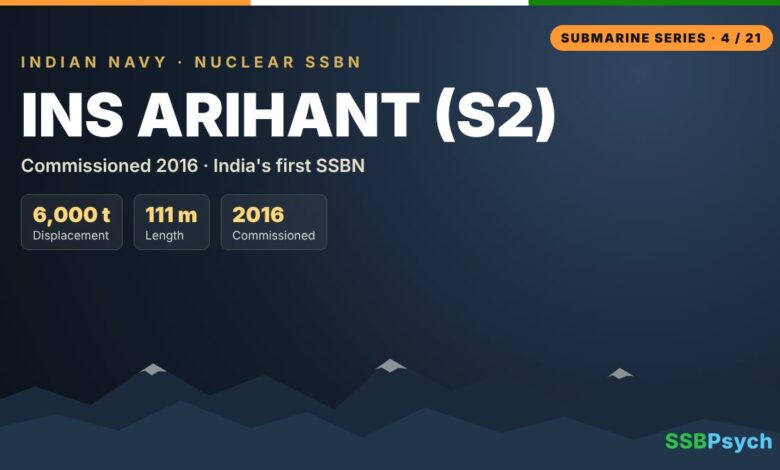
INS Arihant (S2): India’s First Nuclear Missile Submarine
Somewhere in the deep waters around India, a black steel giant may be quietly cruising with weapons that can change the course of any war. Nobody outside a tiny circle knows where it is, and that is exactly the point. INS Arihant is India’s first home-built nuclear-powered ballistic missile submarine, and it gave India a hidden way to strike back if ever attacked with nuclear weapons.
In this guide we explain what INS Arihant is, why India built it, how big it is, what powers it, what weapons it reportedly carries, how many sailors run it, what it may have cost, and what life inside a nuclear submarine is like. Many details are classified, and we clearly say so wherever that is the case.

What Is INS Arihant?
INS Arihant (often called S2) is the lead boat of the Arihant class. In navy language it is an SSBN: a submarine that is nuclear-powered (N) and carries ballistic missiles (B). The name Arihant is commonly translated from Sanskrit as destroyer or slayer of enemies.
It was designed and built in India under the long-secret Advanced Technology Vessel (ATV) project, with the hull constructed at the Ship Building Centre in Visakhapatnam. Several Indian organisations, including the Navy, DRDO and the Department of Atomic Energy, worked on it, and Russian assistance was reportedly received for some parts of the programme.
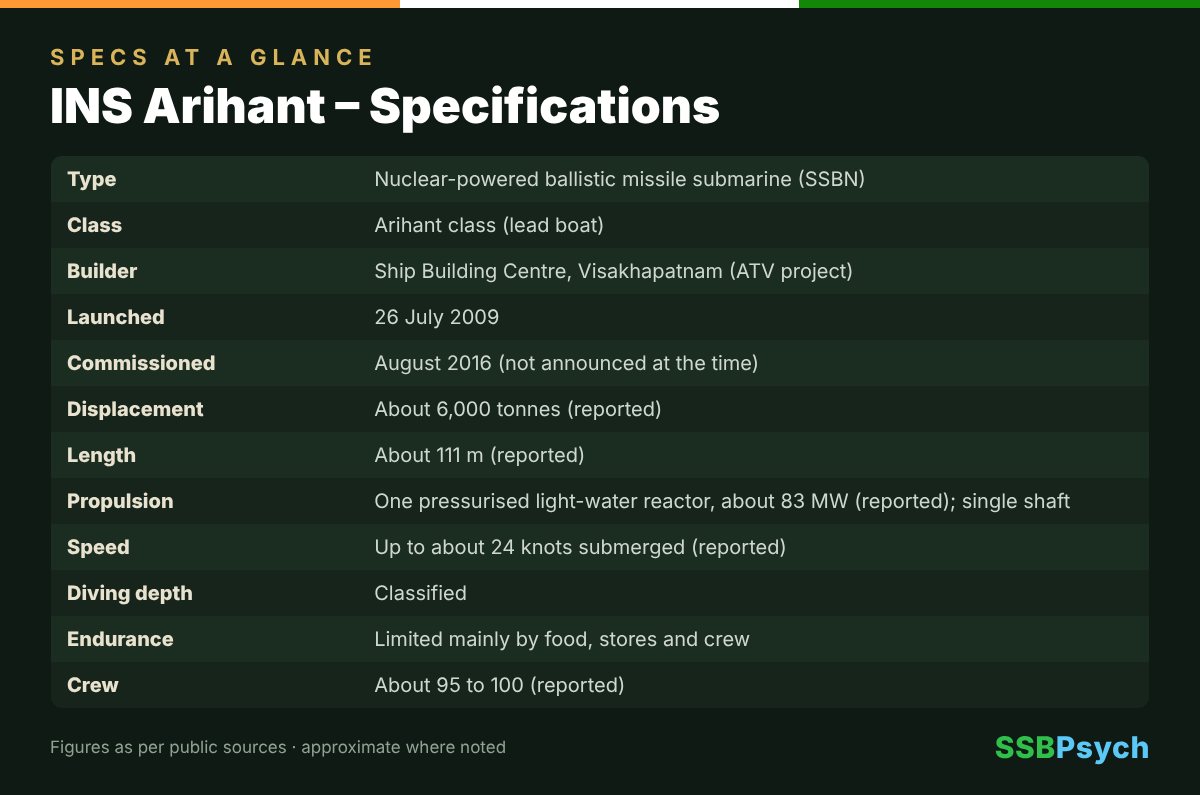
INS Arihant Specifications
| Type | Nuclear-powered ballistic missile submarine (SSBN) |
| Class | Arihant class (lead boat) |
| Builder | Ship Building Centre, Visakhapatnam (ATV project) |
| Launched | 26 July 2009 |
| Commissioned | August 2016 (not announced at the time) |
| Displacement | About 6,000 tonnes (reported) |
| Length | About 111 m (reported) |
| Propulsion | One pressurised light-water reactor, about 83 MW (reported); single shaft |
| Speed | Up to about 24 knots submerged (reported) |
| Diving depth | Classified |
| Endurance | Limited mainly by food, stores and crew |
| Crew | About 95 to 100 (reported) |
| Missiles | K-15 Sagarika SLBMs in four launch tubes (reported) |
| Torpedoes | 533 mm torpedo tubes (reported) |
| Status | In service |
INS Arihant Size: How Big Is It?
INS Arihant is reported to be about 111 metres long, roughly the length of a football field, and to displace around 6,000 tonnes. To picture that weight, think of about 4,000 to 5,000 family cars packed together. It is nearly four times heavier than one of India’s Kalvari-class diesel submarines.
Despite its size, most of the space is taken by the reactor, the machinery that turns heat into motion, the missile compartment and the systems that keep the crew alive for weeks underwater. The missile tubes sit inside a raised section behind the tower, often called the hump.
What Powers INS Arihant?
The heart of the submarine is a pressurised light-water reactor reported to be about 83 MW. Inside it, controlled nuclear reactions produce heat. That heat turns water into steam, the steam spins turbines, and the turbines drive a single propeller shaft and generate electricity for the whole boat.
The reactor design was first proven on a land-based prototype at Kalpakkam in Tamil Nadu before it went to sea. Arihant’s on-board reactor achieved criticality, meaning it started a self-sustaining chain reaction, in August 2013. Because the reactor needs no oxygen, the submarine does not have to come up for air, and it can make its own drinking water and breathing oxygen.
Its top submerged speed is reported to be around 24 knots (about 44 km per hour), but the exact performance and diving depth are classified.
Why India Has INS Arihant: Duty and Role
India follows a nuclear policy of No First Use. It promises never to use nuclear weapons first, but warns that any nuclear attack on India will be answered. For that warning to be believable, India must be sure it can still strike back even after a surprise attack. This is called assured second-strike capability.
Land-based missiles and airbases could, in theory, be targeted. A submarine hiding somewhere in a vast ocean is far harder to find. That is the duty of INS Arihant: to stay hidden, stay ready and ensure that no enemy ever believes it can escape retaliation. Its purpose is to prevent war, not to fight one.
When Arihant completed its first deterrence patrol in November 2018, the Prime Minister announced that India’s nuclear triad, the ability to deliver nuclear weapons from land, air and sea, was complete. India became the only country outside the five permanent members of the UN Security Council to build and operate a ballistic missile submarine. Its operational control is widely reported to rest with India’s Strategic Forces Command.
Aircraft, Weapons and Sensors
- K-15 Sagarika submarine-launched ballistic missiles, range about 750 km (reported)
- Four vertical missile launch tubes in the hump behind the sail (reported)
- Capability to fire the longer-range K-4 missile, tested from Arihant in 2016 (reported)
- 533 mm heavyweight torpedo tubes (reported)
- Indian-developed sonar and combat systems (details classified)
The K-15 Sagarika missile has a reported range of about 750 km, which means the submarine must come relatively close to a potential adversary’s waters to use it. That is one reason India developed the longer-range K-4 missile for later boats. The exact number of missiles carried on any patrol is not made public.
Operations and Missions
- 2015 – K-15 test launch: An unarmed K-15 missile was reportedly test-fired from the submarine
- 2016 – K-4 trial: A K-4 missile with a dummy payload was reportedly launched from Arihant in March
- 2018 – First deterrence patrol: Completed in November and announced by the Prime Minister
- 2022 – SLBM launch: Defence Ministry announced a successful missile launch in the Bay of Bengal on 14 October
INS Arihant Timeline
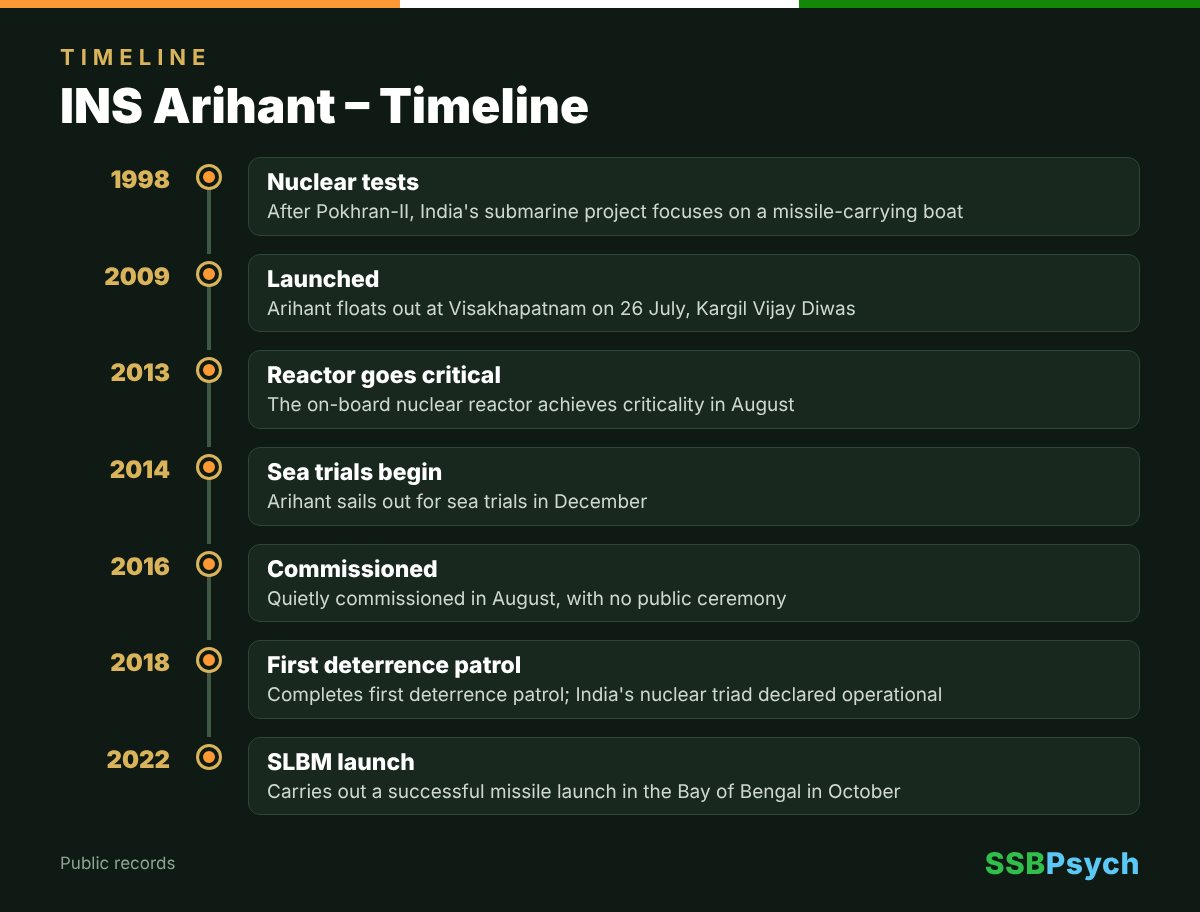
- 1998 – Nuclear tests: After Pokhran-II, India’s submarine project focuses on a missile-carrying boat
- 2009 – Launched: Arihant floats out at Visakhapatnam on 26 July, Kargil Vijay Diwas
- 2013 – Reactor goes critical: The on-board nuclear reactor achieves criticality in August
- 2014 – Sea trials begin: Arihant sails out for sea trials in December
- 2016 – Commissioned: Quietly commissioned in August, with no public ceremony
- 2018 – First deterrence patrol: Completes first deterrence patrol; India’s nuclear triad declared operational
- 2022 – SLBM launch: Carries out a successful missile launch in the Bay of Bengal in October
INS Arihant Home Port and Operations
Arihant was built at Visakhapatnam, home of the Navy’s Eastern Naval Command, and it is publicly reported to operate from the east coast. A dedicated base for nuclear submarines, named INS Varsha, is reported to be under development at Rambilli near Visakhapatnam. Its patrol areas, schedules and movements are, understandably, secret.
A deterrence patrol simply means the submarine slips out of port with its weapons, disappears into the ocean and stays hidden and ready for a period of time. The first such patrol in 2018 was reported to have lasted around 20 days.

Why Building INS Arihant Was So Hard
Very few countries have ever built a nuclear submarine on their own, and for good reason. Engineers had to squeeze a working nuclear reactor into a narrow submarine hull, shield the crew from radiation, make the whole machine quiet enough to avoid detection, and design missile tubes that can launch from underwater. Every pipe, valve and weld had to survive enormous water pressure for decades.
India also had to build the supporting ecosystem: special steel, reactor fuel, a land-based prototype reactor, trained crews and secure shore facilities. The ATV project worked largely in secrecy for many years before Arihant was finally launched in 2009. Then came years of harbour trials, reactor tests and sea trials before commissioning in 2016. That long journey is a big reason why Arihant is a symbol of national technological strength.
How a Deterrence Patrol Works
Think of a deterrence patrol like a security guard who is never seen but is always on duty. The submarine leaves port quietly, dives, and moves slowly to avoid making noise. It listens constantly with its sonar to avoid ships and other submarines, and it receives coded messages from shore through special low-frequency radio while staying hidden.
The crew keeps the reactor, missiles and life-support systems ready at all times, but the hope is that the missiles are never used. Success is measured by one thing: the submarine returns home without ever being detected, and the enemy never doubts that India can respond. In that sense, every quiet patrol is a victory.
Crew and Life on Board
INS Arihant is reported to carry a crew of about 95 to 100 officers and sailors. Like other Indian submarines, it is commanded by a senior officer, typically of Commander or Captain rank in submarine service, supported by specialist officers for the reactor, weapons, navigation and communications. The names of serving commanding officers are not discussed here for security reasons.
- Long days in darkness: there is no sunlight for weeks, so the boat runs on a strict watch routine.
- Total silence: during patrols the crew avoids unnecessary noise, because sound is the biggest giveaway underwater.
- Highly trained people: nuclear submariners train for years, and Indian crews gained experience on the leased nuclear submarine INS Chakra.
- Self-sufficient boat: fresh water and oxygen are produced on board, so food and stores become the main limit on endurance.
- Cut off from home: communication with family is very limited during a patrol, which demands strong mental resilience.
How Much Did INS Arihant Cost?
The Government has not published a separate price for INS Arihant. What has been reported is the cost of the wider ATV project: about Rs 30,000 crore when three submarines were authorised in 2006, rising to about Rs 90,000 crore by 2017 according to media reports. These figures cover research, design, infrastructure and multiple boats, not just Arihant.
What drives running costs?
Exact running costs are not public, but the main drivers are clear: maintaining and refuelling a nuclear reactor, strict radiation safety, specialised shore facilities, long periods of refit, expensive missiles and test firings, and the long training of a highly skilled crew. A nuclear submarine is one of the most expensive weapons any country can own.
Dangers and Challenges
Operating a nuclear submarine leaves no room for error. Fire, flooding, equipment failure and the risk of collision in the dark depths are constant concerns, and the reactor adds radiation safety to the list. In January 2018, a media report claimed that Arihant had suffered damage in 2017 after water entered its propulsion compartment through a hatch left open. The Defence Ministry did not officially comment, so it remains a reported claim, but it shows how unforgiving submarine life can be. India’s Deep Submergence Rescue Vehicles, inducted in 2018 and 2019, add a layer of safety for submarine crews.
INS Arihant and India’s Growing SSBN Fleet
Arihant was the pathfinder. It was followed by INS Arighaat, commissioned on 29 August 2024, which can carry the longer-range K-4 missile. A third, larger boat, INS Aridhaman, was reported commissioned on 3 April 2026. Each new boat builds on lessons learnt from Arihant. A fourth boat of the family was launched in October 2024 and is reported to be on trials. Defence experts point out that a navy needs several SSBNs so that at least one can be at sea at any time, which is called continuous deterrence. With only one boat, that is impossible, because every submarine must spend time in port for maintenance and crew rest. This is why the arrival of Arighaat and Aridhaman made Arihant’s mission far more meaningful.
INS Arihant in Your SSB Interview
Aspirants are often asked about recent defence developments. If INS Arihant comes up, keep it simple and accurate: it is India’s first indigenous SSBN, commissioned in 2016, built at Visakhapatnam under the ATV project, and its first deterrence patrol in 2018 made India’s nuclear triad operational. If asked for classified details like diving depth, say honestly that they are not public. That shows maturity and awareness, which assessors value.
Did You Know?
- INS Arihant was launched on 26 July 2009, the 10th anniversary of victory in the Kargil war.
- Its commissioning in 2016 was kept quiet and became public only later.
- It is often listed with the hull number S2, as the prototype reactor was treated as S1.
- Arihant made India one of only six countries in the world to operate nuclear-powered ballistic missile submarines.
- Arihant was built in Visakhapatnam, the same city where India’s first submarine museum, INS Kursura, stands.
- The first deterrence patrol in 2018 was reported to have lasted about 20 days.
Quiz: Test Your Knowledge of INS Arihant
Click an option to see if you are right. Your score updates live.
INS Arihant: Frequently Asked Questions
INS Arihant is India’s first indigenously built nuclear-powered ballistic missile submarine (SSBN). It was commissioned in 2016 and gives India a sea-based nuclear deterrent.
Because India follows No First Use, it needs assured second-strike capability. A hidden SSBN like Arihant can survive a surprise attack and strike back, completing India’s nuclear triad.
It is reported to carry K-15 Sagarika submarine-launched ballistic missiles with a range of about 750 km, along with torpedoes. The exact load on patrol is not disclosed.
Its diving depth is classified and has not been officially disclosed.
No separate official cost has been published. The overall ATV programme was reported at about Rs 30,000 crore in 2006, rising to about Rs 90,000 crore by 2017.
This is part 4 of 21 in SSBPsych’s submarine series – a new post every morning at 10 AM.
Sources: en.wikipedia.org, en.wikipedia.org, en.wikipedia.org, en.wikipedia.org, en.wikipedia.org.
Preparing for NDA, CDS, AFCAT or your SSB? Join SSBPsych’s online and offline batches – explore our courses or call +91 8076540582.