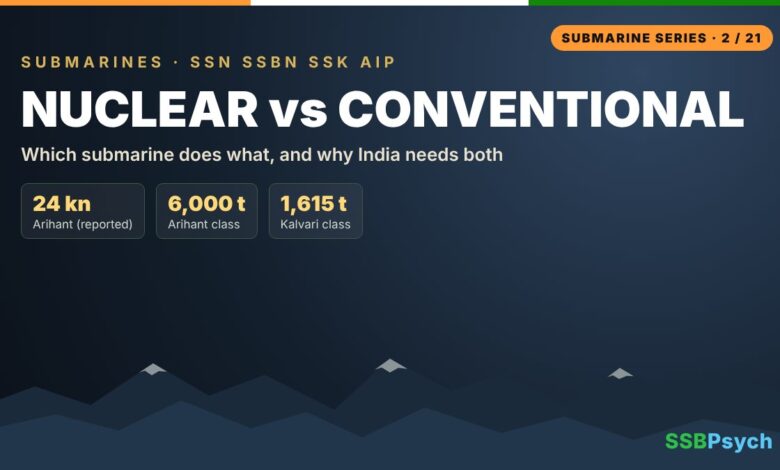
Nuclear vs Conventional Submarines: SSN, SSBN, SSK, AIP
Some submarines must come up for air every few days. Others can stay hidden for months, limited only by how much food they carry. That single difference sits at the heart of the nuclear vs conventional submarines debate, and it explains why India spends huge sums on both kinds.
In this guide we decode the confusing navy codes SSK, AIP, SSN and SSBN, compare their strengths and weaknesses, look at what drives their cost, and explain how India’s nuclear submarines complete the country’s nuclear triad. If you are preparing for NDA, CDS, AFCAT or the SSB interview, these are exactly the terms that pop up in current affairs.

Nuclear vs Conventional Submarines: The Core Difference
The difference is simply what produces the power. A conventional submarine burns diesel fuel, which needs oxygen, so it must reach the surface or snorkel depth regularly. A nuclear submarine gets its energy from a small nuclear reactor, which needs no air at all. Everything else, from size to speed to cost, flows from this one fact.
Conventional (Diesel-Electric) Submarines: The SSK
Navies use the code SSK for a conventional attack submarine. Think of it like a hybrid car. Diesel engines run generators that charge a huge bank of batteries. Underwater, the boat runs only on battery power and electric motors.
How an SSK stays hidden
When the batteries run low, the submarine rises to just below the surface and raises a snorkel pipe so its diesels can breathe and recharge the batteries. This is its most vulnerable moment, because the snorkel and engine noise can be detected. Once charged, it slips back into the deep and becomes extremely quiet, sometimes quieter than a nuclear boat.
Strengths and limits of an SSK
- Very quiet on batteries, which makes it a deadly ambush hunter.
- Smaller and cheaper to build and run, so a navy can buy more of them.
- Ideal for coastal and shallow waters, close to the home coast or choke points.
- Limited underwater endurance and speed, because running fast drains the batteries quickly.
- Must snorkel regularly, which risks detection.
India’s current SSKs include the Kalvari class (based on the French Scorpene design and built by Mazagon Dock Limited in Mumbai), the Russian-origin Sindhughosh class and the German-designed Shishumar class. A Kalvari-class boat displaces about 1,615 tonnes on the surface and is around 67.5 metres long, according to published figures. The six-boat Project 75 was ordered in 2005 at a reported cost of about Rs 23,500 crore.
AIP Submarines: Conventional With Extra Lungs
AIP stands for Air Independent Propulsion. It is an add-on that lets a conventional submarine produce some power underwater without outside air, by carrying its own oxygen supply. Types include Stirling engines (used by Sweden and Japan), fuel cells (used by Germany’s Type 212) and the French MESMA system.
AIP does not make a submarine fast, but it lets it crawl quietly underwater for much longer. Published figures for some AIP boats are around two to three weeks submerged at slow speed, far more than a battery-only submarine. That means fewer trips to snorkel depth and fewer chances of being caught.
India’s DRDO has developed its own AIP based on phosphoric acid fuel cells, which make electricity by combining hydrogen with stored oxygen. In December 2024, Mazagon Dock received a reported contract of about Rs 1,990 crore to build and fit an AIP section into the Kalvari class, with INS Khanderi expected to be the first boat fitted during a refit.
Nuclear Submarines: SSN and SSBN
A nuclear submarine carries a compact reactor. The reactor heats water into steam, the steam spins turbines, and the turbines drive the propeller and make electricity. Because no air is needed, the boat can stay submerged for months, make its own fresh water and oxygen, and run fast for long periods. Its real limits are food supplies, maintenance and the endurance of the crew.
SSN: the nuclear hunter
An SSN is a nuclear-powered attack submarine. Its job is to hunt enemy submarines and warships, escort aircraft carriers, collect intelligence and, if needed, fire torpedoes and cruise missiles. Its high sustained speed lets it keep up with a fast-moving fleet across an ocean, something an SSK cannot do.
India has gained SSN experience by leasing two boats from Moscow, both named INS Chakra: a Soviet Charlie-class submarine from 1988 and a Russian Akula-class submarine from 2012, which returned to Russia in 2021. In October 2024, the government was widely reported to have cleared a plan to build India’s own nuclear-powered attack submarines.
SSBN: the nuclear deterrent
An SSBN is a nuclear-powered ballistic missile submarine. It does not go looking for fights. Its job is to hide deep in the ocean carrying nuclear-capable ballistic missiles, so that no enemy can ever hope to destroy all of a nation’s nuclear weapons in a surprise attack. Its greatest weapon is the fact that nobody knows where it is.
India’s SSBNs belong to the Arihant class, built at the Ship Building Centre in Visakhapatnam under the Advanced Technology Vessel (ATV) project. INS Arihant was commissioned in 2016 and INS Arighaat in August 2024. A third, larger boat, INS Aridhaman, was reported commissioned in April 2026. The first two displace about 6,000 tonnes and are powered by a pressurised light-water reactor of about 83 MW, according to published reports. Details like their exact diving depth, patrol areas and number of missiles carried at any time are classified.

Which Countries Operate Nuclear Submarines?
Building a nuclear submarine is one of the hardest engineering tasks on Earth. You must shrink a reactor to fit inside a narrow hull, shield the crew from radiation, keep the whole system quiet and make it safe enough to run for decades. Only a handful of nations have managed it.
- United States: operates only nuclear submarines, including SSNs and SSBNs.
- Russia: runs a large fleet of nuclear and conventional boats.
- United Kingdom and France: both have all-nuclear submarine fleets with SSBNs for deterrence.
- China: operates both SSNs and SSBNs alongside many conventional submarines.
- India: operates home-built SSBNs and has earlier leased nuclear attack boats from Russia.
Several other countries, such as Brazil and Australia, are working on nuclear-powered submarine programmes. Most navies of the world, however, stick to conventional submarines because they are far cheaper and suit their needs. For India, being in this small club is a big strategic achievement and a source of national pride, and it is a favourite topic in SSB group discussions and lecturettes.
Nuclear vs Conventional Submarines Compared
- Endurance underwater: SSK a few days on battery; AIP up to a few weeks at slow speed; nuclear boats months.
- Speed submerged: SSKs and AIP boats move fast only in short bursts; nuclear boats can sustain high speed for long periods.
- Size: SSKs are usually 1,500 to 3,000 tonnes; nuclear boats are much larger (Arihant class about 6,000 tonnes).
- Noise: a battery-run SSK can be extremely quiet; a reactor’s pumps make some noise, though modern designs reduce it.
- Cost: nuclear boats cost several times more to build and need special bases, fuel and highly trained crews.
- Best use: SSKs guard nearby waters and choke points; SSNs roam oceans; SSBNs provide nuclear deterrence.
What Drives Submarine Costs?
Building a submarine is only the first bill. Running it for 30 years or more costs a lot too. Exact running costs of Indian submarines are not published, but the main cost drivers are well known.
- Refits and maintenance: submarines spend long periods in dockyards for overhauls, battery replacement and system upgrades.
- Nuclear infrastructure: reactors need specialised shore facilities, safety systems, fuel handling and strict radiation monitoring.
- Crew training: submariners, especially nuclear-trained ones, take years to train.
- Weapons: modern torpedoes and missiles are expensive, and so are test firings.
- Secure bases: India is reported to be developing a dedicated base, INS Varsha, near Visakhapatnam to house its nuclear submarines.
For scale, the ATV project for nuclear submarines was reported at about Rs 30,000 crore when three boats were authorised in 2006, and media reports in 2017 put the overall project cost at around Rs 90,000 crore. Treat these as reported figures, since official costs are rarely made public.
India’s Nuclear Triad: Why the SSBN Matters
A nuclear triad means a country can deliver nuclear weapons from three different platforms: land-based missiles, aircraft and submarines. India’s land leg is formed by the Agni family of missiles, its air leg by nuclear-capable fighter aircraft, and its sea leg by the Arihant-class SSBNs armed with K-series submarine-launched ballistic missiles.
Why is the submarine leg so important? India follows a policy of No First Use, which means it will not use nuclear weapons first, and a doctrine of credible minimum deterrence. To make that promise believable, India must be able to strike back even after being attacked, which is called a second-strike capability. Missile silos and airbases can be targeted, but a submarine hidden somewhere in the ocean is extremely hard to find. That makes the SSBN the most survivable leg of the triad.
When INS Arihant completed its first deterrence patrol in November 2018, the government announced that India’s nuclear triad was now operational. India thus joined a very small group of countries that operate ballistic missile submarines, and it became the only country outside the five permanent members of the UN Security Council to build and operate one.
Nuclear vs Conventional Submarines Timeline
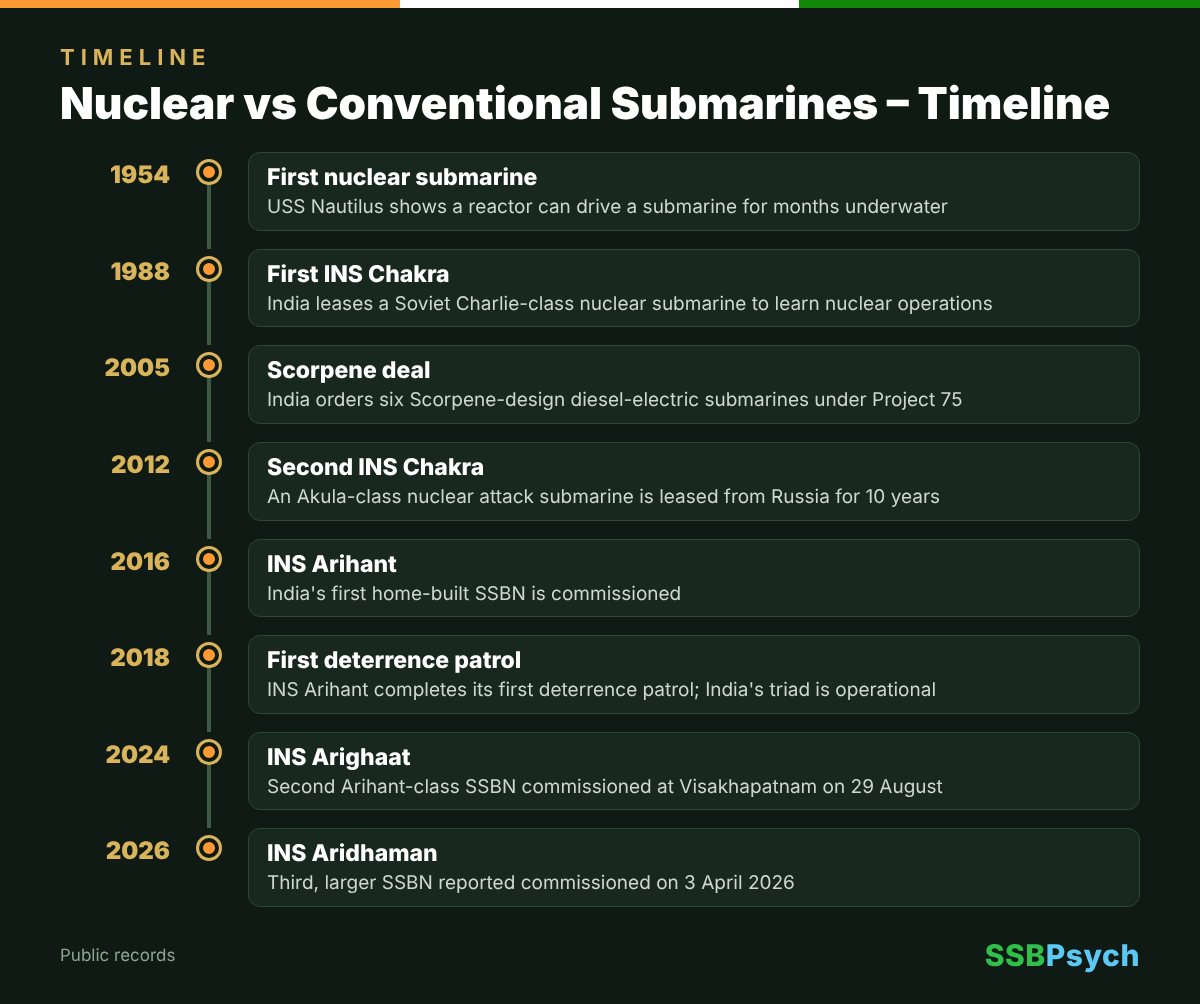
- 1954 – First nuclear submarine: USS Nautilus shows a reactor can drive a submarine for months underwater
- 1988 – First INS Chakra: India leases a Soviet Charlie-class nuclear submarine to learn nuclear operations
- 2005 – Scorpene deal: India orders six Scorpene-design diesel-electric submarines under Project 75
- 2012 – Second INS Chakra: An Akula-class nuclear attack submarine is leased from Russia for 10 years
- 2016 – INS Arihant: India’s first home-built SSBN is commissioned
- 2018 – First deterrence patrol: INS Arihant completes its first deterrence patrol; India’s triad is operational
- 2024 – INS Arighaat: Second Arihant-class SSBN commissioned at Visakhapatnam on 29 August
- 2026 – INS Aridhaman: Third, larger SSBN reported commissioned on 3 April 2026
Nuclear vs Conventional Submarines: Why India Needs Both
It is not a question of one being better than the other. India has a long coastline, island territories, busy trade routes and two neighbours with growing navies. Cheaper, quiet SSKs guard the Arabian Sea and Bay of Bengal approaches, while nuclear submarines provide long-range reach and an assured nuclear deterrent. A balanced fleet gives the Navy the right tool for each job.
Quick memory trick for exams: SS means submarine. Add K and you get the quiet diesel hunter that guards home waters. Add N and the boat becomes a nuclear hunter that can roam oceans. Add B and N together and you get the nuclear boat carrying ballistic missiles, the silent guardian of India’s second-strike capability. AIP is not a separate code but a booster fitted to conventional boats so they can stay underwater for longer. Remember these four and you can decode almost any submarine headline in the newspaper.
Did You Know?
- The letters SS in navy codes simply mean submarine; N stands for nuclear power and B for ballistic missiles.
- The K in SSK traditionally stands for hunter-killer.
- A nuclear submarine can make its own drinking water and oxygen from seawater.
- The world’s first nuclear submarine, USS Nautilus, entered service in 1954.
- The reactor design for the Arihant class was first proven on a land-based prototype at Kalpakkam in Tamil Nadu.
- Kalvari-class submarines can launch Exocet anti-ship missiles from underwater.
Quiz: Test Your Knowledge of Nuclear vs Conventional Submarines
Click an option to see if you are right. Your score updates live.
Nuclear vs Conventional Submarines: Frequently Asked Questions
A conventional submarine runs on diesel engines and batteries and must surface or snorkel to recharge. A nuclear submarine uses a reactor, needs no air and can stay submerged for months.
An SSN is a nuclear attack submarine that hunts ships and submarines. An SSBN is a nuclear submarine that carries ballistic missiles to provide nuclear deterrence.
No. AIP is fitted to conventional submarines and lets them stay underwater for longer, typically up to a few weeks at slow speed, without a reactor.
India commissioned INS Arihant in 2016 and INS Arighaat in 2024, and a third boat, INS Aridhaman, was reported commissioned in April 2026.
Because India follows No First Use, it needs an assured second-strike capability. A hidden SSBN can survive a surprise attack and strike back, which deters any enemy.
This is part 2 of 21 in SSBPsych’s submarine series – a new post every morning at 10 AM.
Sources: en.wikipedia.org, en.wikipedia.org, en.wikipedia.org, en.wikipedia.org, en.wikipedia.org.
Preparing for NDA, CDS, AFCAT or your SSB? Join SSBPsych’s online and offline batches – explore our courses or call +91 8076540582.