IAC-2: India’s Next Aircraft Carrier and Third Carrier Plans
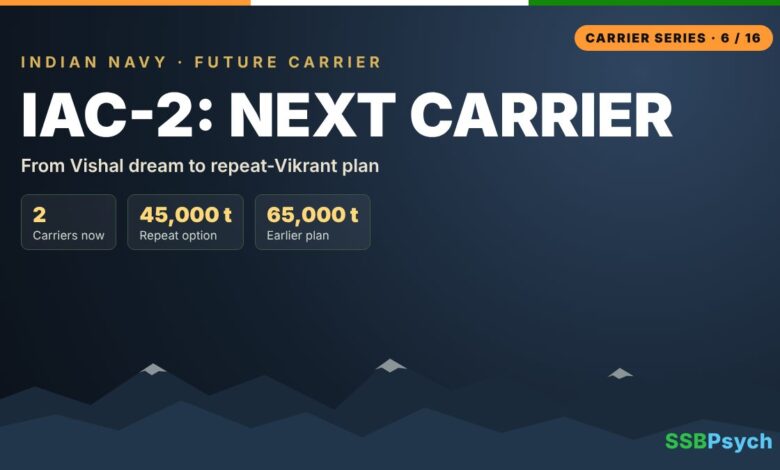
India has two aircraft carriers today, INS Vikramaditya and INS Vikrant. But a warship does not last forever, and carriers take more than ten years to build. So the big question in Indian naval circles is simple: what comes next? The answer has a code name, IAC-2, short for Indigenous Aircraft Carrier-2. Its story is full of twists, from a dream of a 65,000-tonne super-carrier to a more practical plan for a second Vikrant-type ship.
In this explainer we cover why India wants another carrier, what the different plans have been, the debates over size, catapults and nuclear power, the costs that have been reported, and the latest public status as far as we could verify. A perfect topic for SSB group discussions and lecturettes on defence self-reliance.

What Is IAC-2?
IAC-2 means the second aircraft carrier to be designed and built in India, following IAC-1, which became INS Vikrant in 2022. Over the years, Indian media have often called the proposed ship INS Vishal, meaning huge or vast. It is important to remember that this name has been widely reported but the Navy names a ship only when it is ready to be commissioned, so the final name could be different.
IAC-2 is sometimes also called India’s third carrier, because India would then operate three carriers at the same time: Vikramaditya, Vikrant and the new ship. However, as we will see, recent reports suggest IAC-2 may instead replace Vikramaditya when that ship retires, keeping the fleet at two.
Why Does India Want IAC-2?
Navy planners have long argued for three carriers: one for the Arabian Sea, one for the Bay of Bengal, and one in maintenance or reserve. The logic is simple. Every carrier spends months in refit every few years. If you have only two, there are times when only one is available, and in a crisis that may not be enough.
- Ageing ship: INS Vikramaditya was built in the Soviet era and will need replacing in the coming decades.
- Two seaboards: India’s east and west coasts are thousands of kilometres apart by sea.
- Growing Indian Ocean competition: more foreign navies now operate in the region, raising the need for a strong presence.
- Industrial base: Cochin Shipyard and Indian suppliers have learned carrier building with IAC-1; a gap of many years could cause skills to fade.
- Self-reliance: every Indian-built carrier increases local content and reduces dependence on foreign help.
The Big Plan: A 65,000-Tonne IAC-2
The idea of a second home-built carrier was first raised publicly by the Navy chief in 2011. By 2012, reports described a much larger ship of about 65,000 tonnes, almost one and a half times the size of the new Vikrant. More importantly, it was to be a CATOBAR carrier: Catapult Assisted Take-Off But Arrested Recovery.
Why catapults matter
On a ski-jump carrier like Vikrant, jets must take off using only their own engine power plus the push of the ramp. This limits how much fuel and weaponry they can carry. A catapult works like a giant slingshot, flinging the jet to flying speed in about two seconds. That lets heavier aircraft take off, including fixed-wing early-warning planes with big radars, which ski-jump carriers cannot normally operate. In short, catapults make a carrier’s air wing much more powerful.
In 2013, the Navy showed interest in EMALS, the Electromagnetic Aircraft Launch System, which uses electric motors instead of steam. In 2015, India sent requests for design inputs to several foreign shipbuilders and defence firms for a carrier of about 65,000 tonnes, around 300 metres long and faster than 30 knots. In May 2015, the Defence Acquisition Council approved a small initial sum, reported as Rs 30 crore, for early planning. In 2017, the United States reportedly approved the release of EMALS technology for India’s carrier, a sign of growing defence ties.
The Nuclear Power Question
A nuclear-powered carrier can sail for years without refuelling and has more electrical power for catapults and sensors. In 2016, reports suggested the Navy was considering nuclear propulsion for IAC-2. But in 2017, it was reported that the idea had been set aside because developing a suitable reactor could take 15 to 20 years. Instead, an Integrated Full Electric Propulsion system was considered, in which engines produce electricity that drives the propellers and powers everything on board.
The debate has not ended. In September 2025, a defence technology roadmap made public by the Ministry of Defence was reported to include nuclear-powered surface warships, including a carrier, as a long-term goal. This suggests that a nuclear carrier remains an ambition for the more distant future rather than for the next ship.
IAC-2 Plan B: A Repeat of Vikrant
A 65,000-tonne catapult carrier would be very expensive and would take many years to design. In December 2022, the then Navy chief said the Navy could first order a repeat of the Vikrant design, using the experience Cochin Shipyard had just gained. A repeat ship would be faster to build, cheaper per tonne, and easier to maintain because it would share parts and training with Vikrant.
In 2023, reports said a proposal for an improved Vikrant-type carrier of about 45,000 tonnes, with an estimated cost of around Rs 40,000 crore, was moving through the Ministry of Defence’s approval process and had been cleared at an early review stage. In March 2024, reports added that the Navy wanted more Indian content in this ship, with systems such as the arresting gear, restraining gear and the precision approach radar to be developed in India.
Replacing Vikramaditya instead of a third carrier
In February 2025, reports indicated that IAC-2 was being seen as the replacement for INS Vikramaditya, keeping the Navy at a two-carrier force rather than growing to three. This reflects the hard reality of budgets: the Navy also needs submarines, destroyers, frigates and aircraft, and every rupee spent on a carrier is a rupee not spent elsewhere.
How long does it take to build a carrier?
The experience of IAC-1 gives a useful guide. Design work began in 1999, the keel was laid in 2009, the ship was launched in 2013 and it was commissioned in 2022. That is more than two decades from first drawings to service, though much of the delay came from doing everything for the first time. A repeat design could move much faster because the drawings, suppliers and skilled workers already exist. Even so, a new carrier would likely take close to a decade from contract to commissioning, which is why the Navy keeps pushing for an early decision.
What an improved Vikrant-type IAC-2 might change
- Higher indigenous content, including landing and arresting systems made in India, as reported in 2024.
- Lessons from Vikrant’s sea trials and flight operations built into the design from day one.
- An air wing planned around the Rafale M and, later, the Indian TEDBF fighter.
- Possible design changes to improve aircraft handling on deck, though details have not been made public.
What Is the Latest Status of IAC-2?
As of the latest public reports we could verify, no construction contract for IAC-2 has been publicly announced, and the final size, design and timeline have not been officially confirmed. Commentators in 2026 described the project as slow-moving. The most likely path, based on public reporting, is an improved Vikrant-type carrier first, while the larger catapult or nuclear-powered carrier remains a longer-term idea. Readers should watch for an official Defence Acquisition Council or Cabinet approval, which would be the clearest sign that the project is truly moving.
IAC-2 Timeline
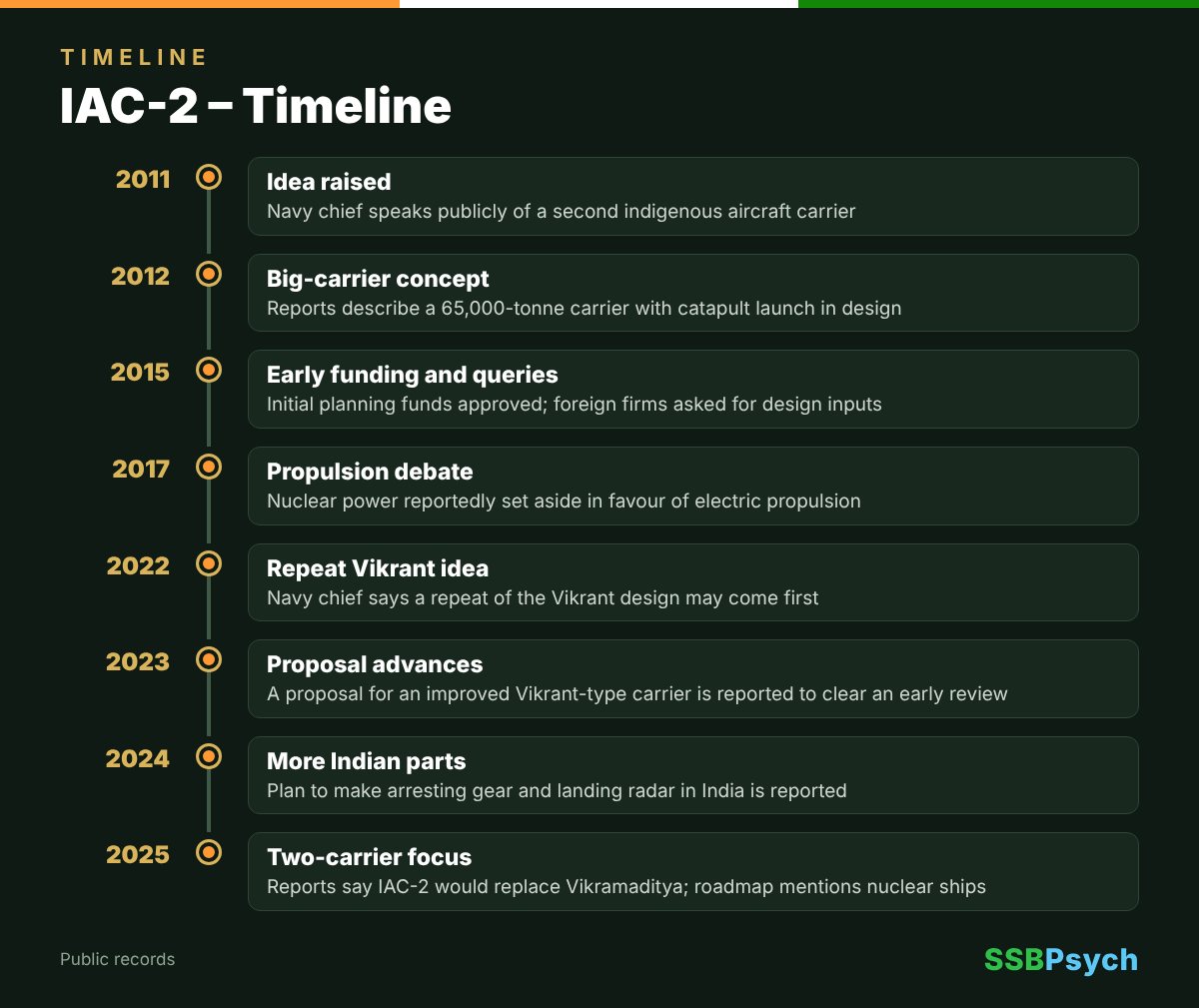
- 2011 – Idea raised: Navy chief speaks publicly of a second indigenous aircraft carrier
- 2012 – Big-carrier concept: Reports describe a 65,000-tonne carrier with catapult launch in design
- 2015 – Early funding and queries: Initial planning funds approved; foreign firms asked for design inputs
- 2017 – Propulsion debate: Nuclear power reportedly set aside in favour of electric propulsion
- 2022 – Repeat Vikrant idea: Navy chief says a repeat of the Vikrant design may come first
- 2023 – Proposal advances: A proposal for an improved Vikrant-type carrier is reported to clear an early review
- 2024 – More Indian parts: Plan to make arresting gear and landing radar in India is reported
- 2025 – Two-carrier focus: Reports say IAC-2 would replace Vikramaditya; roadmap mentions nuclear ships

What Aircraft Would IAC-2 Fly?
A carrier is only as strong as its aircraft. India signed a deal in April 2025 for 26 Rafale M naval fighters from France, with deliveries expected from 2030. These are expected to fly from INS Vikrant first. In the longer term, India is developing its own Twin Engine Deck Based Fighter (TEDBF), intended for carrier service in the late 2030s. Helicopters such as the MH-60R for anti-submarine work and Ka-31 or future platforms for early warning would complete the air wing.
If a future carrier gets catapults, it could also carry heavier aircraft like fixed-wing early-warning planes or large drones, which would greatly increase its reach and awareness. That is one reason why the CATOBAR versus STOBAR question matters so much.
Analysis: The IAC-2 Debate in Simple Terms
Supporters of IAC-2 say carriers give India a unique ability to control the seas, protect trade routes, and respond to crises far from the coast. They point out that China is rapidly expanding its carrier fleet, and that India’s industrial skills from IAC-1 should not be wasted.
Critics say carriers are expensive and could be vulnerable to modern long-range anti-ship missiles. They argue that more submarines and land-based aircraft might give better value. The middle path many experts support is a balanced navy: enough carriers to always have one ready, plus strong submarine and surface fleets.
- For IAC-2: sea control, presence in the Indian Ocean, air cover for the fleet, disaster relief capability, shipbuilding jobs and skills.
- Against or cautious: high cost, long build time, vulnerability debates, competing needs like submarines.
- Practical compromise: build a repeat Vikrant-type ship first, then decide on a larger or nuclear carrier later.
How to use this topic in your SSB group discussion
If the topic is India’s need for a third aircraft carrier, start by explaining what a carrier does, then present both sides: strategic needs versus budget limits. Mention facts like India’s two current carriers, the IAC-2 proposal of about 45,000 tonnes reported in 2023, and the Rafale M order. Conclude with a balanced view, such as building carriers steadily while also strengthening submarines. This shows awareness, logic and maturity, exactly what assessors look for.
Did You Know?
- The name INS Vishal for IAC-2 is widely used by media but has not been officially confirmed.
- An early IAC-2 concept was for a 65,000-tonne carrier with catapults, much larger than the current Vikrant.
- EMALS uses powerful electric motors instead of steam to launch aircraft.
- In 2015, initial planning money for IAC-2 was reported at just Rs 30 crore, a tiny fraction of a carrier’s final cost.
- A repeat Vikrant-type design would let pilots and crews switch between the two ships easily.
- India’s Rafale M jets are expected to start arriving from 2030.
Quiz: Test Your Knowledge of IAC-2
Click an option to see if you are right. Your score updates live.
IAC-2: Frequently Asked Questions
IAC-2 is India’s planned second Indigenous Aircraft Carrier, following INS Vikrant (IAC-1). It has been discussed since 2011, with designs ranging from a 65,000-tonne catapult carrier to an improved 45,000-tonne Vikrant-type ship.
As of the latest public reports we could verify, a proposal advanced through early Ministry of Defence reviews in 2023, but no construction contract has been publicly announced and the final design is not officially confirmed.
Not likely for the next ship. Nuclear propulsion was reportedly set aside in 2017, though a 2025 defence technology roadmap mentioned nuclear surface ships, including a carrier, as a long-term goal.
No. INS Vishal is a name widely used in media reports. The Navy announces a ship’s official name closer to commissioning.
Reports in 2023 cited about Rs 40,000 crore for an improved Vikrant-type carrier. Costs for a larger catapult or nuclear design would be much higher, and no official final figure has been released.
This is part 6 of 16 in SSBPsych’s Indian Navy aircraft carrier series – a new post every day at 2 PM.
Sources: en.wikipedia.org, en.wikipedia.org, en.wikipedia.org, en.wikipedia.org.
Preparing for NDA, CDS, AFCAT or your SSB? Join SSBPsych’s online and offline batches – explore our courses or call +91 8076540582.