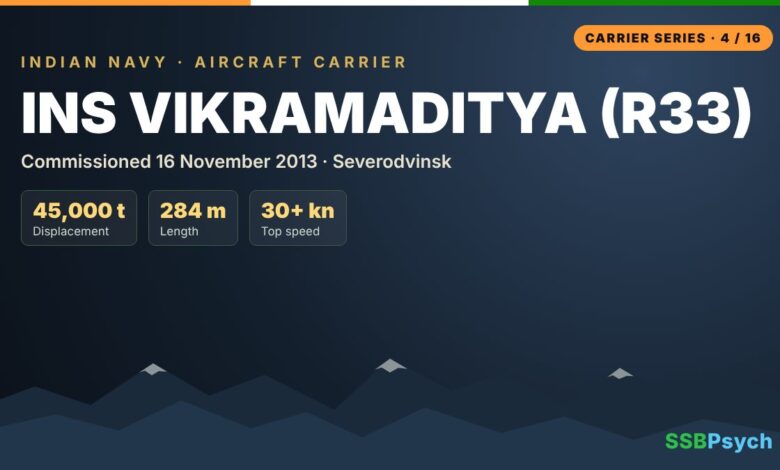
INS Vikramaditya (R33): Ex-Admiral Gorshkov Carrier Explained
Picture a ship longer than two and a half football fields, about as tall as a 20-storey building from keel to mast top, carrying supersonic fighter jets that leap off a curved ramp into the sky. That is INS Vikramaditya, the longest ship in the Indian Navy. It began life as a Soviet warship, sat idle for years, and was then rebuilt from the inside out in a Russian shipyard to become an Indian airbase at sea.
In this guide we cover its origin, the long and costly rebuild, why it is named after a legendary emperor, its specifications, fuel and endurance, aircraft, crew, cost and its missions. Defence aspirants preparing for NDA, CDS, AFCAT and the SSB interview will find all the key facts in one place.

Origin of INS Vikramaditya: The Soviet Ship Baku
The story begins in the Soviet Union. A large warship named Baku was laid down in 1978 at a shipyard on the Black Sea in Nikolayev, now Mykolaiv in Ukraine. It was a Kiev-class ship, a strange mix of cruiser and carrier. The front half carried heavy anti-ship and anti-aircraft missiles, while the back half had a flight deck for vertical take-off jets and helicopters.
Baku was launched in 1982 and entered service in 1987. After the Soviet Union broke up in 1991, it was renamed Admiral Gorshkov, after a famous Soviet naval chief. But Russia’s navy was short of money in the 1990s, and running such a big ship was too expensive. By 1996 it was taken out of active service.
The Deal: Why India Chose Admiral Gorshkov
In the early 2000s India had only one carrier, the ageing INS Viraat. Building a new carrier at home would take many years. Russia offered Admiral Gorshkov on special terms: the ship itself would be given free, but India would pay for a complete rebuild into a proper aircraft carrier, plus new jets. The agreement was signed on 20 January 2004.
The rebuild took place at the Sevmash shipyard in Severodvinsk, in Russia’s far north. It turned out to be far bigger than expected. The missiles and guns on the front deck were removed, a full-length flight deck was built, a ski-jump was added at the bow, arrester wires were fitted, the boilers were replaced and kilometres of new cabling were laid. The amount of cabling needed had been badly underestimated, which was one major cause of delays.
Cost of INS Vikramaditya
As work grew, so did the bill. Russia asked for more money, and after long negotiations the two governments settled on a refit price of about 2.35 billion US dollars in March 2010. This was for the ship’s refurbishment; the MiG-29K jets were bought under a separate deal. India’s Comptroller and Auditor General criticised the purchase, arguing that a second-hand ship had become very expensive. Supporters replied that it gave India a large carrier years before a home-built one could be ready.
The boiler setback
In September 2012, during sea trials, reports said that seven of the eight boilers had developed problems. Delivery was pushed back by about a year. Sea trials finally finished in July 2013, with the ship reportedly reaching a top speed of about 32 knots, followed by flying trials in September 2013.
Commissioning: When and Where
INS Vikramaditya was commissioned on 16 November 2013 at Severodvinsk, Russia, in the presence of India’s then Defence Minister A. K. Antony. It sailed for India later that month, crossing the Atlantic, the Mediterranean and the Arabian Sea, and reached its home port of Karwar in Karnataka on 7 January 2014. Prime Minister Narendra Modi formally dedicated the ship to the nation on 14 June 2014.
Why the Name Vikramaditya?
The ship is named after Vikramaditya, a legendary Indian emperor famous in folk tales for his bravery, wisdom and justice, including the well-known stories of Vikram and Betaal. The name itself combines vikrama (valour) and aditya (the sun), roughly meaning as brave and bright as the sun. Its pennant number is R33.
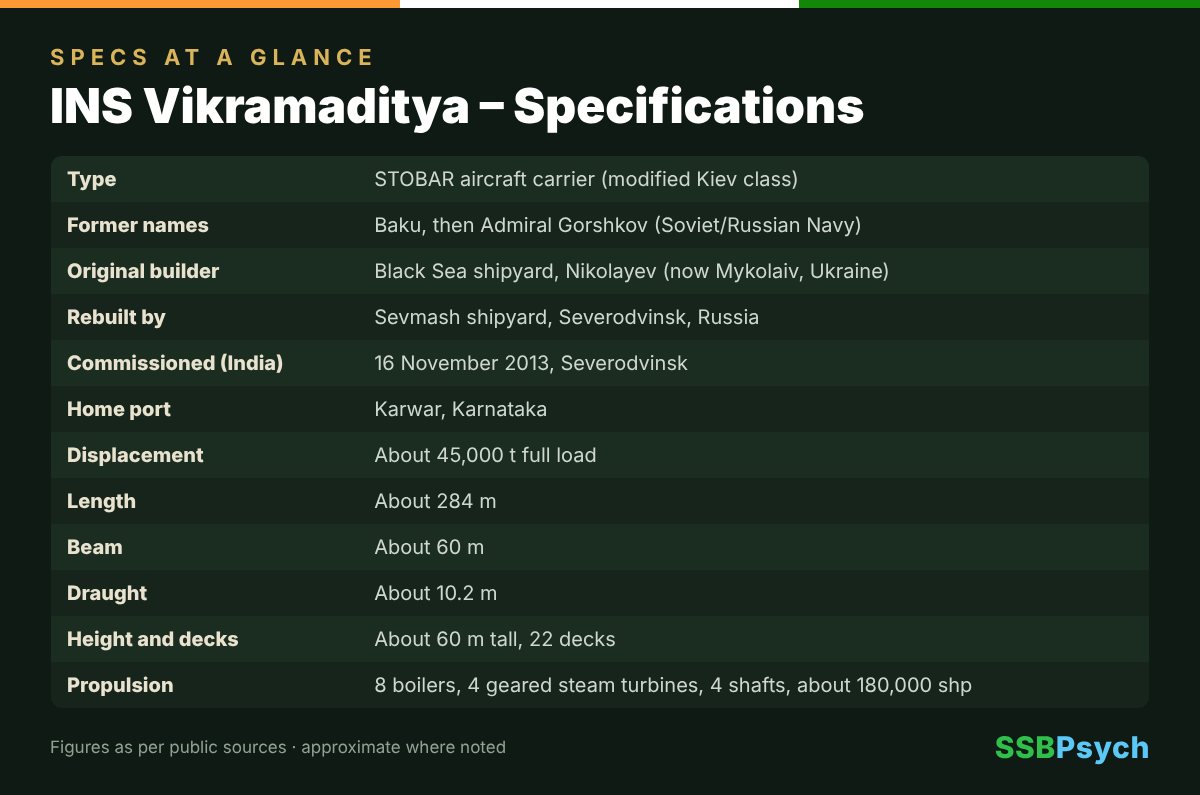
INS Vikramaditya Specifications
| Type | STOBAR aircraft carrier (modified Kiev class) |
| Former names | Baku, then Admiral Gorshkov (Soviet/Russian Navy) |
| Original builder | Black Sea shipyard, Nikolayev (now Mykolaiv, Ukraine) |
| Rebuilt by | Sevmash shipyard, Severodvinsk, Russia |
| Commissioned (India) | 16 November 2013, Severodvinsk |
| Home port | Karwar, Karnataka |
| Displacement | About 45,000 t full load |
| Length | About 284 m |
| Beam | About 60 m |
| Draught | About 10.2 m |
| Height and decks | About 60 m tall, 22 decks |
| Propulsion | 8 boilers, 4 geared steam turbines, 4 shafts, about 180,000 shp |
| Speed | Over 30 knots (55+ km/h) |
| Range / endurance | About 13,500 nautical miles at 18 knots; about 45 days |
| Crew | About 1,600 (around 110 officers and 1,500 sailors) |
| Aircraft | Up to about 34 aircraft: MiG-29K fighters, Kamov helicopters |
What these numbers really mean
At about 284 metres long, Vikramaditya is longer than two and a half football fields. Its height of about 60 metres is spread over 22 decks. It weighs around 45,000 tonnes when fully loaded, which is roughly the weight of 35,000 small cars. Eight boilers drive four turbines producing about 180,000 shaft horsepower, enough to push the giant at over 30 knots, or more than 55 km per hour.
INS Vikramaditya Timeline
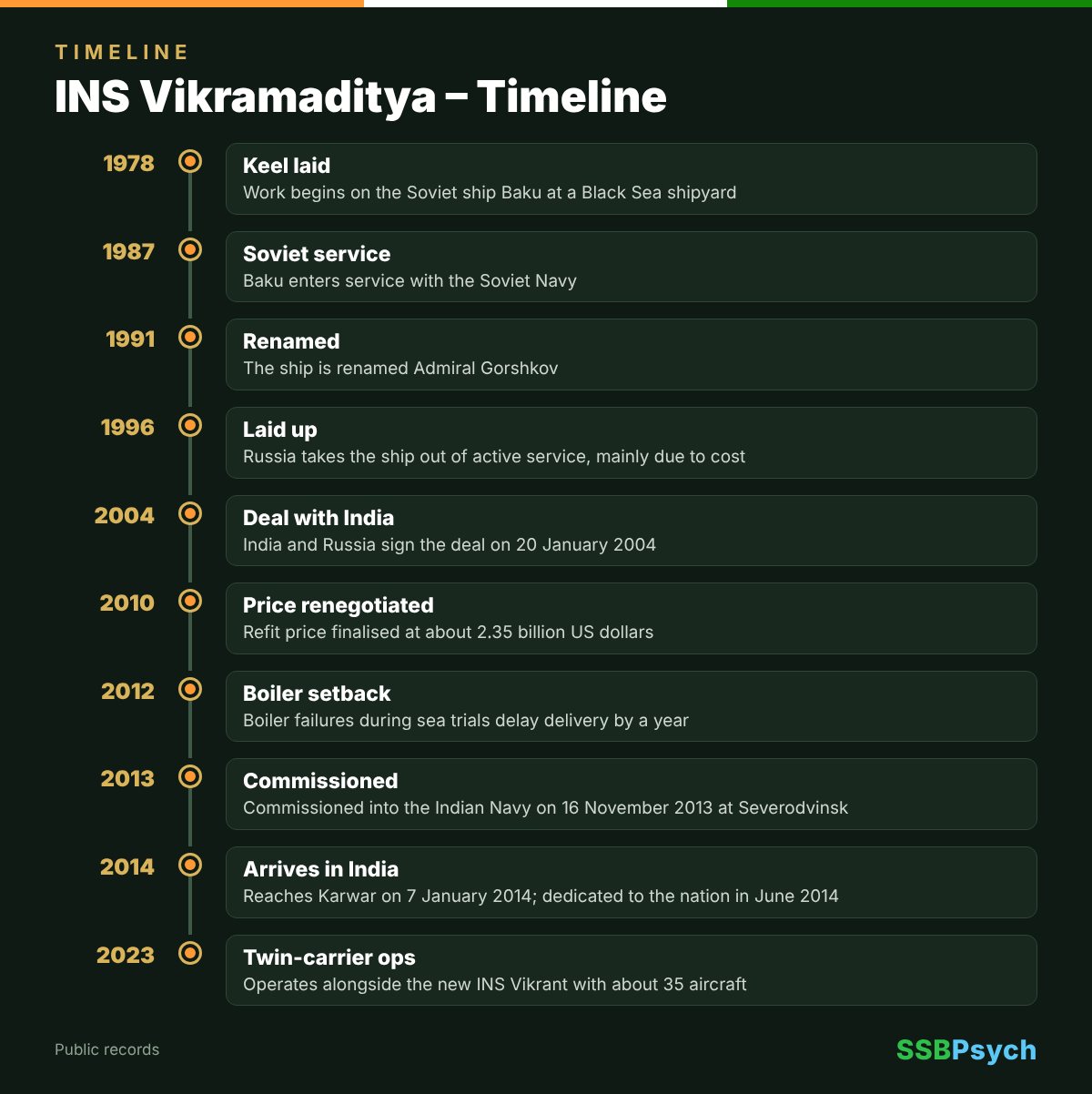
- 1978 – Keel laid: Work begins on the Soviet ship Baku at a Black Sea shipyard
- 1987 – Soviet service: Baku enters service with the Soviet Navy
- 1991 – Renamed: The ship is renamed Admiral Gorshkov
- 1996 – Laid up: Russia takes the ship out of active service, mainly due to cost
- 2004 – Deal with India: India and Russia sign the deal on 20 January 2004
- 2010 – Price renegotiated: Refit price finalised at about 2.35 billion US dollars
- 2012 – Boiler setback: Boiler failures during sea trials delay delivery by a year
- 2013 – Commissioned: Commissioned into the Indian Navy on 16 November 2013 at Severodvinsk
- 2014 – Arrives in India: Reaches Karwar on 7 January 2014; dedicated to the nation in June 2014
- 2023 – Twin-carrier ops: Operates alongside the new INS Vikrant with about 35 aircraft
How Jets Fly From INS Vikramaditya: STOBAR Explained
Vikramaditya is a STOBAR carrier, which means Short Take-Off But Arrested Recovery. A MiG-29K fighter holds its position with its brakes on while its engines roar to full power. Small restraining blocks hold it in place. When released, it races a short distance down the deck and shoots up the ski-jump, a curved ramp of roughly 14 degrees, which throws its nose upward like a skier off a slope.
Landing is even more dramatic. The jet approaches at high speed with a strong hook hanging under its tail. The hook catches one of three arrester wires stretched across the deck, which stop the heavy fighter within a few seconds. If the hook misses all wires, the pilot pushes the throttle forward and takes off again for another try.
Aircraft, Weapons and Sensors
- Mikoyan MiG-29K and MiG-29KUB multirole fighters
- Kamov Ka-31 airborne early-warning helicopters
- Kamov Ka-28 anti-submarine helicopters
- Indian Navy utility helicopters such as Chetak and Dhruv
- Barak-1 surface-to-air missile system (fitted after 2015)
- AK-630 close-in weapon systems (original fit)
- About 14-degree ski-jump and three arrester wires
- Modern air-search radars and landing aids installed during the Russian rebuild
Why India Needed INS Vikramaditya
When Vikramaditya arrived, INS Viraat was already more than 50 years old counting from its launch. India needed a modern carrier that could fly supersonic fighters, not just jump jets. Vikramaditya gave the Navy the MiG-29K, a far more capable aircraft with longer range and better radar. It also trained pilots and deck crews in STOBAR operations, the same method later used on the home-built INS Vikrant. Without Vikramaditya, the move to the new Vikrant would have been much harder.
Operations and Missions
- Jan 2014 – First two-carrier drill in decades: Sailed with INS Viraat as part of a Western Fleet group
- 2016 – First overseas visits: Visited Colombo and Male in early 2016
- Jan 2020 – LCA Navy deck trials: Hosted the first carrier trials of the naval version of the Tejas
- Jun 2023 – Twin-carrier operations: Operated with INS Vikrant and about 35 aircraft in the Arabian Sea
- Feb 2024 – Exercise Milan 2024: Took part alongside INS Vikrant in the multinational exercise
- Oct 2024 – Exercise with Italy: Joined drills with the Italian carrier Cavour

Crew, Fuel and Endurance
Around 1,600 people live and work on board, including about 110 officers. The ship is reported to have an endurance of around 45 days, meaning it carries enough food and stores for about six weeks at sea, and a range of about 13,500 nautical miles at a cruising speed of 18 knots. That is enough to sail from Karwar to Australia and back without stopping, at least in theory. In practice it travels with escorts and a fleet tanker that refuels the group at sea.
As with every Indian carrier, the ship is commanded by an officer of Captain rank, supported by department heads for aviation, engineering, electrical, weapons, logistics and medical services. The kitchens prepare thousands of meals every day, and the ship carries its own hospital facilities and fresh-water plants.
Refits and challenges
Big ships need regular care. Vikramaditya had a short refit at Karwar in 2015, a dry-dock refit at Cochin Shipyard in 2016, and in November 2024 the Ministry of Defence signed a contract with Cochin Shipyard for a further refit, reported at about Rs 1,207 crore. Its service life has not been free of tragedy: a toxic gas leak during a 2016 refit and a boiler-room fire in April 2019 cost lives. These incidents remind us that life on a warship carries real risk even in peacetime.
Two Carriers Together: The Power of a Pair
In June 2023, INS Vikramaditya and the new INS Vikrant sailed together in the Arabian Sea with about 35 aircraft, including MiG-29K fighters and helicopters. This kind of twin-carrier operation is rare; only a few navies in the world can do it. Running two flight decks at once means more jets in the air for longer periods, and if one deck has a problem, aircraft can land on the other.
Each carrier sails at the heart of a Carrier Battle Group. Destroyers and frigates form a protective ring, watching for enemy aircraft, missiles and ships. Submarines and anti-submarine helicopters hunt hidden threats below the surface. A fleet tanker keeps everyone supplied with fuel. The Ka-31 helicopter, with its large radar, acts like a flying watchtower, spotting low-flying threats far beyond the horizon that ship radars cannot see.
Life on board INS Vikramaditya
With 22 decks and around 1,600 people on board, getting lost is easy for a new sailor. The ship has its own galleys, bakery, laundry, gym, medical facilities and a sophisticated communication centre. Fresh water is made from sea water by special plants, and large generators produce electricity for radars, lights, air conditioning and kitchens. During flying, the flight deck becomes the busiest and most dangerous place on the ship, with jet blast, spinning rotors and fuel lines everywhere, so every person on deck follows strict safety drills.
For young officers, a posting on a carrier is a chance to see how hundreds of specialists work as one team. That is a quality the SSB looks for too: the ability to plan, cooperate and stay calm when many things are happening at once.
INS Vikramaditya: Analysis and Future
Vikramaditya proved both the value and the cost of buying a second-hand ship. It arrived late and over budget, yet it gave India a big-deck carrier with modern fighters at a crucial time. With the new INS Vikrant now in service, India has two carriers, one of which can be ready while the other is under repair. Public reports suggest the ship is expected to keep serving into the 2030s, and the Navy’s plans for a second home-built carrier are partly about replacing Vikramaditya when it retires.
Quick revision for exams: INS Vikramaditya is ex-Admiral Gorshkov (originally Baku), a STOBAR carrier rebuilt at Sevmash, commissioned on 16 November 2013 at Severodvinsk, based at Karwar, about 284 metres long, and flies MiG-29K fighters. Its refurbishment price was settled at about 2.35 billion US dollars in 2010. Remember these anchors and you can answer most questions on this ship with confidence, whether in a written paper or a personal interview.
Did You Know?
- INS Vikramaditya is the longest ship in the Indian Navy at about 284 metres.
- It originally carried heavy anti-ship missiles on its front deck, all removed during the rebuild.
- It has 22 decks, more than many tall buildings have floors.
- In January 2020, the naval version of the home-built Tejas made its first carrier landing on Vikramaditya.
- The ship sailed from the Arctic coast of Russia to Karwar in India to reach its home port.
- Its name honours the legendary King Vikramaditya of the Vikram and Betaal tales.
Quiz: Test Your Knowledge of INS Vikramaditya
Click an option to see if you are right. Your score updates live.
INS Vikramaditya: Frequently Asked Questions
INS Vikramaditya (R33) is an Indian Navy aircraft carrier, formerly the Soviet and Russian ship Baku and Admiral Gorshkov. It was rebuilt in Russia and commissioned on 16 November 2013.
In March 2010 India and Russia agreed a refurbishment price of about 2.35 billion US dollars. The MiG-29K jets were purchased under a separate contract.
It can carry up to about 34 aircraft, mainly MiG-29K fighters along with Kamov Ka-31 and Ka-28 helicopters and smaller utility helicopters.
Vikramaditya is longer at about 284 metres compared with about 262 metres for the new Vikrant, while both displace around 45,000 tonnes.
Its home port is Karwar in Karnataka, on India’s western coast.
This is part 4 of 16 in SSBPsych’s Indian Navy aircraft carrier series – a new post every day at 2 PM.
Sources: en.wikipedia.org, en.wikipedia.org.
Preparing for NDA, CDS, AFCAT or your SSB? Join SSBPsych’s online and offline batches – explore our courses or call +91 8076540582.