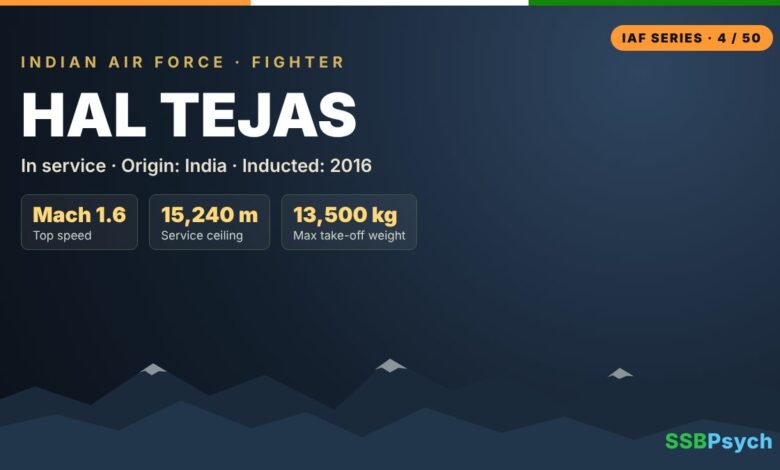
Tejas Fighter Jet in Indian Air Force: Specs, Missiles, History
Every Indian can be proud of one fighter jet in particular: the Tejas. Designed and built in India, this small, sharp, delta-winged fighter is the result of decades of hard work by Indian scientists, engineers and test pilots. Its name means “radiant” or “brilliant” in Sanskrit, and today it flies with Indian Air Force squadrons and is set to become one of the most numerous fighters in the IAF.
In this guide we cover the Tejas in simple, clear words: its specifications, how fast and how high it flies, the missiles it carries, its long journey from drawing board to squadron, the missions it has flown, where it is based and what the Mk1A and Mk2 versions will bring. Finish with the 10-question quiz and FAQ to prepare for your NDA, CDS, AFCAT or SSB.

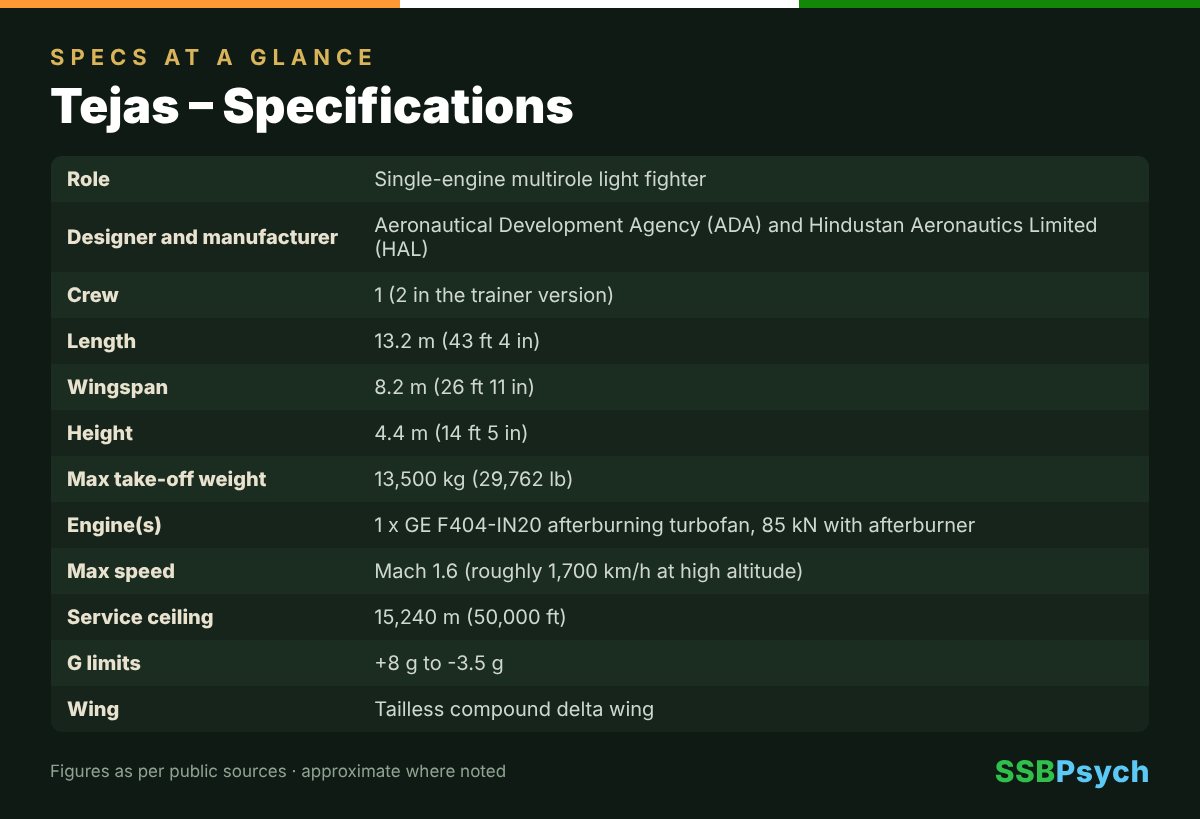
Tejas Specifications
| Role | Single-engine multirole light fighter |
| Designer and manufacturer | Aeronautical Development Agency (ADA) and Hindustan Aeronautics Limited (HAL) |
| Crew | 1 (2 in the trainer version) |
| Length | 13.2 m (43 ft 4 in) |
| Wingspan | 8.2 m (26 ft 11 in) |
| Height | 4.4 m (14 ft 5 in) |
| Max take-off weight | 13,500 kg (29,762 lb) |
| Engine(s) | 1 x GE F404-IN20 afterburning turbofan, 85 kN with afterburner |
| Max speed | Mach 1.6 (roughly 1,700 km/h at high altitude) |
| Service ceiling | 15,240 m (50,000 ft) |
| G limits | +8 g to -3.5 g |
| Wing | Tailless compound delta wing |
| First flight | 4 January 2001 (Technology Demonstrator TD-1) |
| Inducted in IAF | 1 July 2016 (No. 45 Squadron) |
| Number in IAF | 40 Tejas Mk1 delivered (32 fighters, 8 trainers); two lost in crashes |
| On order | 180 Tejas Mk1A (83 ordered in 2021, 97 in 2025) |
What Is the Tejas?
The Tejas is a single-engine, multirole Light Combat Aircraft (LCA). It was designed by the Aeronautical Development Agency (ADA) under the Ministry of Defence and is built by Hindustan Aeronautics Limited (HAL) in Bengaluru. It is described as one of the smallest and lightest supersonic fighters of its generation.
Look at a Tejas and you will notice it has no tail wings at the back. Instead it uses a large compound delta wing, a triangle-shaped wing with two different sweep angles. It is also deliberately built to be slightly unstable, a design called relaxed static stability. That sounds risky, but a computer-controlled fly-by-wire system makes thousands of tiny corrections every second, so the jet feels smooth to the pilot and can turn very sharply. Much of its body is made of light, strong composite materials instead of metal.
Inside, the pilot sits in a glass cockpit, where old-style dials are replaced by colourful multi-function screens, much like a smartphone compared with an old wall clock. A head-up display projects speed, height and targeting information onto a glass panel in front of the pilot’s eyes, so they can keep looking outside while flying and fighting. Many of these systems were developed in Indian laboratories, which is a big part of why the Tejas matters so much.
Why India Needed the Tejas
In the 1980s, India’s most numerous fighter was the Soviet-designed MiG-21. Planners knew it would need replacing, and they also wanted India to stop depending entirely on foreign fighters. The Light Combat Aircraft programme was born, and ADA was set up in 1984 to lead it. The goal was bold: design a modern fighter from scratch in a country that had built only a few combat jets before.
The journey was long. Indian teams had to master fly-by-wire flight controls, composite structures, glass cockpits and much more, often while facing technology sanctions. India also tried to develop its own engine, the Kaveri, but it could not deliver enough power in time, so the Tejas uses the American GE F404 engine.
Behind every test flight were brave test pilots at ADA’s National Flight Test Centre, many of them from the IAF, who flew early prototypes to find and fix problems before squadron pilots ever touched the jet. Hundreds of engineers in public sector units, private companies and research labs worked on parts such as the radar, flight controls and landing gear. The Tejas is truly a team effort of the whole country.
History of the Tejas in the IAF
The first Technology Demonstrator, TD-1, took off from Bengaluru on 4 January 2001, a landmark day for Indian aviation. In 2003 the aircraft was named “Tejas” by then Prime Minister Atal Bihari Vajpayee. Years of testing followed, with the jet earning Initial Operational Clearance in stages in 2011 and 2013. The first Tejas was handed over to the IAF on 17 January 2015.
On 1 July 2016, No. 45 Squadron, the “Flying Daggers”, became the first IAF unit to fly the Tejas. The jet received Final Operational Clearance on 20 February 2019 at Aero India, adding features like the internal gun and mid-air refuelling. On 27 May 2020, No. 18 Squadron, the “Flying Bullets”, was formed with the first FOC-standard jets. The IAF had ordered 40 Tejas Mk1 jets in two batches of 20, and HAL handed over the last two trainers in September 2026, completing the order.
The Tejas has had two crashes so far. On 12 March 2024, a Tejas came down near Jaisalmer in Rajasthan, and the pilot ejected safely; reports later linked it to an engine problem. On 21 November 2025, a Tejas crashed during a display at the Dubai Airshow, killing its pilot. For a fighter that had flown for over two decades without a crash, these were rare and painful events.
Engine and Performance Explained Simply
The Tejas Mk1 is powered by one GE F404-IN20 afterburning turbofan engine, giving about 85 kilonewtons of thrust with the afterburner on. The afterburner sprays extra fuel into the exhaust for a big burst of power, a bit like a boost button, used for take-off, quick climbs and high speed.
Top speed: Mach 1.6, which is 1.6 times the speed of sound, or roughly 1,700 km/h at high altitude. That is more than five times faster than a bullet train running at 320 km/h. At that pace, the Tejas could fly from Bengaluru to Chennai, about 300 km, in roughly ten minutes.
Service ceiling: 50,000 feet, or about 15,240 metres. The service ceiling is the highest altitude at which the aircraft can still fly and climb usefully. That is more than one and a half times the height of Mount Everest.
Size and weight: The Tejas is just 13.2 metres long, about three and a half hatchback cars in a row, with a wingspan of 8.2 metres. Its maximum take-off weight is 13.5 tonnes, which is roughly a third of a fully loaded Su-30MKI. Being small makes it harder to spot, both by eye and on some radars.
Agility: The Tejas is cleared to pull up to 8 g, meaning the pilot feels eight times their own body weight pressing down in a tight turn. Pilots wear special g-suits and train hard to stay conscious under such forces.
Weapons and Missiles
- Derby beyond-visual-range air-to-air missile
- Python-5 close-combat air-to-air missile
- R-73 close-combat air-to-air missile
- Astra Indian beyond-visual-range air-to-air missile (tested on Tejas Mk1A)
- ASRAAM close-combat air-to-air missile (tested on Tejas Mk1A)
- Laser-guided bombs and other precision ground-attack weapons
- 23 mm GSh-23 twin-barrel internal cannon
For air combat, the Tejas carries Israeli Derby missiles for beyond-visual-range fights and Python-5 and R-73 missiles for close dogfights. The newer Mk1A has been tested with India’s own Astra missile and the British ASRAAM. For ground attack it can carry laser-guided bombs, and it has a 23 mm twin-barrel cannon for close-in fighting. At Vayu Shakti 2024 it showed this swing-role ability, switching between missile and bomb attacks in the same show.
Tejas Missions and Operations
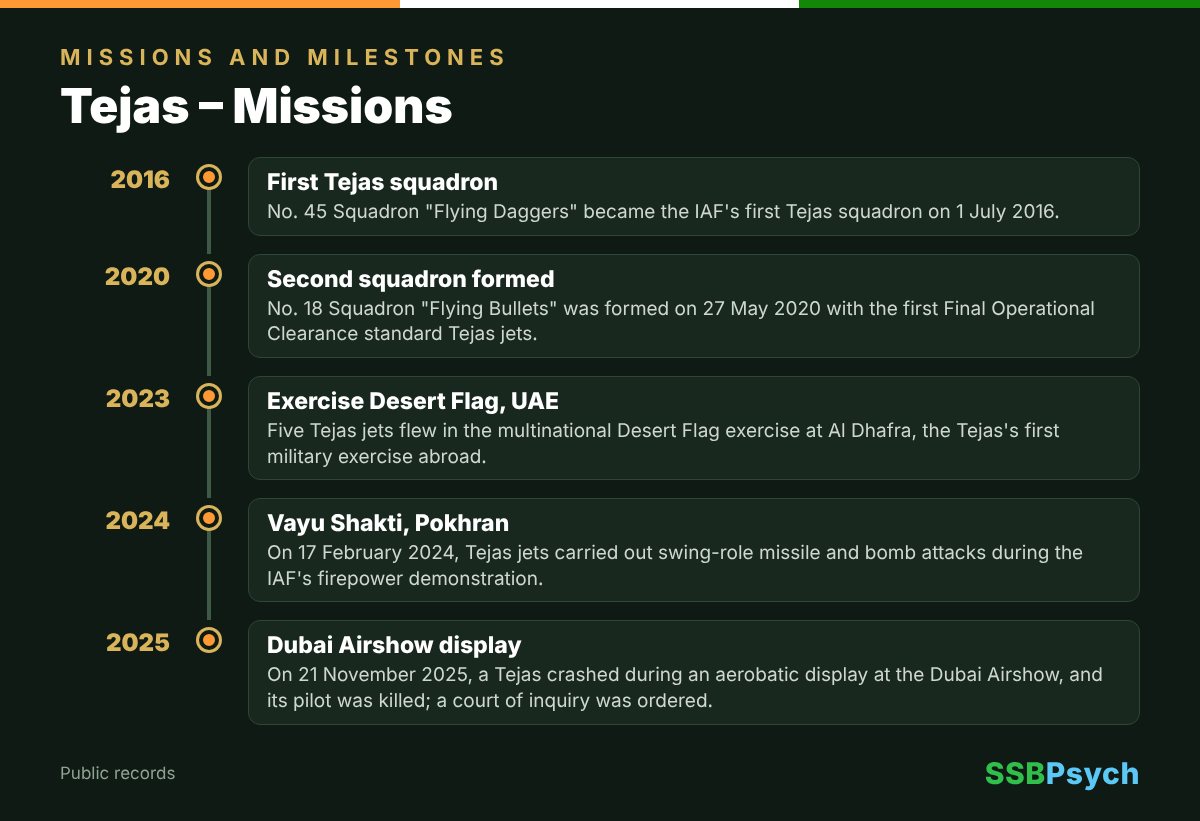
- 2016 – First Tejas squadron: No. 45 Squadron “Flying Daggers” became the IAF’s first Tejas squadron on 1 July 2016.
- 2020 – Second squadron formed: No. 18 Squadron “Flying Bullets” was formed on 27 May 2020 with the first Final Operational Clearance standard Tejas jets.
- 2023 – Exercise Desert Flag, UAE: Five Tejas jets flew in the multinational Desert Flag exercise at Al Dhafra, the Tejas’s first military exercise abroad.
- 2024 – Vayu Shakti, Pokhran: On 17 February 2024, Tejas jets carried out swing-role missile and bomb attacks during the IAF’s firepower demonstration.
- 2025 – Dubai Airshow display: On 21 November 2025, a Tejas crashed during an aerobatic display at the Dubai Airshow, and its pilot was killed; a court of inquiry was ordered.
Desert Flag was a special moment. For the first time, an Indian-designed fighter flew alongside jets from countries such as France, the UK, the USA and Australia in complex air combat drills, far from home. Taking part in such exercises helps pilots test their skills and tactics against different aircraft, and it shows the world that India can design, build and operate its own modern fighter. Air shows abroad also give the Tejas valuable international exposure as India looks for export customers.

Where the Tejas Is Based and Who Flies It
As publicly reported, No. 45 Squadron “Flying Daggers” flies the Tejas from Sulur near Coimbatore in Tamil Nadu, and No. 18 Squadron “Flying Bullets” is based at Naliya in Gujarat, close to the western border. Reports in 2026 said the first Tejas Mk1A squadron is planned to be No. 3 Squadron “Cobras” at Nal near Bikaner in Rajasthan, replacing the MiG-21.
As in other fighter units, a Tejas squadron is usually commanded by a Wing Commander, with Squadron Leaders as flight commanders and Flight Lieutenants and Flying Officers as line pilots. The Air Force Station itself is led by a senior officer, often an Air Commodore or Group Captain.
To fly a Tejas, you first join the IAF flying branch through NDA, CDS or AFCAT. At the Air Force Academy, Dundigal, and other training establishments, cadets progress broadly from the Pilatus PC-7 Mk II basic trainer to jet trainers like the Kiran and the Hawk, and are commissioned after roughly one and a half to two years. Further conversion training then prepares them for a frontline fighter such as the Tejas.
Strengths and Limitations of the Tejas
- Strength: Designed and built in India, supporting self-reliance and local industry.
- Strength: Small size and composite body make it light, agile and harder to spot.
- Strength: Modern fly-by-wire controls and glass cockpit, with mid-air refuelling in the FOC version.
- Strength: Lower operating cost than heavy twin-engine fighters.
- Limitation: Single engine and small size mean less range and payload than heavy fighters.
- Limitation: It depends on an imported American engine, and engine supply delays have slowed the Mk1A.
- Limitation: Long development and production delays mean the IAF has only two Tejas squadrons so far.
Future of the Tejas: Mk1A and Mk2
The big future of the Tejas lies in the Mk1A, an improved version with an AESA radar, a better electronic warfare suite and easier maintenance. The IAF ordered 83 in February 2021 and another 97 in September 2025, for a total of 180. The first production Mk1A flew on 28 March 2024, but deliveries were delayed mainly by GE engine supply problems and integration work. As of September 2026, HAL was still working to begin Mk1A deliveries to the IAF.
Further ahead is the Tejas Mk2, a larger and more powerful medium-weight fighter with the GE F414 engine, more weapon stations and canard foreplanes. If these programmes succeed, Tejas variants could fill many of the squadrons left empty by retiring MiG-21s, Jaguars and MiG-29s.
Why the Tejas Matters for SSB and AFCAT Aspirants
The Tejas is one of the most popular topics in defence general knowledge. AFCAT and CDS papers often ask about its first flight, squadrons, engine or designer, and at the SSB it is a natural topic for lecturettes on “Make in India” or “Self-reliance in defence”. Being able to talk about both its achievements and its delays shows mature, balanced thinking, which is exactly what assessors want to see.
Did You Know?
- The first Tejas, TD-1, flew on 4 January 2001.
- The name “Tejas” means “radiant” in Sanskrit.
- No. 45 Squadron “Flying Daggers” was the first Tejas squadron.
- The Tejas has no horizontal tail; it uses a compound delta wing.
- In 2023, the Tejas took part in a foreign exercise for the first time, Desert Flag in the UAE.
- The IAF has ordered 180 Tejas Mk1A jets.
- The Tejas Mk2 will use the more powerful GE F414 engine.
Quiz: Test Your Knowledge of Tejas
Click an option to see if you are right. Your score updates live.
Tejas: Frequently Asked Questions
The Tejas can fly at up to Mach 1.6, which is about 1,700 km/h at high altitude.
The Tejas was designed by the Aeronautical Development Agency (ADA) and is built by Hindustan Aeronautics Limited (HAL) in Bengaluru.
The IAF flies two Tejas Mk1 squadrons: No. 45 “Flying Daggers” at Sulur and No. 18 “Flying Bullets” at Naliya. More squadrons are planned with the Mk1A.
The Mk1A is an improved version with an AESA radar, a better electronic warfare suite and easier maintenance. The IAF has ordered 180 of them.
The first Tejas was handed over in January 2015, and No. 45 Squadron became the first operational Tejas unit on 1 July 2016.
This is part 4 of 50 in SSBPsych’s Indian Air Force aircraft series – a new aircraft every evening at 6 PM.
Sources: en.wikipedia.org, ddpmod.gov.in, theprint.in, business-standard.com, tribuneindia.com.
Preparing for NDA, CDS, AFCAT or your SSB? Join SSBPsych’s online and offline batches – explore our courses or call +91 8076540582.