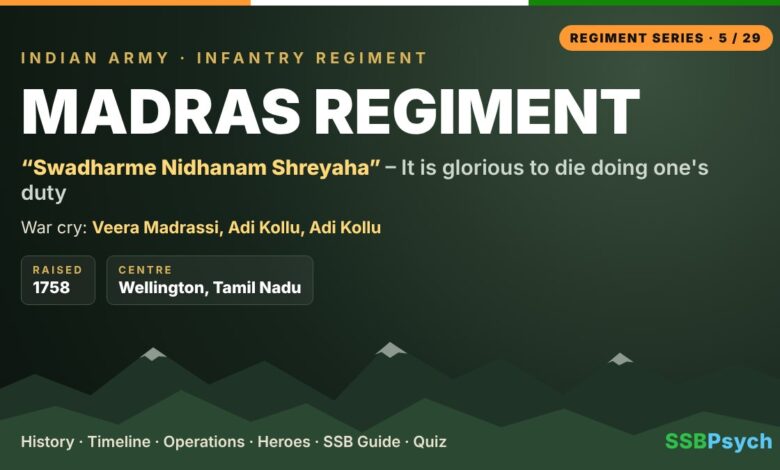
Madras Regiment: History, Motto, War Cry, Battles and Heroes
If you want to understand how the Indian Army began, start with the Madras Regiment. Raised in 1758, it is the oldest infantry regiment of the Indian Army, with roots that go back even further through its oldest battalion. Its soldiers, affectionately called the Thambis, come mainly from South India, and its war cry, Veera Madrassi, Adi Kollu, has rung out on battlefields from Assaye to Basantar.
This guide for NDA, CDS, AFCAT, TES and SSB aspirants covers the regiment’s history, a visual timeline, major operations and battle honours, its insignia, motto and war cry, its heroes, and life in the regiment. We finish with SSB-focused tips, likely interview questions and a 10-question quiz.
Madras Regiment – Quick Facts
| Raised | 1758, from the Madras Levies, under Major Stringer Lawrence |
| Distinction | Oldest infantry regiment of the Indian Army |
| Regimental Centre | Wellington, near Ooty in the Nilgiris, Tamil Nadu |
| Motto | Swadharme Nidhanam Shreyaha (It is glorious to die doing one’s duty) |
| War Cry | Veera Madrassi, Adi Kollu, Adi Kollu (Brave Madrassi, strike and kill) |
| Insignia | The Assaye elephant on a shield with crossed swords |
| Nickname | Thambis (younger brothers) |
| Recruitment | Tamil Nadu, Kerala, Karnataka, Andhra Pradesh and Telangana |
| Battalions | Over 20 regular battalions, plus RR and TA battalions |
| Notable gallantry | Ashok Chakra and several Maha Vir Chakras |
History of the Madras Regiment
In the mid-eighteenth century, the East India Company was fighting rival powers for control of South India. In 1758, Major Stringer Lawrence, often called the father of the Indian Army, organised the local Madras Levies into regular battalions. These were the first steps towards a disciplined Indian infantry force, and they make the Madras Regiment the senior infantry regiment of today’s Army.
The regiment’s battalions fought in many of the major campaigns of that era, including the Carnatic wars and the wars against Mysore and the Marathas. Famous commanders such as Robert Clive and Arthur Wellesley, the future Duke of Wellington, led Madras troops. At the Battle of Assaye in 1803, Madras infantry played a key role in a hard-fought victory, which is why an elephant, the Assaye elephant, became part of the regimental badge.
The regiment’s oldest battalion is even older than 1758. Today’s 9 Madras traces its roots to the Nair Brigade of the Kingdom of Travancore, raised in 1704. After Independence, units of the former princely states of Travancore, Cochin and Mysore joined the regiment as the 9th, 16th, 17th and 18th Battalions, adding their own proud histories.
During British rule, the Madras battalions went through many changes. In the late nineteenth and early twentieth centuries, recruitment from the south was sharply reduced, and many Madras units were disbanded or converted. The regiment as we know it was re-formed during the Second World War, when the need for more soldiers brought South Indian recruitment back, and after Independence it grew steadily. Its home is at Wellington, in the Nilgiri hills near Ooty in Tamil Nadu, where the Madras Regimental Centre trains its recruits in a beautiful but demanding hill setting.
Madras Regiment Timeline: From Raising to Today
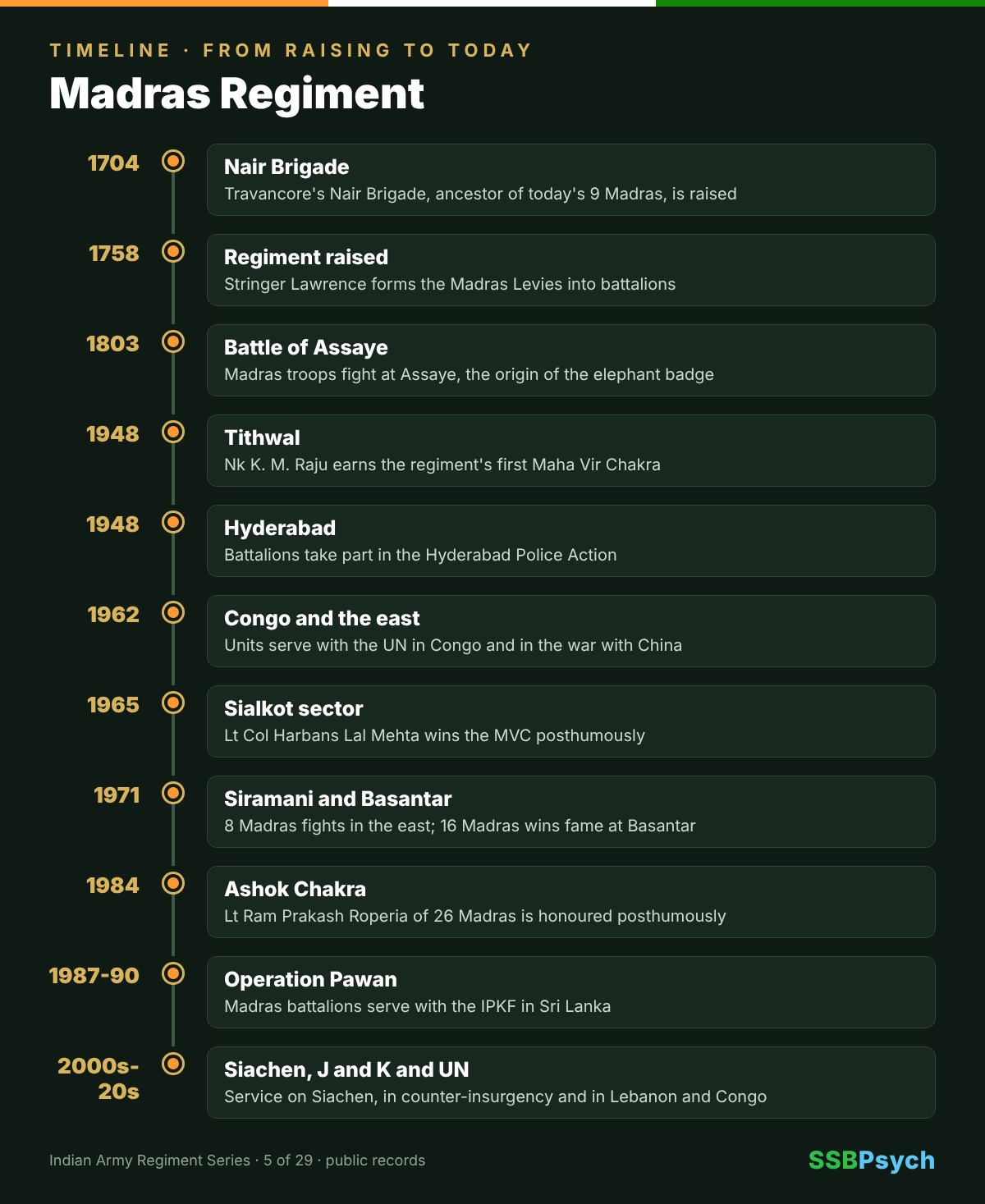
- 1704 – Nair Brigade: Travancore’s Nair Brigade, ancestor of today’s 9 Madras, is raised
- 1758 – Regiment raised: Stringer Lawrence forms the Madras Levies into battalions
- 1803 – Battle of Assaye: Madras troops fight at Assaye, the origin of the elephant badge
- 1948 – Tithwal: Nk K. M. Raju earns the regiment’s first Maha Vir Chakra
- 1948 – Hyderabad: Battalions take part in the Hyderabad Police Action
- 1962 – Congo and the east: Units serve with the UN in Congo and in the war with China
- 1965 – Sialkot sector: Lt Col Harbans Lal Mehta wins the MVC posthumously
- 1971 – Siramani and Basantar: 8 Madras fights in the east; 16 Madras wins fame at Basantar
- 1984 – Ashok Chakra: Lt Ram Prakash Roperia of 26 Madras is honoured posthumously
- 1987-90 – Operation Pawan: Madras battalions serve with the IPKF in Sri Lanka
- 2000s-20s – Siachen, J and K and UN: Service on Siachen, in counter-insurgency and in Lebanon and Congo
Major Operations and Battle Honours
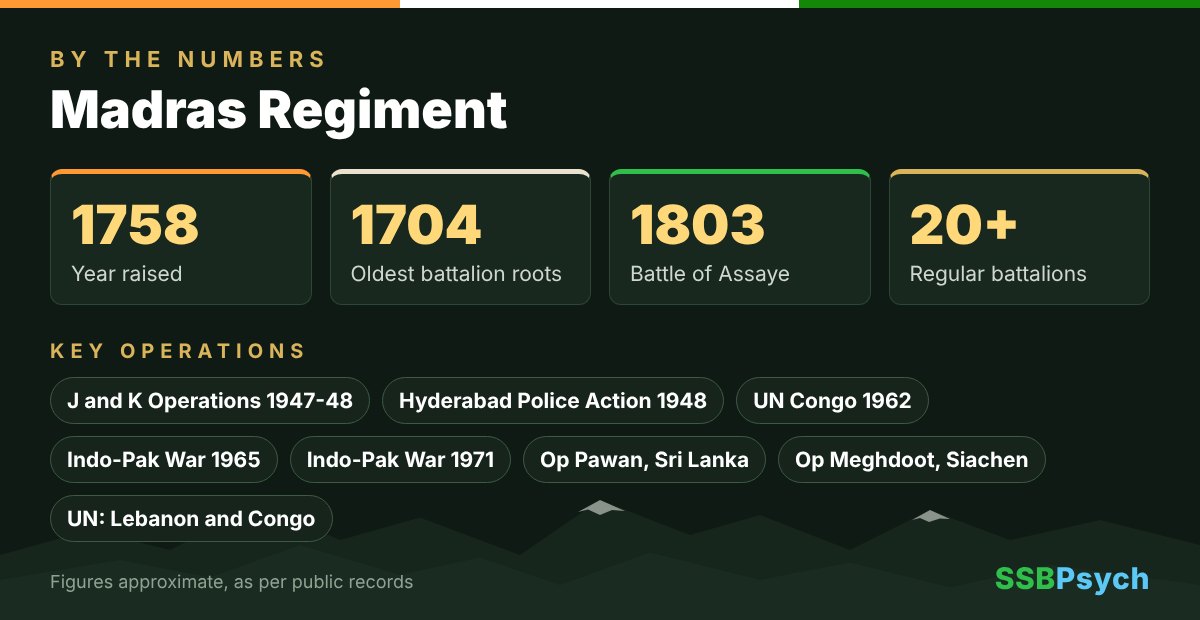
Since Independence, the regiment has fought in every major war and many internal and international operations. Its post-Independence battle honours include Tithwal, Punch, Kalidhar, Maharajke, Siramani and Basantar, alongside a long list of honours from earlier centuries.
1947-48: Tithwal and Punch
In the first Kashmir war, Madras battalions fought in the Tithwal and Punch sectors. On 11 June 1948, at Tithwal, Naik K. M. Raju held his post against a strong enemy attack, becoming the first soldier of the regiment to receive the Maha Vir Chakra. The same year, Madras units also took part in the Hyderabad Police Action.
The Hyderabad operation of September 1948, often called Operation Polo, lasted only a few days but had lasting importance, because it brought the princely state of Hyderabad into the Indian Union. For a regiment drawn largely from South India, taking part in this operation so close to home was a meaningful early task for the young nation’s Army. It also showed how quickly well-trained infantry, working with armour, could achieve a decisive result with limited loss of life.
1962 and 1965
In 1962, Madras troops served with the United Nations in the Congo, and the regiment also fought in the war with China. In the 1965 war, in the Sialkot sector, Lt Col Harbans Lal Mehta led an assault from the front and was fatally wounded. He was posthumously awarded the Maha Vir Chakra, the first officer of the regiment to receive it.
1971: Siramani and Basantar
The 1971 war brought glory on both fronts. In the east, 8 Madras, nicknamed the gallant Thambis, captured Siramani in what was then East Pakistan. In the west, 16 Madras, the old Travancore battalion, fought in the battle of Basantar in the Shakargarh sector. Its commanding officer, Lt Col Ved Prakash Ghai, was mortally wounded and awarded the Maha Vir Chakra, while Havildar Thomas Philipose led a counter-charge despite serious wounds and also won the MVC.
Basantar was one of the toughest battles of the 1971 war, fought across minefields and a river line in the Shakargarh bulge, with infantry and armour working together under heavy fire. That two Maha Vir Chakras were won by a single Madras battalion in this battle shows how fiercely the Thambis fought. For many in the regiment, Basantar is the proudest chapter of its post-Independence history.
Later Operations
In 1984, during the operation at Amritsar, Lt Ram Prakash Roperia of 26 Madras led his company into a fortified building and was mortally wounded; he was awarded the Ashok Chakra posthumously. Madras battalions served with the IPKF in Sri Lanka during Operation Pawan, on the Siachen Glacier under Operation Meghdoot, in counter-insurgency in Jammu and Kashmir and the North-East, and with UN missions in Lebanon and the Congo.
Madras Regiment Insignia, Motto and War Cry
The regimental insignia shows the Assaye elephant standing on a shield with crossed swords. The elephant honours the battle of 1803 and also reflects the strength, patience and loyalty for which South Indian soldiers are known.
The motto, adopted in 1955, is Swadharme Nidhanam Shreyaha, a line drawn from the Bhagavad Gita. It means that it is glorious to die while doing one’s own duty. The war cry, adopted in 1969, is Veera Madrassi, Adi Kollu, Adi Kollu, meaning Brave Madrassi, strike and kill, strike and kill. The regiment’s customary greeting is Namaskaram.
Heroes of the Madras Regiment
- Lieutenant Ram Prakash Roperia, Ashok Chakra (posthumous) – 26 Madras, Amritsar, June 1984.
- Naik K. M. Raju, Maha Vir Chakra – Tithwal, 1948; the regiment’s first MVC.
- Lt Col Harbans Lal Mehta, Maha Vir Chakra (posthumous) – Sialkot sector, 1965.
- Lt Col Ved Prakash Ghai, Maha Vir Chakra (posthumous) – commanding 16 Madras at Basantar, 1971.
- Havildar Thomas Philipose, Maha Vir Chakra – 16 Madras, Basantar, 1971.
- General S. M. Shrinagesh – Colonel of the Regiment from 1949 to 1961 and later Chief of the Army Staff.
Before Independence, officers serving with Madras units also won the Victoria Cross, including Lt Charles Grant of the 12th Madras Native Infantry and Captain Herbert Clogstoun of the 19th Madras Native Infantry. The regimental museum at Wellington, housed in the Shrinagesh Barracks, preserves many of these stories.
Role and Life in the Regiment
Being the oldest infantry regiment brings both pride and responsibility. Every Madras soldier is reminded that his battalion carries more than two and a half centuries of service, and that the reputation built by earlier generations must be protected. This sense of continuity is visible in regimental customs, in the care given to the museum and memorials, and in the way old soldiers are welcomed back to the centre.
The Madras Regiment is a standard infantry regiment and its battalions serve everywhere the Army does: on the Line of Control and the Line of Actual Control, on the Siachen Glacier, in the deserts of Rajasthan and in the jungles of the North-East. Its soldiers come mainly from Tamil Nadu, Kerala, Karnataka, Andhra Pradesh and Telangana, so a battalion often has men speaking Tamil, Malayalam, Kannada and Telugu.
The Thambis are known for their discipline, cheerful nature and ability to adapt to any terrain. Officers from North India who join the regiment often learn a South Indian language and grow to love the food, music and festivals of their men. Onam, Pongal and other festivals are celebrated with great enthusiasm in the unit lines, and the regiment has a strong tradition in sports such as football, volleyball and athletics.
Life at the Regimental Centre in Wellington is shaped by the Nilgiri hills. Recruits train on steep slopes in cool weather, which builds stamina for postings in the mountains. Wellington is also home to the Defence Services Staff College, so it is a well-known name for officers across the services. Passing-out parades at the centre are proud moments for families who travel from villages and towns across the south to watch their sons take the oath to serve the nation.
Today the regiment also includes Territorial Army battalions based in the south and in the Andaman and Nicobar Islands, and Rashtriya Rifles battalions serving in Jammu and Kashmir. This wide footprint means that a Madras officer may find himself in a remote island, a snowbound post or a jungle camp within a few years of service.
Why the Madras Regiment Matters for SSB Aspirants
Questions about the history of the Indian Army are common in SSB interviews, and the Madras Regiment is the perfect starting point. Knowing that it is the oldest infantry regiment, that it was raised in 1758, and that its badge honours the battle of Assaye shows the board that you have read beyond the basics.
The regiment is also a good example of how the Army brings together soldiers from many states and languages. If you are from South India, you can speak with pride about the Thambis and their record. If you are from elsewhere, you can talk about how you would learn your soldiers’ language and culture to lead them better. Both answers show the officer-like quality of adaptability.
You can also use the regiment’s history in group discussions on the evolution of the Indian Army. Its journey from Company-era levies to a modern regiment of independent India shows how traditions can be kept while loyalties and purposes change. A balanced candidate will acknowledge this colonial origin honestly while focusing on how the regiment has served the Indian nation since 1947.
Madras Regiment for SSB Candidates: What You Should Know
How officers join
- Officers join the Army through NDA, the IMA (via CDS, TES or TGC) or the OTA Chennai (Short Service Commission), after clearing the SSB and medicals.
- Regiment allotment is made during academy training based on choice, merit and vacancies; no entry guarantees the Madras Regiment.
- Officers from any state can be commissioned into the regiment and are expected to learn their soldiers’ languages and customs.
- Young officers then attend infantry courses before taking charge of a platoon in their battalion.
How soldiers join
- The regiment recruits mainly from Tamil Nadu, Kerala, Karnataka, Andhra Pradesh and Telangana.
- Since 2022, soldiers join through the Agnipath scheme as Agniveers, via Army recruitment rallies and the online common entrance exam.
- Recruits train at the Madras Regimental Centre, Wellington, in the Nilgiris.
Questions you may face in the SSB interview, GD or lecturette
- Which is the oldest infantry regiment of the Indian Army?
- What is the meaning of the Madras Regiment’s motto?
- Why does the Madras Regiment badge show an elephant?
- How would you lead soldiers who speak a language different from yours?
- Tell us about the battle of Basantar in 1971.
SSBPsych tip: When the board asks about adaptability, use the Madras Regiment’s multilingual battalions as an example and back it with a real moment when you adjusted to a new place, language or culture.
The Madras Regiment’s story runs from the first battalions of the eighteenth century to the soldiers on Siachen today. Learn its key facts, remember its heroes, and then take the quiz below to check your knowledge.
Quiz: How Well Do You Know the Madras Regiment?
Test yourself! Click an option to see if you are right. Your score updates live.
Madras Regiment: Frequently Asked Questions
The motto is Swadharme Nidhanam Shreyaha, from the Bhagavad Gita, meaning it is glorious to die doing one’s duty.
The Madras Regimental Centre is at Wellington, near Ooty in the Nilgiris district of Tamil Nadu.
The war cry is Veera Madrassi, Adi Kollu, Adi Kollu, meaning Brave Madrassi, strike and kill.
Yes. Raised in 1758, it is regarded as the oldest infantry regiment of the Indian Army.
It recruits mainly from Tamil Nadu, Kerala, Karnataka, Andhra Pradesh and Telangana, now through the Agnipath scheme.
Indian Army Regiments Series on SSBPsych
This is part 5 of 29 in our series on every infantry regiment of the Indian Army – a new regiment every day at 11 AM. Previous in the series: Punjab Regiment. Also follow our Param Vir Chakra series.
Sources: en.wikipedia.org, en.wikipedia.org, salute.co.in, honourpoint.in, en.wikipedia.org.
Preparing for NDA, CDS, AFCAT or your SSB? Join SSBPsych’s online and offline batches – explore our courses or call +91 8076540582.