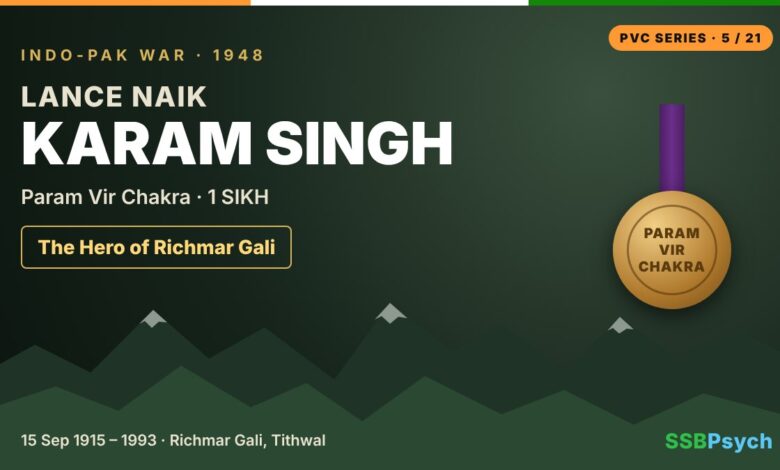
Lance Naik Karam Singh, PVC, MM: The Hero of Richmar Gali, Tithwal 1948 – Full Story (with Quiz)
On 13 October 1948, as the enemy hoped to take Indian troops by surprise on the festival of Eid, a powerful force attacked a small Sikh position at Richmar Gali, south of Tithwal in north Kashmir. Shells rained down, bunkers collapsed, and wave after wave of attackers climbed the slopes. In command of a forward post was a Lance Naik from a farming family in Punjab, a man who had already won a gallantry medal fighting the Japanese. He was wounded twice, yet he refused to leave his men. By the end of the day the enemy had attacked eight times and failed every time. That soldier was Lance Naik Karam Singh of 1 Sikh, and he became one of the few Param Vir Chakra recipients to survive the action that won it.
For SSB, NDA, CDS and AFCAT aspirants, Karam Singh’s story is especially valuable because it shows sustained courage over many hours, not just in one moment. It also shows a junior leader caring for his wounded and keeping his men’s spirits up when everything seemed to be going wrong. In this post you will read about his early life, his service in Burma, the background of Tithwal, the defence of Richmar Gali in detail, his citation in plain words and his long, proud life after the war. A quiz, WAT words and SRT situations are at the end.
Lance Naik Karam Singh – Quick Facts
| Full name | Karam Singh |
| Born | 15 September 1915, Sangrur–Barnala area, Punjab |
| Father | Uttam Singh, a farmer |
| Enlisted | 1941, Sikh Regiment |
| Unit | 1st Battalion, The Sikh Regiment (1 Sikh) |
| Battle | Defence of Richmar Gali, Tithwal sector, Jammu and Kashmir |
| Date of action | 13 October 1948 |
| Award | Param Vir Chakra (gazetted 21 June 1950) |
| Earlier award | Military Medal, Battle of the Admin Box, Burma, 1944 |
| Retired | 1969, as Honorary Captain |
| Died | 1993, Punjab (aged 77) |
Early Life in Punjab
Karam Singh was born on 15 September 1915 in a village in the Sangrur–Barnala area of Punjab, then part of British India. His father, Uttam Singh, was a farmer, and the family lived a simple rural life. Karam Singh completed his primary schooling in the village.
He expected to spend his life farming, like his father. But his village had men who had fought in the First World War, and their stories of distant battles, loyalty and bravery captured his imagination. Inspired by these veterans, he decided that the Army was where he belonged.
Joining the Sikh Regiment
Karam Singh joined the Army in 1941, during the Second World War, and was enrolled in the 1st Battalion of the Sikh Regiment. The Sikh Regiment is one of the most decorated regiments of the Indian Army, and 1 Sikh had a long tradition of service.
Military Medal in Burma
During the Burma campaign against the Japanese, Karam Singh showed early signs of the courage that would later make him famous. He was awarded the Military Medal, a British gallantry award for other ranks, for his conduct and bravery in the Battle of the Admin Box in 1944. In that battle, Allied troops in Arakan were surrounded by the Japanese but held their ground, supplied from the air, until the enemy was beaten back. It was one of the first major defeats of the Japanese in Burma, and it taught soldiers like Karam Singh how to hold firm when cut off.
Background: The Struggle for Tithwal
Tithwal, on the Kishanganga River in the Kupwara area of north Kashmir, was one of the most hotly contested areas of the 1947–48 war. Indian forces captured Tithwal on 23 May 1948, but the enemy kept counter-attacking from the surrounding heights. Through the summer, both sides fought hard for the ridges around the town.
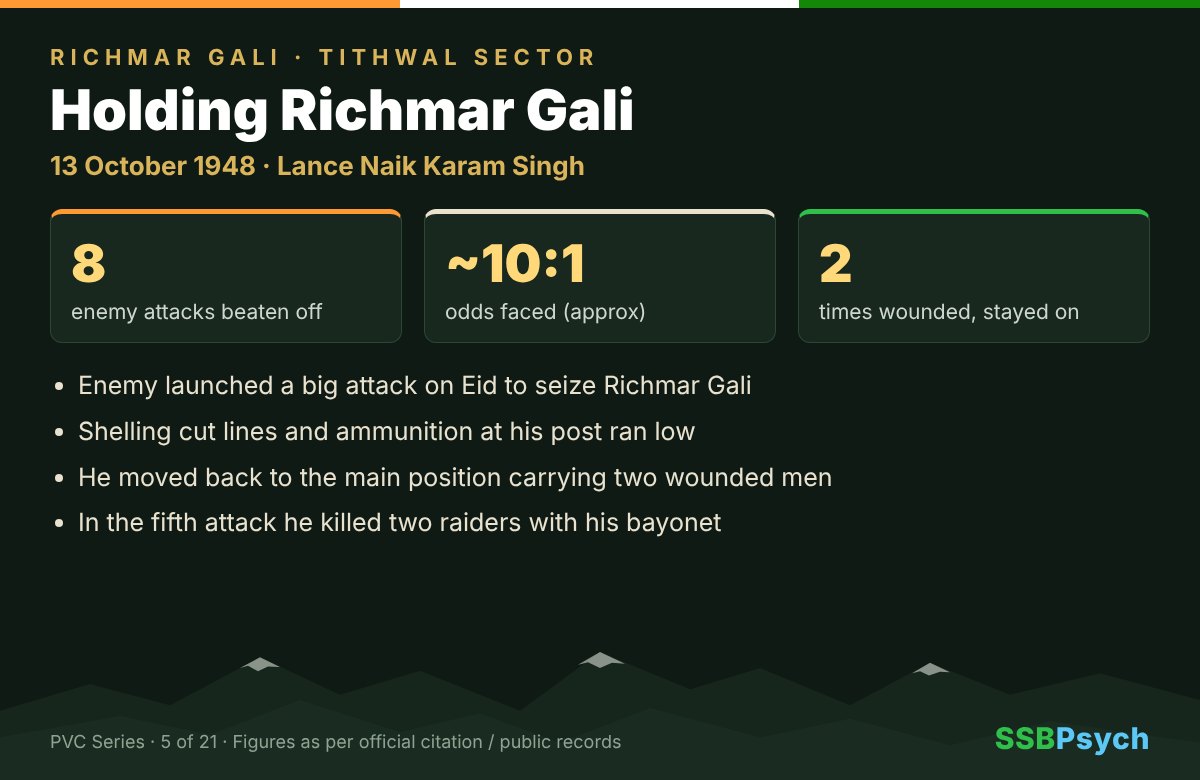
Richmar Gali, a pass south of Tithwal, was an important feature in the Indian defence. If the enemy captured it, along with the nearby Nastachur Pass, Indian troops in Tithwal would be in grave danger. In October 1948 the enemy planned a major attack to seize these positions. They chose 13 October, the day of Eid al-Adha, hoping that Indian troops would be off guard. 1 Sikh was holding the area, and Lance Naik Karam Singh was commanding a forward post at Richmar Gali.
The Defence of Richmar Gali: 13 October 1948
A Storm of Fire
The attack began with heavy shelling. Enemy artillery and mortar fire smashed into the Sikh bunkers, damaged trenches and cut the communication lines. Then the infantry assaults started. According to accounts of the battle, the Sikhs were outnumbered by roughly ten to one. Even so, the first attacks were driven back.
Wounded but Unwilling to Leave
As the hours passed, ammunition at Karam Singh’s forward post began running low. He realised that staying put would only lead to his men being overrun. He ordered his men to fall back and join the main company position. Although he was wounded, he brought two injured soldiers back with him, refusing to leave anyone behind.
At the company position, he was wounded again. He was hit twice in the course of the fighting, yet he refused to be evacuated. Instead, he kept moving from bunker to bunker, checking on the wounded, encouraging the men and throwing grenades at the attackers. His calm presence in the middle of the chaos steadied the whole position.
The Fifth Attack: Cold Steel
During the fifth enemy attack, two enemy soldiers managed to get very close to his position. Karam Singh leapt out of his trench and killed both of them with his bayonet. This bold act shocked the attackers and broke the momentum of their assault.
Holding to the End
The enemy did not give up. They attacked again and again. In total, they made eight separate attacks that day. Each time, Karam Singh and his men drove them back. When the enemy did manage to get a foothold, he led a bayonet counter-attack to throw them out. Finally, exhausted and having suffered heavy losses, the enemy withdrew. Richmar Gali remained in Indian hands, and the threat to Tithwal was defeated.
Lessons from the Battle
The defence of Richmar Gali shows how much depends on junior leaders. A Lance Naik is the first step on the ladder of command, usually in charge of a handful of men. Yet on that day, the survival of an important pass rested on the judgement of such a man. Karam Singh made several sound decisions in quick succession: when to pull back, whom to carry, where to stand and when to counter-attack. None of them came from a manual. They came from experience, from care for his men and from a refusal to accept defeat.
It is also worth noting that his courage was not a single burst. A brave act in one moment is admirable, but holding a position through a long day of shelling and eight assaults, while wounded, requires a deeper kind of strength. Every time an attack ended, he had to prepare his tired men for the next one.
The Param Vir Chakra Citation
Lance Naik Karam Singh’s Param Vir Chakra was gazetted on 21 June 1950, among the first set of PVC awards. In simple words, his citation records these points:
- He was commanding a section post at Richmar Gali when the enemy launched a heavy, determined attack with strong artillery support.
- The enemy made eight separate attacks on the position in the course of the day.
- Despite being wounded, he kept going from bunker to bunker to help the wounded and to encourage his men to fight on.
- When the enemy gained a foothold, he counter-attacked with the bayonet and drove them out.
- The citation describes him as a fearless leader of men in a crisis, a soldier whom nothing could subdue.
With the Param Vir Chakra added to his Military Medal, Karam Singh was now honoured for bravery in two different wars: against the Japanese in Burma and in the defence of Kashmir.
Life After the War
Unlike several other heroes of 1947–48, Karam Singh survived his great battle and went on to serve for many more years. He was promoted to Jemadar (later called Naib Subedar) in January 1957 and to Subedar in March 1964, and he went on to become Subedar Major. On 26 January 1969 he was given the honorary rank of Captain, and he retired later that year after nearly three decades of service.
He returned to Punjab and lived there until his death in 1993, at the age of 77. He was survived by his wife, Gurdial Kaur, and their children.
Legacy of Lance Naik Karam Singh
- The Shipping Corporation of India named a crude oil tanker MT Lance Naik Karam Singh, PVC after him; it was delivered in 1984 and served for about 25 years.
- A memorial to him stands at the District Administrative Complex in Sangrur, Punjab.
- The Sikh Regiment counts him among its greatest heroes, and the defence of Richmar Gali is an inspiring chapter in its history.
For aspirants, the most striking thing about Karam Singh is his steadiness. He was already a decorated soldier, yet at Richmar Gali he did not look for glory. He looked after his wounded, kept his men in good spirits and fought for every metre of ground for a whole day. Officer selection looks for exactly this mix of courage, care and staying power.
Lessons for SSB Aspirants: OLQs in Action
The SSB does not test whether you can recite history – it looks for the qualities of an officer. Here is how Lance Naik Karam Singh showed them:
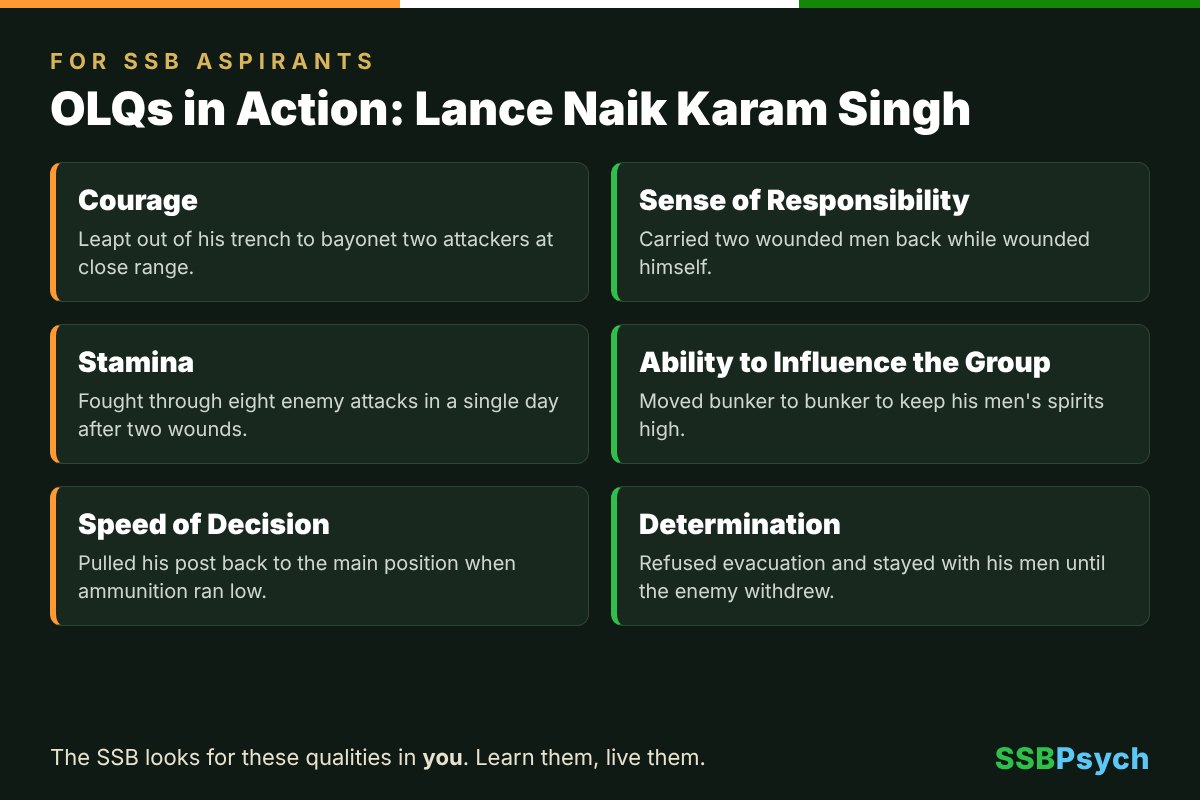
- Courage – Leapt out of his trench to bayonet two attackers at close range.
- Sense of Responsibility – Carried two wounded men back while wounded himself.
- Stamina – Fought through eight enemy attacks in a single day after two wounds.
- Ability to Influence the Group – Moved bunker to bunker to keep his men’s spirits high.
- Speed of Decision – Pulled his post back to the main position when ammunition ran low.
- Determination – Refused evacuation and stayed with his men until the enemy withdrew.
Tip for your SSB interview: Interviewers like to test how you look after your team under pressure. Prepare a real example where you put a teammate’s needs before your own comfort, the way Karam Singh refused to leave his wounded men behind.
Practice Corner: WAT and SRT
Write your first spontaneous response to these before you scroll to the quiz. Keep WAT sentences short, positive and action-oriented.
WAT Words
- Bunker
- Bayonet
- Wounded
- Festival
- Steady
SRTs
- During a group trek, two members get hurt and the group wants to move ahead without them. He…
- He is leading a team in a competition and the team keeps losing round after round. He…
- He is injured in a match but his team has no substitute left and the game is close. He…
Quiz: How Well Do You Know Lance Naik Karam Singh?
Test yourself! Click an option to see if you are right. Your score updates live.
Frequently Asked Questions
Was Lance Naik Karam Singh alive when he received the Param Vir Chakra?
Yes. He survived the battle, served until 1969, retired as an Honorary Captain and died in 1993.
What did Karam Singh do at Richmar Gali?
On 13 October 1948 he led the defence of a forward post of 1 Sikh against eight enemy attacks, stayed on despite two wounds, rescued wounded comrades and counter-attacked with the bayonet.
Which other gallantry award did Karam Singh have?
He held the Military Medal, won for bravery at the Battle of the Admin Box in Burma in 1944.
Where is Richmar Gali?
Richmar Gali is a pass south of Tithwal in the Kupwara area of north Kashmir, close to the Kishanganga River.
The Param Vir Chakra Series on SSBPsych
This is part 5 of 21 in our series on every Param Vir Chakra awardee. A new hero goes live every morning at 7:30 AM. Also read the story of Captain Vikram Batra, PVC – the Sher Shah of Kargil.
Sources: en.wikipedia.org, honourpoint.in, esamskriti.com.
Preparing for your SSB? Join SSBPsych’s online and offline SSB batches and learn how to show your OLQs with confidence – explore our courses or call +91 8076540582.