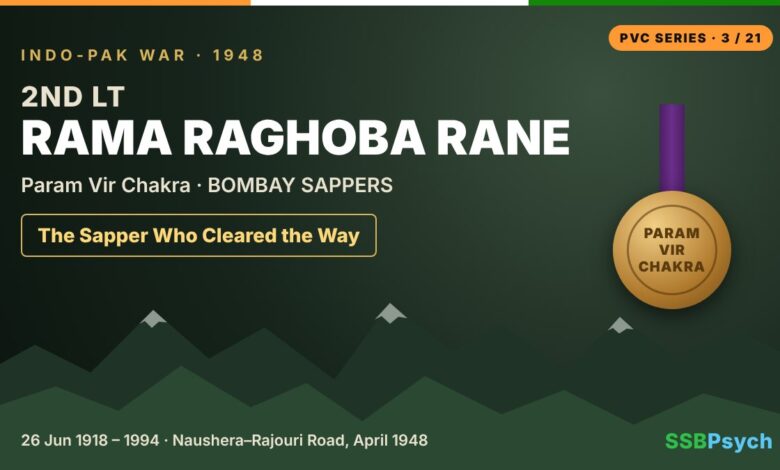
2nd Lt Rama Raghoba Rane, PVC: The Sapper Who Opened the Road to Rajouri – Full Story (with Quiz)
Some war heroes are remembered for a single charge. Second Lieutenant Rama Raghoba Rane is remembered for something just as hard: four days and nights of dangerous, exhausting work under enemy fire, without rest, while wounded. In April 1948, as the Indian Army fought its way from Naushera towards Rajouri in Jammu and Kashmir, the road was choked with mines, felled trees and blown-up culverts. Rane and his small band of combat engineers cleared it, metre by metre, so that tanks and infantry could move forward. For this he received the Param Vir Chakra, and unlike the first two recipients, he lived to wear it.
For NDA, CDS and AFCAT aspirants, Rane’s story is a great way to understand the role of the Corps of Engineers, whose sappers make it possible for the rest of the Army to move and fight. It is also a lesson in stamina and determination, two qualities the SSB looks for closely. This post covers his early life, his rise from recruit to officer, the operation of April 1948, his citation in simple words and his legacy, followed by a quiz, WAT words and SRT situations.
2nd Lt Rama Raghoba Rane – Quick Facts
| Full name | Rama Raghoba Rane |
| Born | 26 June 1918, Chendia, Karwar district (now Karnataka) |
| Father | Raghoba P. Rane, a police constable |
| Enlisted | 10 July 1940, Bombay Engineer Regiment (Bombay Sappers) |
| Commissioned | 15 December 1947, Corps of Engineers |
| Unit | 37 Assault Field Company, Bombay Sappers, with 4 Dogra |
| Battle | Advance from Naushera towards Rajouri, Jammu and Kashmir |
| Date of action | 8 to 11 April 1948 |
| Award | Param Vir Chakra |
| Retired | 1968, as a Major |
| Died | 1994, Pune (aged 76) |
Early Life on the Konkan Coast
Rama Raghoba Rane was born on 26 June 1918 in Chendia, a village in the Karwar area on the coast of present-day Karnataka. He came from a Konkani-speaking family. His father, Raghoba P. Rane, was a police constable, and because his father was transferred often, Rama’s schooling kept getting interrupted.
As a boy he was stirred by the freedom movement. Around 1930 he was drawn towards the Non-Cooperation movement, and his father, worried about his son’s involvement, moved the family back to their ancestral village. This early spirit of standing up for a cause would later find a different outlet in uniform.
From Recruit to Officer
On 10 July 1940, at the age of 22, Rane enlisted in the Bombay Engineer Regiment, popularly called the Bombay Sappers. He did so well in training that he was declared the Best Recruit of his batch and was soon promoted to Naik.
Second World War in Burma
During the Second World War he served with the 28th Field Company of the 26th Indian Infantry Division against the Japanese in Burma. After one setback in the Arakan, he was left behind at Buthidaung with two sections of sappers to destroy important equipment and facilities so that they would not fall into enemy hands. The boats that were supposed to take them away never came. Rane led his men past Japanese patrols, crossed a river and rejoined his division. For this resourcefulness he was promoted to Havildar.
His performance continued to stand out. He received a Viceroy’s Commission as a Jemadar and was later selected for an officer’s commission. After Independence he chose to stay in the Indian Army and was commissioned as a Second Lieutenant in the Corps of Engineers on 15 December 1947. Just a few months later he would be tested in battle.
Background: The Road to Rajouri
In the winter of 1947–48, enemy forces held large parts of the Rajouri area and had cut off the town, where many civilians were suffering. After Indian troops recaptured Jhangar in March 1948, the next goal was to advance from Naushera to Rajouri and relieve it.
The 4th Battalion of the Dogra Regiment (4 Dogra) captured the Barwali Ridge, about 11 kilometres north of Naushera, in early April 1948. But the advance then ran into trouble. The enemy had laid minefields on the road and built road-blocks of huge pine trees, rocks and destroyed culverts. All of these were covered by machine guns, mortars and artillery. Tanks could not move forward until the road was made safe. The job of opening it fell to a section of 37 Assault Field Company, commanded by Second Lieutenant Rane.
It helps to understand what a sapper actually does in such a situation. Each mine has to be found, often by prodding the ground by hand, and then lifted or destroyed. Each road-block has to be studied for hidden booby traps before charges are placed. The sapper cannot rush, because one careless move can kill him and his team. Yet the infantry and tanks waiting behind him want speed. Balancing safety and speed while bullets and shells land nearby demands extraordinary nerve.
Four Days Under Fire: 8 to 11 April 1948
Day One, 8 April: Wounded but Unstoppable
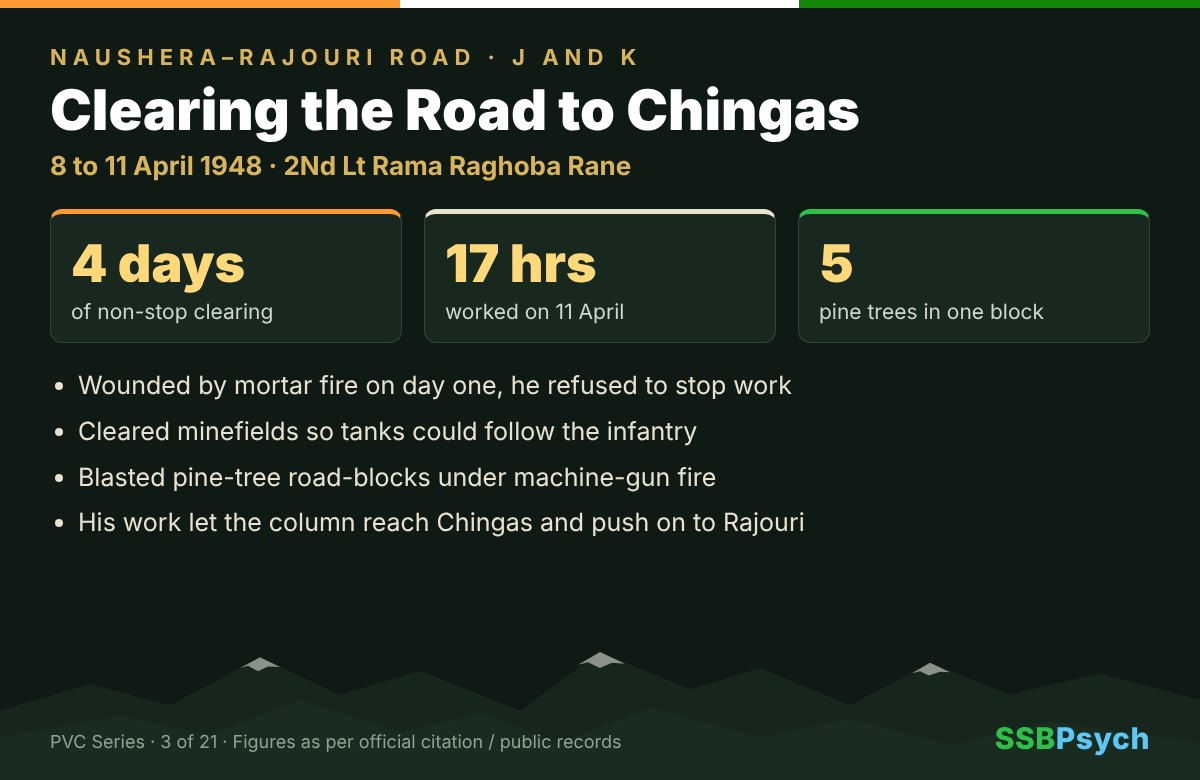
Rane’s section began clearing a minefield so that the tanks could follow the infantry. Enemy mortar bombs began falling around them. Two of his sappers were killed and five others were wounded. Rane himself was among the wounded. Instead of going back for treatment, he kept his remaining men at work. By evening they had cleared the minefield, and they carried on through the night to prepare a safe lane for the tanks.
Day Two, 9 April: Twelve Hours of Work
The next day Rane and his men worked for about twelve hours at a stretch, removing mines and road-blocks. Where the road was too damaged to use, he built diversions so the column could get around the obstacles. All of this was done under enemy artillery and mortar fire. Sappers in such work cannot take cover and shoot back; they must stay exposed and concentrate on careful, dangerous tasks with their hands.
Day Three, 10 April: Blasting the Pine Trees
Early on 10 April he started again. In front of him was a road-block of five large pine trees, protected by mines and covered by enemy machine guns. Rane and his men cleared it in about two hours. Further on, the column met another mass of road-blocks. To get close to one of them, Rane used a tank as protection against enemy fire, reached the obstacle and blasted it away with explosives. Pushing on despite his wounds, he cleared more blocks and blew away embankments, opening the road before night fell. The tanks were able to reach Chingas, an important point on the route to Rajouri.
Day Four, 11 April: Seventeen Hours
On 11 April Rane began work at 6 in the morning and kept going for about seventeen hours, opening the road to Chingas and clearing the stretch beyond it. With the road open, the Indian column could keep moving. The capture of Chingas gave the force a firm base for its advance on Rajouri, and the operation helped bring relief to the civilians trapped in the area.
The Param Vir Chakra Citation
Rane’s award was gazetted on 21 June 1950, in the first list of Param Vir Chakra awards. His citation, put simply, highlights the following:
- On 8 April 1948 his section came under mortar fire while clearing a minefield; two men were killed and five, including him, were wounded, yet he completed the task.
- He worked through the night and the following day for about twelve hours, clearing mines and road-blocks and making diversions under fire.
- On 10 April he cleared a pine-tree road-block covered by machine guns and then forced open further road-blocks, protected by armour, using explosives.
- On 11 April he worked for about seventeen hours to open the road to Chingas.
- The citation praises his outstanding courage and leadership, his disregard for his own safety and his success in keeping the advance moving.
- His efforts helped the force capture an important position and saved many civilian lives.
Later Life and Legacy
Rane continued to serve after the war. He was promoted to Lieutenant in 1950 and to Captain in 1954, and he received a regular commission in 1955. He retired as a Major in 1968 and then worked with the Army as a civilian staff member for a few more years. He died in 1994 at the Command Hospital in Pune, aged 76, survived by his wife and children.
- The Shipping Corporation of India named a crude oil tanker after him, delivered in 1984, which served for about 25 years.
- A statue in his memory was unveiled in November 2006 on Rabindranath Tagore Beach in Karwar, near the INS Chapal warship museum.
- The Bombay Sappers and the Corps of Engineers hold him up as an ideal for every young sapper officer.
Rane’s story teaches an important lesson for anyone who wants to wear the uniform: courage is not only about attacking the enemy. It also means doing slow, risky and tiring work, again and again, because the mission depends on it. He was wounded on the first day, yet he did not let his injury become an excuse. That is the kind of commitment that turns a recruit into an officer, and an officer into a legend.
Lessons for SSB Aspirants: OLQs in Action
The SSB does not test whether you can recite history – it looks for the qualities of an officer. Here is how 2nd Lt Rama Raghoba Rane showed them:
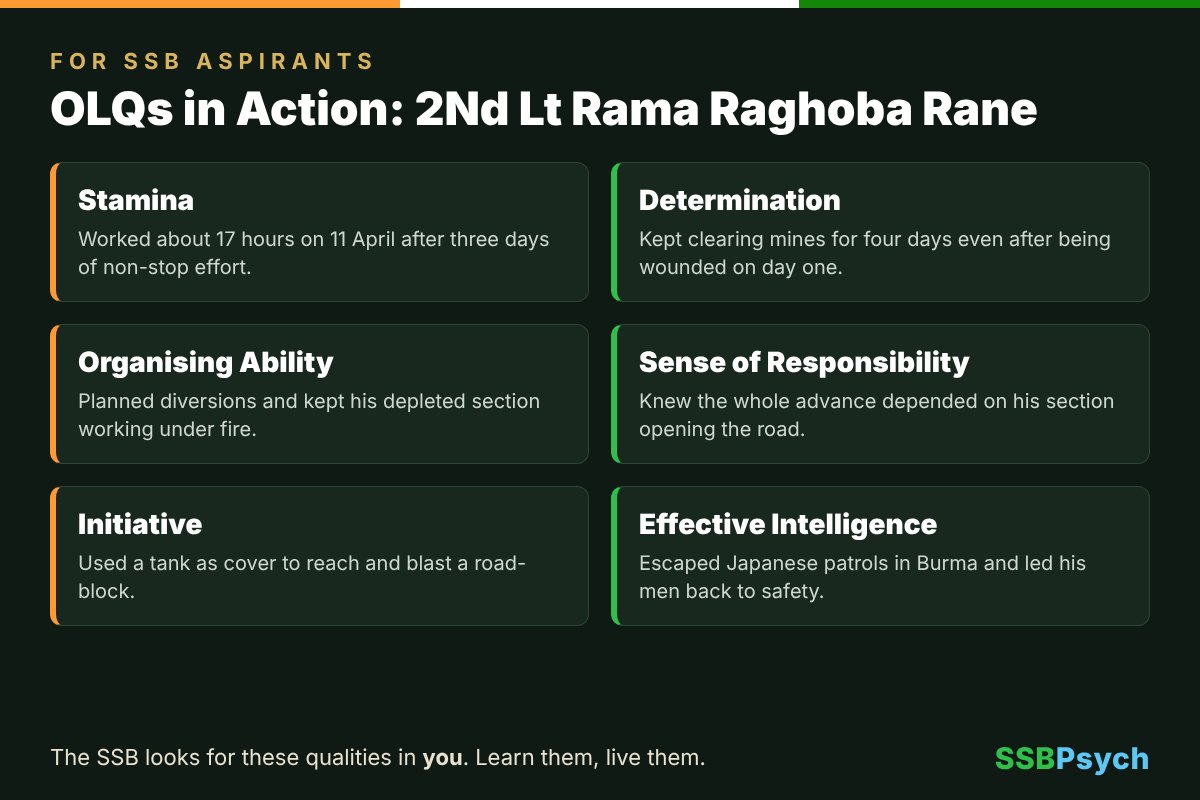
- Stamina – Worked about 17 hours on 11 April after three days of non-stop effort.
- Determination – Kept clearing mines for four days even after being wounded on day one.
- Organising Ability – Planned diversions and kept his depleted section working under fire.
- Sense of Responsibility – Knew the whole advance depended on his section opening the road.
- Initiative – Used a tank as cover to reach and blast a road-block.
- Effective Intelligence – Escaped Japanese patrols in Burma and led his men back to safety.
Tip for your SSB interview: When the interviewer asks how you handle long, boring or tiring tasks, use a real example where you kept working steadily towards a goal. Rane’s four days on the Rajouri road show that steady, unglamorous effort is also leadership.
Practice Corner: WAT and SRT
Write your first spontaneous response to these before you scroll to the quiz. Keep WAT sentences short, positive and action-oriented.
WAT Words
- Mine
- Road-block
- Sapper
- Stamina
- Wound
SRTs
- He is in charge of setting up a college event overnight and two volunteers leave midway. He…
- While on a trek, he finds the only path blocked by fallen trees and night is approaching. He…
- He gets a minor injury during an important task that only he knows how to finish. He…
Quiz: How Well Do You Know 2nd Lt Rama Raghoba Rane?
Test yourself! Click an option to see if you are right. Your score updates live.
Frequently Asked Questions
Why did 2nd Lt Rama Raghoba Rane receive the Param Vir Chakra?
For clearing minefields and road-blocks under heavy fire from 8 to 11 April 1948, despite being wounded, so that Indian tanks and infantry could advance from Naushera towards Rajouri.
Was Rama Raghoba Rane alive when he received the PVC?
Yes. Unlike the first two PVC recipients, he survived the war, retired as a Major in 1968 and died in 1994.
What is a sapper?
A sapper is a combat engineer. Sappers clear mines, build and destroy bridges and obstacles, and open routes so the rest of the Army can move.
Which unit did Rane serve with?
He served with 37 Assault Field Company of the Bombay Sappers (Bombay Engineer Group), attached to 4 Dogra during the advance.
The Param Vir Chakra Series on SSBPsych
This is part 3 of 21 in our series on every Param Vir Chakra awardee. A new hero goes live every morning at 7:30 AM. Also read the story of Captain Vikram Batra, PVC – the Sher Shah of Kargil.
Sources: en.wikipedia.org, bharat-rakshak.com, www.indiaofthepast.org.
Preparing for your SSB? Join SSBPsych’s online and offline SSB batches and learn how to show your OLQs with confidence – explore our courses or call +91 8076540582.