Aircraft Carriers of the Indian Navy: History 1961 to Today
Imagine a floating airbase that can sail 1,000 km in two days, launch fighter jets far from home and still carry hospitals, kitchens and power stations for over a thousand people. That is an aircraft carrier. The story of the Aircraft Carriers of the Indian Navy began in 1961 and today India is one of only a handful of countries that can design and build such a ship on its own.
In this guide we explain, in simple words, what an aircraft carrier is, how it launches and recovers jets, why a country like India needs them, and the full journey from the first INS Vikrant to the new home-built INS Vikrant. If you are preparing for NDA, CDS, AFCAT or the SSB interview, this is one topic you can expect in current affairs, GK and even in a group discussion.

What Is an Aircraft Carrier?
An aircraft carrier is a warship with a long, flat top called the flight deck. Aircraft take off from it, land back on it and are stored in a giant garage below it called the hangar. Lifts, like huge elevators, carry jets between the hangar and the deck. On one side stands a tall tower called the island, from where the captain steers the ship and air controllers manage flying.
Think of it as a small town at sea. A big carrier has its own power plant, fresh-water plant, kitchens that feed more than a thousand sailors several times a day, a hospital with an operation theatre, workshops to repair jets and storage for fuel and weapons.
Displacement, knots and other words you will hear
- Displacement: the weight of the ship, measured by how much water it pushes aside. INS Vikrant (2022) displaces about 45,000 tonnes.
- Knot: a speed of one nautical mile per hour, about 1.85 km per hour. So 28 knots is roughly 52 km per hour.
- Nautical mile: about 1.85 km, the standard distance unit at sea.
- Pennant number: the ship’s identity code painted on the hull, such as R11 or R33. The R is used for carriers.
How Do Jets Take Off From a Ship?
A runway on land is usually 2 to 3 km long. A carrier deck is only about 250 to 300 metres long. So navies use clever tricks to get jets airborne and to stop them on landing. There are three main systems.
- CATOBAR (Catapult Assisted Take-Off But Arrested Recovery): a steam or electric catapult flings the jet forward like a slingshot. The first INS Vikrant used a steam catapult in its early years.
- STOVL (Short Take-Off, Vertical Landing): jets like the Sea Harrier take a short run and land almost straight down, like a helicopter. INS Viraat and the old Vikrant flew Sea Harriers.
- STOBAR (Short Take-Off But Arrested Recovery): the jet runs up a curved ramp called a ski-jump at the front of the deck, which throws its nose upward. On landing, a hook under the tail catches steel cables called arrester wires that stop a 20-tonne jet in about 100 metres. INS Vikramaditya and INS Vikrant (2022) are STOBAR carriers.
Landing on a carrier is called a trap, and pilots say it feels like a controlled crash. It needs years of training and a lot of courage, which is why carrier pilots are respected across the world.
Why Does India Need Aircraft Carriers?
India has a coastline of over 7,500 km, two long seaboards (the Arabian Sea in the west and the Bay of Bengal in the east) and island territories far out at sea like the Andaman and Nicobar and Lakshadweep islands. Most of India’s trade by volume and much of its oil arrives by sea. Protecting these sea routes is a national need, not a luxury.
Fighter jets based on land can only fly a limited distance from the coast. A carrier takes the airbase along with the fleet, giving warships air cover far from home. This is called sea control: making sure your ships can move freely while an enemy’s cannot.
- Air cover for the fleet: jets and helicopters protect warships from enemy aircraft, ships and submarines.
- Reach: a carrier can move hundreds of kilometres a day and show presence anywhere in the Indian Ocean.
- Deterrence: the mere presence of a carrier group can make an adversary think twice.
- Disaster relief: helicopters, medical teams and supplies on board make a carrier useful for humanitarian missions too.
- Prestige and diplomacy: very few navies operate carriers, so they also project national confidence.
Why two or three carriers?
Every ship needs regular repairs, called refits, which can take months. With only one carrier, India would have no carrier at all during those periods. For years Indian naval planners have spoken of having one carrier for each seaboard plus one in reserve, though recent reports suggest the Navy is focusing on keeping at least two carriers in service. A carrier never sails alone: it moves with destroyers, frigates, a submarine and a tanker. This team is called a Carrier Battle Group.
History of the Aircraft Carriers of the Indian Navy
India has operated four aircraft carriers so far. Interestingly, the name Vikrant has been used twice, and every carrier name starts with the letter V.
1. INS Vikrant (R11), 1961 to 1997
India bought the half-finished British carrier HMS Hercules in 1957. Work on it had stopped after the Second World War. It was completed at Harland and Wolff in Belfast with Indian changes, including an angled deck and a steam catapult, and commissioned on 4 March 1961 as INS Vikrant, a Sanskrit-rooted name meaning courageous or bold. Its finest hour came in the 1971 war, when its jets struck ports and ships in East Pakistan while the Navy blockaded the Bay of Bengal. It served until 31 January 1997, then became a museum ship in Mumbai before being scrapped from 2014.
2. INS Viraat (R22), 1987 to 2017
INS Viraat was the former British carrier HMS Hermes, which had been the flagship of the Royal Navy during the 1982 Falklands War. India bought it and commissioned it on 12 May 1987. Viraat means giant. It flew Sea Harrier jump jets and Sea King helicopters and was the Navy’s flagship for many years. Including its British service, it sailed for nearly six decades, and by the end it was described as the oldest aircraft carrier in service anywhere. It was decommissioned on 6 March 2017.
3. INS Vikramaditya (R33), 2013 to present
INS Vikramaditya began life as the Soviet ship Baku, later renamed Admiral Gorshkov. India signed for the ship in 2004, and it was rebuilt in Russia into a STOBAR carrier with a ski-jump. After long delays and rising costs, it was commissioned on 16 November 2013 at Severodvinsk in Russia and reached India in January 2014. It carries MiG-29K fighters and helicopters and is about 284 metres long.
4. INS Vikrant (R11), 2022 to present
The proudest chapter is the new INS Vikrant, built at Cochin Shipyard in Kochi and designed by the Navy’s own Warship Design Bureau. Its keel was laid in 2009 and it was commissioned by Prime Minister Narendra Modi on 2 September 2022. It displaces about 45,000 tonnes, making it the largest warship ever built in India. With it, India joined the small club of nations that can design and build their own aircraft carrier.
Aircraft Carriers of the Indian Navy Timeline
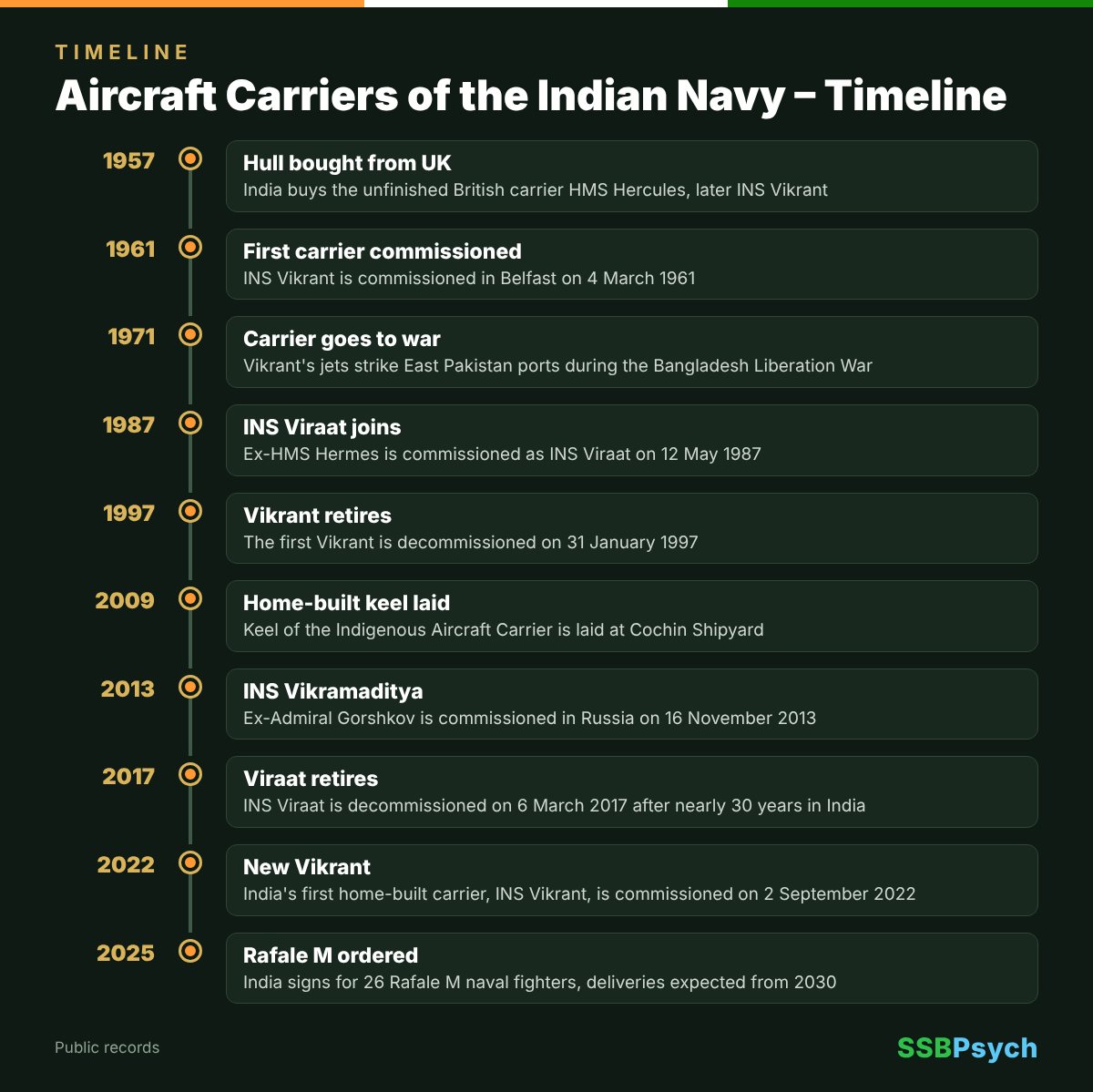
- 1957 – Hull bought from UK: India buys the unfinished British carrier HMS Hercules, later INS Vikrant
- 1961 – First carrier commissioned: INS Vikrant is commissioned in Belfast on 4 March 1961
- 1971 – Carrier goes to war: Vikrant’s jets strike East Pakistan ports during the Bangladesh Liberation War
- 1987 – INS Viraat joins: Ex-HMS Hermes is commissioned as INS Viraat on 12 May 1987
- 1997 – Vikrant retires: The first Vikrant is decommissioned on 31 January 1997
- 2009 – Home-built keel laid: Keel of the Indigenous Aircraft Carrier is laid at Cochin Shipyard
- 2013 – INS Vikramaditya: Ex-Admiral Gorshkov is commissioned in Russia on 16 November 2013
- 2017 – Viraat retires: INS Viraat is decommissioned on 6 March 2017 after nearly 30 years in India
- 2022 – New Vikrant: India’s first home-built carrier, INS Vikrant, is commissioned on 2 September 2022
- 2025 – Rafale M ordered: India signs for 26 Rafale M naval fighters, deliveries expected from 2030
Operations and Missions
- 1971 – Bangladesh Liberation War: INS Vikrant’s Sea Hawks and Alizes struck ports and shipping in East Pakistan
- 2014 – First two-carrier drill in years: INS Viraat and INS Vikramaditya operated together in January 2014
- 2023 – Twin-carrier operations: INS Vikrant and INS Vikramaditya operated together with about 35 aircraft
- 2025 – Operation Sindoor: INS Vikrant’s carrier battle group was forward-deployed in the Arabian Sea

Aircraft That Have Flown From Indian Carriers
The aircraft on board are the real weapons of a carrier. Over six decades, Indian carriers have hosted a wide range of machines.
- Hawker Sea Hawk: the first-generation jet fighter on the old Vikrant, famous for its 1971 strikes.
- Breguet Alize: a French propeller plane used to hunt submarines and for long-range patrol.
- Sea Harrier: the jump jet that flew from the old Vikrant and from Viraat until 2016.
- MiG-29K: the current supersonic fighter on Vikramaditya and Vikrant.
- Helicopters: Sea King, Chetak, Dhruv, Kamov Ka-31 early-warning helicopters and the MH-60R anti-submarine helicopter.
- Rafale M: 26 of these French naval fighters were ordered in April 2025, with deliveries expected from 2030.
What Does It Take to Run a Carrier?
A carrier needs well over a thousand people. INS Vikramaditya, for example, is designed for about 1,600 crew. Sailors and officers from many branches work together: engineers keep the boilers or gas turbines running, electricians manage power, aviators fly and maintain the aircraft, cooks feed everyone, and doctors run the sick bay.
An aircraft carrier of the Indian Navy is commanded by an officer of Captain rank, and the ship’s air operations are led by experienced naval aviators. Above the ship, a Rear Admiral may command the whole fleet or carrier group. For SSB aspirants, this is a good example of teamwork, leadership and planning on a very large scale.
Fuel and endurance
Indian carriers are not nuclear powered. They burn fuel in boilers or gas turbines, so their range is limited by how much fuel they carry. INS Vikramaditya, for example, is reported to have a range of about 13,500 nautical miles at a steady cruising speed and food and stores for around 45 days. Out at sea, a fleet tanker refuels the carrier and its escorts while both ships sail side by side, a tricky skill called replenishment at sea.
What drives the cost?
Carriers are among the most expensive things a country can build. The new Vikrant was reported to cost about Rs 20,000 crore at the time of commissioning, and that does not include its aircraft. Running costs come from fuel, spare parts, regular refits in dry dock, crew salaries, and the high cost of maintaining and replacing jets. Critics sometimes argue that submarines give more value for money, while supporters say no other ship can give a navy its own air power at sea. This is a classic debate topic for a group discussion.
Aircraft Carriers of the Indian Navy: Quick Analysis
Looking at the full journey, a clear pattern appears. India started by buying used ships from Britain, then a rebuilt ship from Russia, and finally designed and built its own. Each step brought new skills: flying jump jets, operating ski-jump and arrester-wire landings, and finally shipbuilding on a massive scale. The new Vikrant is reported to have about 76 percent indigenous content, and the Navy now plans a second home-built carrier, which we cover in post 6 of this series.
Another lesson is that a carrier is only as strong as its aircraft. Jets age and must be replaced, which is why the Rafale M order and the planned Indian twin-engine deck-based fighter are so closely linked to the future of India’s carriers.
Did You Know?
- All four Indian carriers have names starting with V: Vikrant, Viraat, Vikramaditya and Vikrant again.
- The new INS Vikrant kept the same pennant number, R11, as the first Vikrant.
- Metal from the scrapped first Vikrant was used in a motorcycle called the Bajaj V, launched in 2016.
- INS Viraat had served the British Royal Navy as HMS Hermes before joining India.
- INS Vikramaditya was originally a Soviet ship named Baku.
- In June 2023, INS Vikrant and INS Vikramaditya operated together with about 35 aircraft in a twin-carrier drill.
Quiz: Test Your Knowledge of Aircraft Carriers of the Indian Navy
Click an option to see if you are right. Your score updates live.
Aircraft Carriers of the Indian Navy: Frequently Asked Questions
As of 2026 the Indian Navy has two aircraft carriers in service: INS Vikramaditya (commissioned 2013) and INS Vikrant (commissioned 2022). In total India has operated four carriers since 1961.
INS Vikramaditya is the longest at about 284 metres. INS Vikrant (2022), at about 45,000 tonnes, is the largest warship ever built in India.
India’s first aircraft carrier was INS Vikrant, the former British HMS Hercules, commissioned on 4 March 1961 and decommissioned on 31 January 1997.
No. India’s carriers have used steam turbines or gas turbines burning conventional fuel. A future nuclear-powered carrier has been discussed in Navy planning documents but no such ship has been ordered.
The names come from Sanskrit and Indian history. Vikrant means courageous or bold, and Vikramaditya honours a legendary Indian emperor known for valour.
This is part 1 of 16 in SSBPsych’s Indian Navy aircraft carrier series – a new post every day at 2 PM.
Sources: en.wikipedia.org, en.wikipedia.org, en.wikipedia.org, en.wikipedia.org, en.wikipedia.org.
Preparing for NDA, CDS, AFCAT or your SSB? Join SSBPsych’s online and offline batches – explore our courses or call +91 8076540582.