Captain Vikram Batra, PVC: The Complete Story of Kargil’s “Sher Shah” (with Quiz)
“Either I will come back after raising the Indian flag in victory, or I will come back wrapped in it. But I will come back for sure.” These words, widely attributed to a 24-year-old officer from Palampur, have become one of the most quoted lines in Indian military history. That officer was Captain Vikram Batra, PVC – the “Sher Shah” of Kargil.
For every NDA, CDS and AFCAT aspirant preparing for the SSB, Captain Batra’s life is more than a war story. It is a living lesson in the very Officer Like Qualities (OLQs) the board looks for. In this post we cover his complete journey – childhood, NCC, CDS and SSB, IMA, the battles of Point 5140 and Point 4875 – and end with a 12-question interactive quiz, practice WAT/SRT prompts and FAQs.
Captain Vikram Batra – Quick Facts
| Full name | Captain Vikram Batra, PVC |
| Born | 9 September 1974, Palampur, Himachal Pradesh |
| Parents | Shri G.L. Batra (school principal) & Smt. Kamal Kanta Batra (teacher) |
| Twin brother | Vishal Batra (born 14 minutes later) |
| Education | Central School Palampur; DAV College, Chandigarh |
| Entry | CDS 1996 → SSB Allahabad → IMA Dehradun |
| Commissioned | 6 December 1997 |
| Unit | 13th Battalion, The Jammu & Kashmir Rifles (13 JAK RIF) |
| Code name | Sher Shah |
| Famous signal | “Yeh Dil Maange More!” |
| Martyred | 7 July 1999, Point 4875, Kargil (aged 24) |
| Award | Param Vir Chakra (Posthumous), 15 August 1999 |
Early Life in Palampur
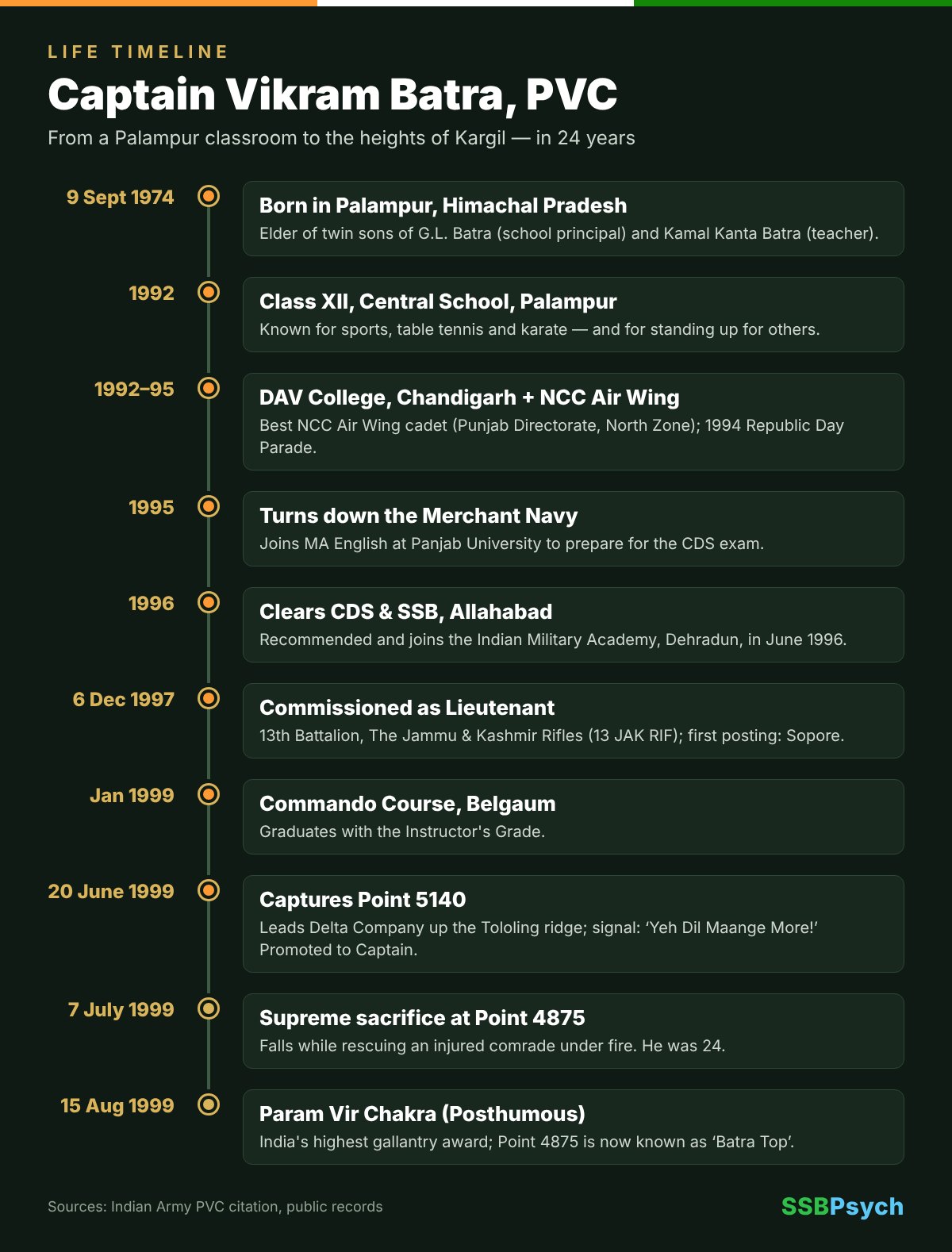
Vikram Batra was born on 9 September 1974 in Palampur, a quiet hill town in Himachal Pradesh. He was the elder of twin sons – his brother Vishal was born 14 minutes later – of Shri G.L. Batra, a government school principal, and Smt. Kamal Kanta Batra, a school teacher. With two teachers as parents, discipline and values came early; his maternal grandfather had also served in the Army.
He studied at D.A.V. Public School and later at Central School, Palampur, finishing Class XII in 1992. Teachers remember him as an all-rounder – good in studies, active in sports such as table tennis and karate, and always the first to stand up for a classmate in trouble. The traits that would later shine on the mountains of Kargil were already visible in the classroom.
College, NCC and the Call of the Uniform
Vikram joined DAV College, Chandigarh for his graduation. Here he joined the NCC Air Wing and excelled – he was adjudged the best NCC Air Wing cadet of the Punjab Directorate (North Zone), completed paratrooping training at Pinjore, rose to the rank of Senior Under Officer and marched in the 1994 Republic Day Parade.
After graduating in 1995 he received an offer from the Merchant Navy – a well-paid, comfortable career. He turned it down. He wanted to do something extraordinary for his country, and he knew that meant the olive green. To prepare for the Combined Defence Services (CDS) exam, he enrolled for an MA in English at Panjab University and attended evening classes while working towards his goal.
CDS, SSB Allahabad and the IMA
In 1996 Vikram cleared the CDS examination and reported to the Services Selection Board at Allahabad, where he was recommended. Today, a block at the SSB Centre Allahabad is named after him – a reminder for every candidate who walks in that heroes once sat in the same rooms, wrote the same TAT stories and faced the same GTO tasks.
He joined the Indian Military Academy, Dehradun in June 1996 and was commissioned as a Lieutenant on 6 December 1997 into the 13th Battalion, The Jammu & Kashmir Rifles (13 JAK RIF).
First Posting: Sopore
His first posting was at Sopore in Baramulla district, an area with active counter-insurgency operations. He completed the Young Officers’ Course at Mhow and, in early 1999, the Commando Course at Belgaum, graduating with the Instructor’s Grade. In the spring of 1999 he went home on leave for Holi – it would be his last visit to Palampur.
The Kargil War – Operation Vijay
In May 1999, Pakistani soldiers and intruders were discovered occupying heights on the Indian side of the Line of Control in Kargil, Ladakh. The Indian Army launched Operation Vijay to evict them. Fighting took place at altitudes above 16,000 feet, in thin air and freezing cold, with the enemy sitting on top of near-vertical cliffs. 13 JAK RIF was moved to the Dras sector and reached there on 6 June 1999.
Battle 1: The Capture of Point 5140 (19–20 June 1999)
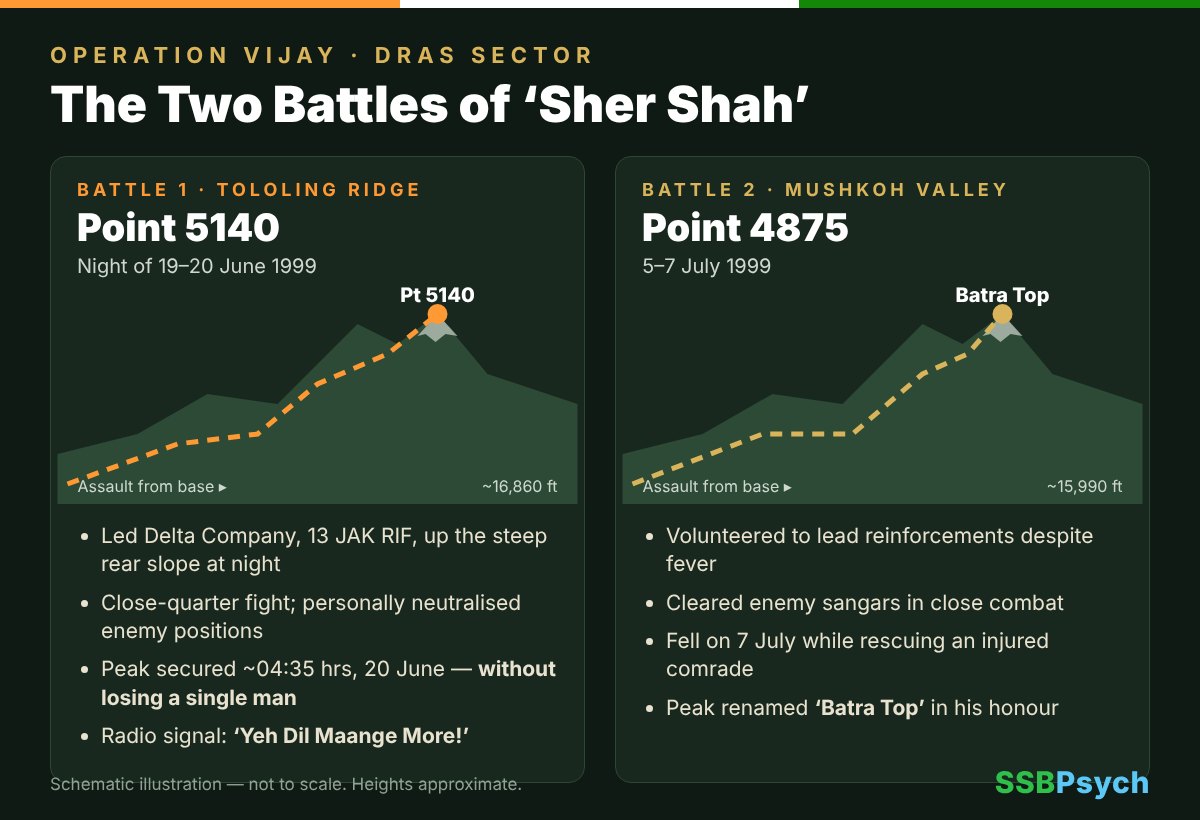
After the capture of Tololing, 13 JAK RIF was tasked with capturing Point 5140, a dominating peak on the same ridge. Lt Vikram Batra commanded Delta Company. Instead of the expected approach, he led his men up the steep rear face of the feature in the dark, aiming to surprise the enemy. As they neared the top, the company came under heavy machine-gun fire. Batra led from the front, closing in on enemy positions and fighting hand-to-hand.
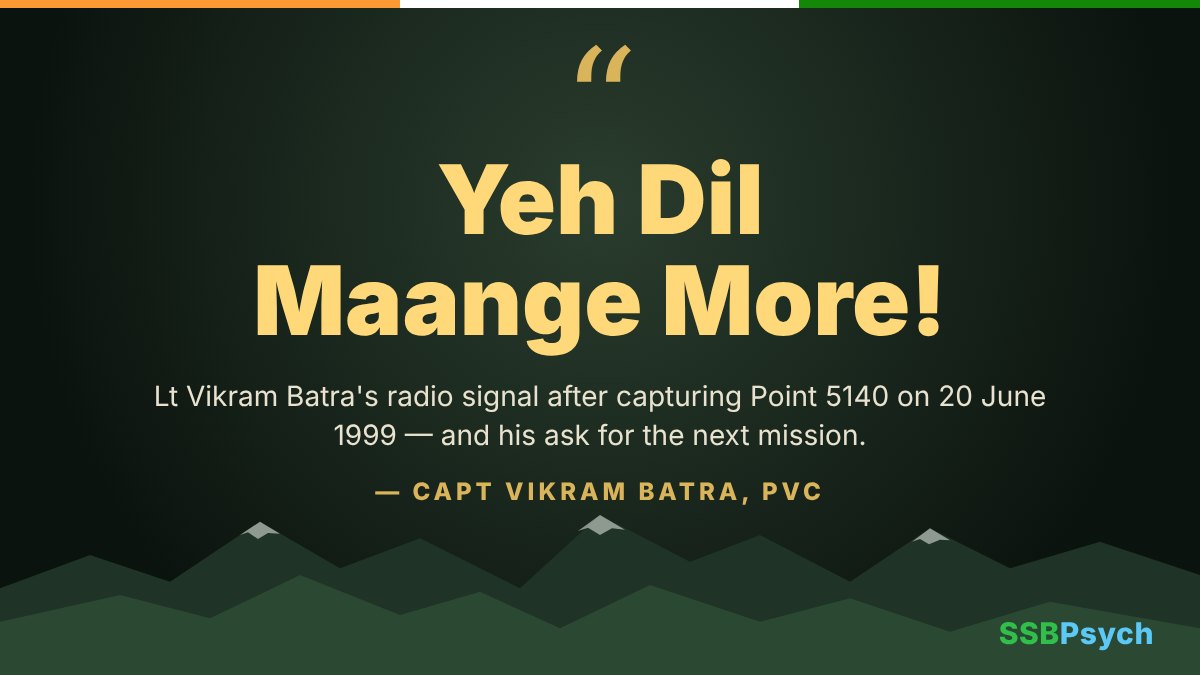
At around 04:35 hrs on 20 June 1999, Point 5140 was captured – remarkably, without a single fatal casualty on Delta Company’s side. Over the radio, Batra sent his now-legendary success signal: “Yeh Dil Maange More!” The line, borrowed from a popular advertisement, became a national rallying cry overnight. He was promoted to Captain soon after.
Battle 2: Point 4875 – Batra Top (5–7 July 1999)
The battalion’s next objective was Point 4875 in the Mushkoh Valley, a feature that allowed the enemy to observe and shell the Srinagar–Leh highway. Captain Batra was still recovering from fever and fatigue, but when reinforcements were needed he volunteered to lead them. His men were energised the moment they heard “Sher Shah” was coming.
On the night of 6–7 July, fighting raged on a narrow ridge leading to the enemy’s positions. Batra led a series of daring assaults, clearing enemy sangars in close combat. During the fight, a fellow soldier was badly wounded in the open. As widely recounted, when a subordinate offered to go instead, Batra told him, “Tu baal-bachchedaar hai, hat ja peeche” – “You have a family, step back” – and went himself.
While pulling the injured soldier to safety, Captain Vikram Batra was hit by enemy fire. He made the supreme sacrifice on 7 July 1999, at the age of just 24. Inspired by his courage, his men pressed on and cleared the position. Point 4875 is today known as Batra Top.
Param Vir Chakra
For conspicuous bravery and leadership of the highest order, Captain Vikram Batra was awarded the Param Vir Chakra, India’s highest wartime gallantry award, posthumously on 15 August 1999. His father, Shri G.L. Batra, received the award from President K.R. Narayanan.
“Some day, I am going to do something great, something extraordinary, which may bring fame to my country.”
– Vikram Batra, explaining why he chose the Army
Legacy: How India Remembers Sher Shah
- Batra Top – Point 4875 in the Mushkoh Valley, Kargil.
- Vikram Batra Block at the SSB Centre, Allahabad (Prayagraj).
- Vikram Batra Mess at the Indian Military Academy, Dehradun.
- Captain Vikram Batra Enclave in Jabalpur Cantonment.
- Shaheed Captain Vikram Batra Chowk – the former Mukarba Chowk in Delhi, renamed in 2019.
- Shaheed Captain Vikram Batra Government College and Stadium, Palampur.
- An island in the Andaman & Nicobar Islands named after him among India’s Param Vir Chakra awardees.
- His story on screen: LOC: Kargil (2003) and Shershaah (2021).
Lessons for SSB Aspirants: OLQs in Action
The SSB does not test whether you can recite facts – it tests whether you have the qualities of an officer. Captain Batra’s life is a textbook of those qualities:
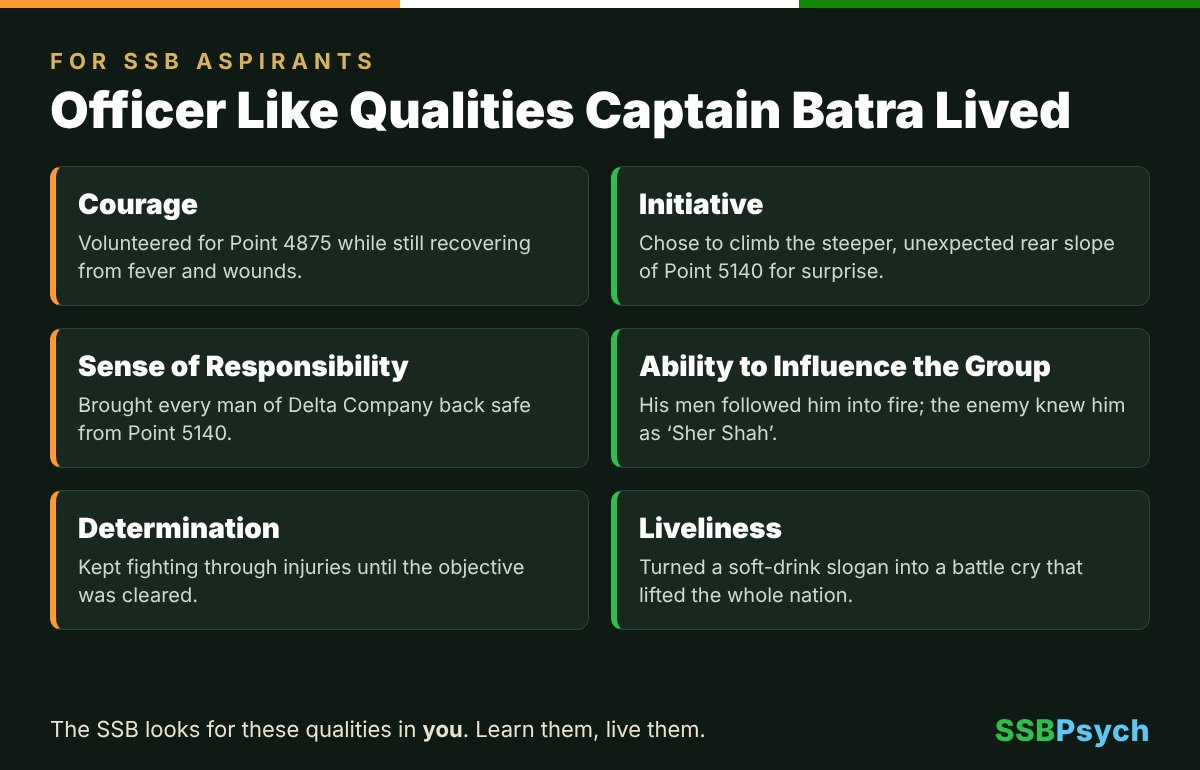
- Effective Intelligence & Initiative – choosing the unexpected route up Point 5140 to achieve surprise.
- Courage – volunteering for Point 4875 while unwell.
- Sense of Responsibility – putting the lives of his men before his own.
- Ability to Influence the Group – soldiers fought harder simply because “Sher Shah” was leading.
- Determination & Stamina – fighting at 16,000+ feet through injury and exhaustion.
- Liveliness – even in battle, his energy and humour lifted morale.
Tip for your SSB interview: If the Interviewing Officer asks about your role model, don’t just say “Captain Vikram Batra”. Explain which of his qualities you are building in yourself and give an example from your own life. That is what makes an answer believable.
Practice Corner: WAT & SRT Inspired by Sher Shah
Try writing your first spontaneous response to these before scrolling to the quiz. Keep WAT sentences short, positive and action-oriented.
WAT Words
- Courage
- Sacrifice
- Mountain
- Leader
- Victory
SRTs
- He is leading a team on a night trek when one member gets injured far from the base and the phone has no network. He…
- His team has completed the task ahead of time, but a neighbouring team is struggling with the same task. He…
- He gets a well-paid private job offer the same week his SSB call letter arrives. He…
Quiz: How Well Do You Know Captain Vikram Batra?
Test yourself! Click an option to see if you are right. Your score updates live.
Frequently Asked Questions
Who was Captain Vikram Batra?
Captain Vikram Batra (1974–1999) was an Indian Army officer of 13 JAK RIF who was awarded the Param Vir Chakra posthumously for his actions in the Kargil War, including the capture of Point 5140 and the battle for Point 4875.
Why is Vikram Batra called “Sher Shah”?
“Sher Shah” was his radio code name during the Kargil operations. It came to symbolise his lion-hearted leadership.
What does “Yeh Dil Maange More” mean in Vikram Batra’s story?
After capturing Point 5140 on 20 June 1999 he used the line “Yeh Dil Maange More!” as his success signal – meaning he was ready and eager for the next mission.
What is Batra Top?
Point 4875 in the Mushkoh Valley, where Captain Batra made the supreme sacrifice on 7 July 1999, was renamed Batra Top in his honour.
How did Vikram Batra join the Army?
He cleared the CDS examination in 1996, was recommended by the SSB at Allahabad, trained at the Indian Military Academy, Dehradun, and was commissioned on 6 December 1997.
Conclusion
Captain Vikram Batra lived only 24 years, but he showed that leadership is not about age or rank – it is about character. He cleared the same CDS exam and faced the same SSB that you are preparing for. The difference he made came from what he chose to build inside himself, day after day.
Jai Hind. Yeh Dil Maange More!
Preparing for your SSB? Join SSBPsych’s online and offline SSB batches and learn how to show your OLQs with confidence – explore our courses or call +91 8076540582.