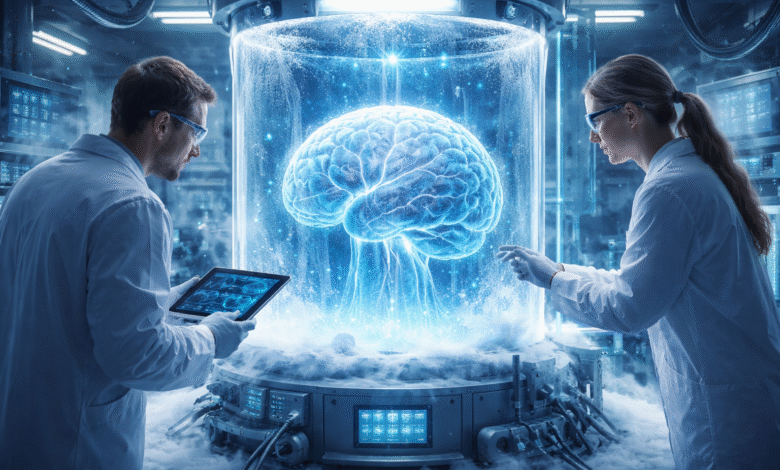
Cryosleep Breakthrough 2026: Scientists Revive Brain Activity After Deep Freezing
In a remarkable leap forward for modern science, researchers have achieved what once belonged purely to the realm of science fiction—reviving brain activity after deep freezing. This groundbreaking discovery in 2026 marks a turning point in neuroscience, cryobiology, and medical science, opening doors to possibilities that could redefine the future of human survival and healthcare.
The study focused on brain tissue extracted from mice, particularly the hippocampus—the region responsible for memory and learning. Scientists cooled this tissue to an astonishing −196°C, a temperature at which all biological processes effectively stop. Under normal circumstances, freezing at such extreme levels would irreparably damage cells due to the formation of ice crystals. However, the researchers employed a sophisticated preservation method known as vitrification.
Vitrification works by transforming biological tissue into a glass-like state rather than allowing ice crystals to form. By using special cryoprotectant chemicals, scientists were able to preserve the delicate internal structures of neurons. When the tissue was carefully reheated, the results were extraordinary—neurons resumed electrical activity, synaptic connections remained functional, and signs of memory-related processes reappeared.
This is the first time complex brain functions have been successfully restored after such extreme freezing conditions. The implications of this achievement are profound. In the field of medicine, this breakthrough could revolutionize the way doctors handle critical conditions such as strokes or traumatic brain injuries. By effectively “pausing” brain activity, medical professionals may gain valuable time to treat patients without causing permanent damage. Furthermore, this technique could significantly enhance organ preservation, addressing one of the biggest challenges in transplantation—limited storage time.
Beyond medicine, the discovery offers new insights into the nature of memory and consciousness. The fact that brain tissue can regain function after being frozen suggests that memory may be deeply embedded in the brain’s physical structure. If that structure remains intact, function—and possibly even stored information—can be restored. This could reshape our understanding of how the human mind works.
The breakthrough also fuels speculation about the future of cryosleep, a concept often depicted in space exploration. Long-duration space missions, which currently pose major biological challenges, could one day become feasible if humans can be preserved safely for extended periods. While this remains a distant goal, the current research provides a scientific foundation for such possibilities.
However, it is important to recognize the limitations of this discovery. The experiments were conducted only on small sections of brain tissue, not on entire brains or living organisms. The restored activity was temporary, and no actual memories or consciousness were revived. Significant technical and ethical challenges must be addressed before this technology can be applied to humans.
In conclusion, the successful revival of brain activity after deep freezing represents a milestone in scientific innovation. It demonstrates that life, even in its most complex form, can be paused and restarted under the right conditions. While the dream of human cryosleep is still far from reality, this breakthrough brings us one step closer to understanding—and potentially mastering—the boundaries of life and time.