
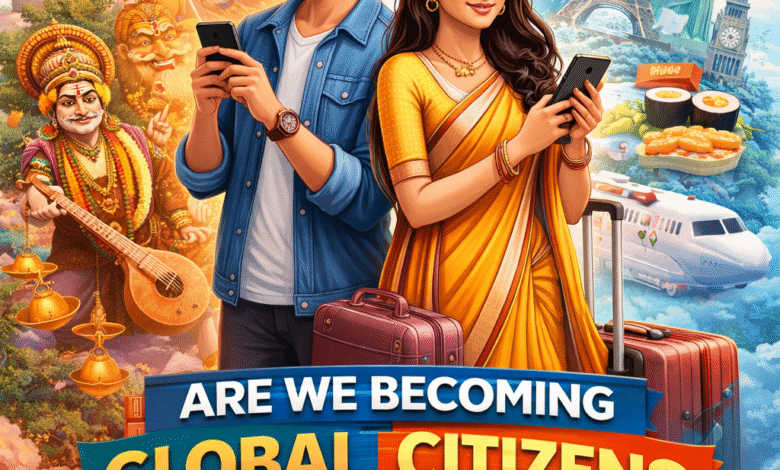
Are We Becoming Global Citizens or Losing Cultural Identity?
In an age where borders are increasingly blurred by technology, travel, and communication, the idea of being a “global citizen” has become more relevant than ever. Today, a young person sitting in Delhi can watch Korean dramas, follow American influencers, celebrate international trends, and interact with people across continents—all within a few taps on platforms like Instagram, YouTube, and TikTok.
This unprecedented level of connectivity has reshaped how we think, live, and express ourselves. But amid this transformation, a deeper question arises: Are we evolving into global citizens, or are we gradually losing our cultural identity?
Global citizenship, at its core, is about embracing diversity, thinking beyond national boundaries, and participating in a shared global community. It encourages openness, adaptability, and awareness of global issues. In many ways, globalization has enriched lives—offering access to better education, exposure to new ideas, and opportunities that were unimaginable just a few decades ago. It has made people more tolerant, more informed, and more connected.
However, this growing interconnectedness comes with its own set of challenges. As global trends dominate everyday life, local traditions often struggle to maintain their relevance. Languages that once defined communities are fading. Cultural practices that were deeply meaningful are sometimes reduced to mere visuals for social media. Festivals, once rooted in tradition and spirituality, are increasingly becoming occasions for aesthetic display rather than genuine celebration.
The concern is not about cultural exchange—because cultures have always influenced each other. India itself is a powerful example of cultural evolution, shaped by centuries of interactions, including the influence of the Mughal Empire and other historical forces. The real issue arises when exchange turns into replacement—when local identity is overshadowed by a desire to fit into a global mold.
Social media plays a crucial role in accelerating this shift. Platforms like Instagram and TikTok not only spread trends rapidly but also shape perceptions of what is desirable or “modern.” In such an environment, identity often becomes curated rather than inherited. People begin to adopt lifestyles not because they resonate with them, but because they are globally accepted or digitally validated.
Yet, the situation is not entirely one-sided. In countries like India, there is also a visible cultural revival. Young people are rediscovering traditional clothing, promoting regional languages, and taking pride in their heritage. This indicates that cultural identity is not disappearing—it is adapting to the modern world.
The real challenge, therefore, is not choosing between being global or cultural. It is about finding a balance. This balance lies in what can be called “rooted globalism”—a way of living where individuals embrace global opportunities while staying connected to their roots. It means adopting new ideas without abandoning old values, and engaging with the world without losing one’s sense of self.
In conclusion, the question is not whether we are becoming global citizens or losing cultural identity—it is whether we are doing so consciously. Globalization is inevitable, but cultural loss is not. Identity does not vanish overnight; it fades when it is neglected.
In a world that is more connected than ever, the responsibility lies with individuals to preserve what truly defines them. Because the strongest identity is not one that resists change, but one that evolves without forgetting where it came from.